
AI vs Human Financial Advisors: Which Is Better in 2026?
Introduction
AI vs Human Financial Advisors has become one of the most important discussions in the investment world. Artificial intelligence is transforming financial services, making investment advice more accessible and affordable than ever before.
Today, investors can choose between traditional financial advisors and AI-powered platforms that use algorithms to manage portfolios, analyze markets, and provide personalized recommendations.
But which option is better in 2026?
In this guide, we compare AI and human financial advisors based on cost, performance, personalization, accessibility, and long-term value.
👉 Related article:
Best AI Investing Tools for Beginners in 2026
What Is an AI Financial Advisor?
AI financial advisors, often called robo-advisors, use algorithms and data analysis to help investors manage their money.
These platforms can:
- Build investment portfolios
- Rebalance assets automatically
- Analyze risk tolerance
- Provide investment recommendations
- Track financial goals
Popular AI-powered investing solutions continue growing as technology improves.
What Is a Human Financial Advisor?
A human financial advisor is a professional who provides personalized financial guidance.
Services may include:
- Retirement planning
- Tax strategies
- Estate planning
- Investment management
- Wealth preservation
Human advisors can also help investors navigate emotional decisions during market volatility.
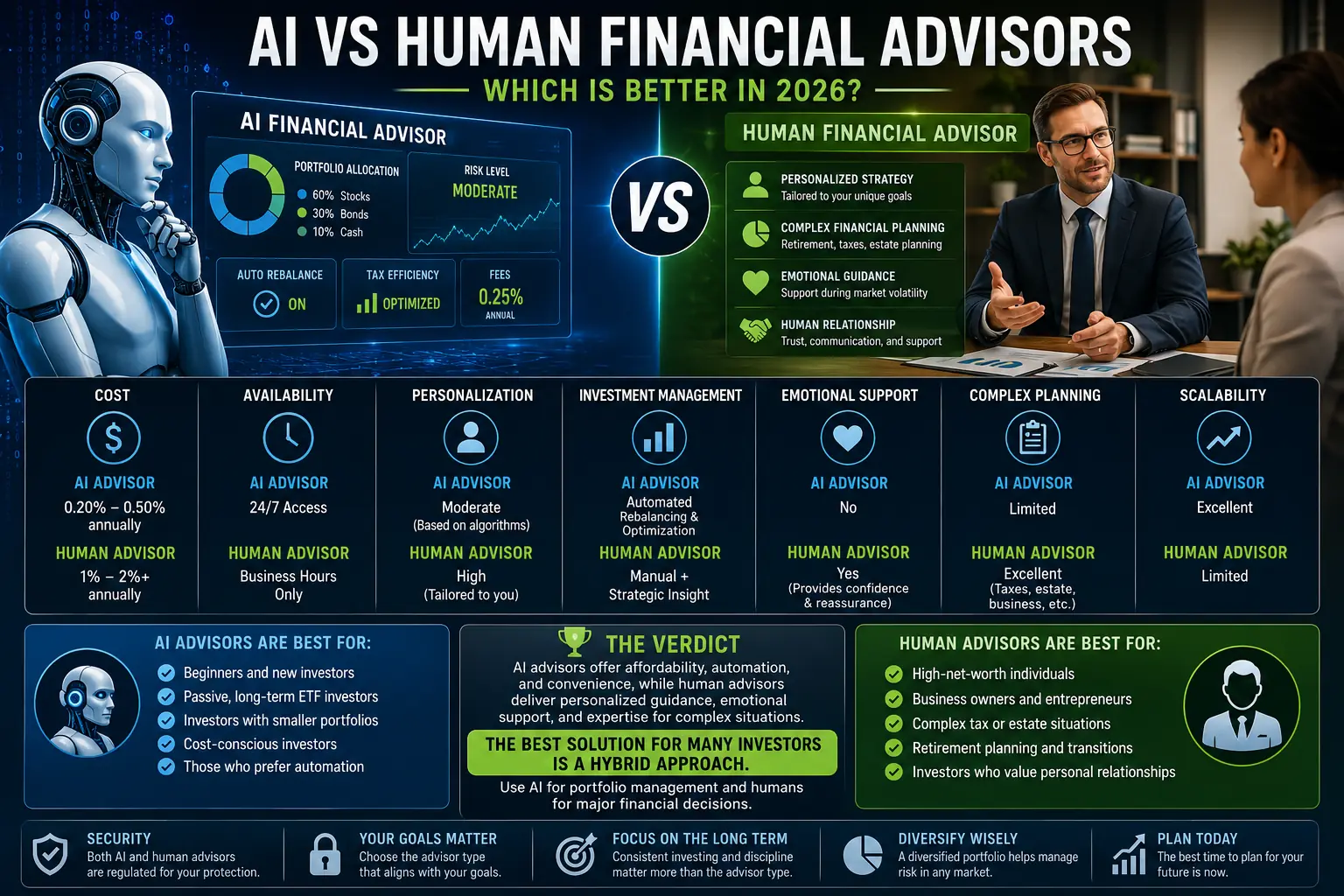
AI vs Human Financial Advisors: Key Differences
| Feature | AI Advisor | Human Advisor |
|---|---|---|
| Cost | Lower | Higher |
| Availability | 24/7 | Limited Hours |
| Emotional Guidance | No | Yes |
| Personalization | Moderate | High |
| Scalability | Excellent | Limited |
| Complex Planning | Limited | Excellent |
Both approaches have strengths and weaknesses.
Advantages of AI Financial Advisors
Lower Costs
AI platforms often charge significantly lower fees than traditional advisors.
24/7 Availability
Investors can access their portfolios anytime.
Automated Portfolio Management
AI can automatically rebalance investments and maintain target allocations.
Data-Driven Decisions
Algorithms rely on data rather than emotions.
Accessibility
Many platforms allow investors to start with relatively small amounts of money.
Advantages of Human Financial Advisors
Personalized Advice
Human advisors can tailor recommendations to unique situations.
Emotional Support
Investors often make poor decisions during market downturns.
Human advisors can help maintain discipline.
Complex Financial Planning
Areas such as estate planning, tax optimization, and business succession often require human expertise.
Relationship Building
Many investors value direct communication and trust.
Cost Comparison
One of the biggest differences is cost.
AI Advisors
Typical annual fees:
- 0.20% to 0.50%
Human Advisors
Typical annual fees:
- 1% to 2%
- Additional consulting fees may apply
For smaller portfolios, AI advisors often provide a cost advantage.
Which Performs Better?
Performance depends on investment strategy rather than whether advice comes from AI or humans.
Many AI advisors use:
- ETF portfolios
- Diversification strategies
- Long-term investing principles
Many human advisors use similar approaches.
The biggest difference often comes from investor behavior rather than portfolio construction.
AI and Personalization in 2026
Artificial intelligence continues improving rapidly.
Modern AI platforms can analyze:
- Spending habits
- Risk tolerance
- Investment goals
- Market conditions
This allows increasingly personalized recommendations.
However, AI still struggles to fully understand complex life situations compared to experienced human advisors.
When AI Advisors Make Sense
AI advisors may be ideal for:
- Beginners
- Passive investors
- Long-term ETF investors
- Cost-conscious investors
Many people simply need a diversified portfolio and automated management.
When Human Advisors Make Sense
Human advisors may be better for:
- High-net-worth individuals
- Business owners
- Complex tax situations
- Estate planning
- Retirement transitions
These situations often require personalized guidance beyond portfolio management.
Can AI Replace Human Financial Advisors?
Probably not completely.
Instead, many experts believe the future will involve a hybrid model.
Human advisors increasingly use:
- AI analytics
- Portfolio optimization tools
- Automated reporting
- Risk management software
AI enhances advisor capabilities rather than replacing them entirely.
The Future of Financial Advice
Several trends are shaping the industry:
Artificial Intelligence
AI continues improving investment analysis and automation.
Personalized Investing
Investors increasingly expect customized recommendations.
Lower Costs
Competition continues reducing investment management fees.
Digital Platforms
More investors prefer online financial services.
These trends are likely to continue throughout 2026 and beyond.
Final Verdict
The AI vs Human Financial Advisors debate does not have a universal answer. AI advisors offer affordability, convenience, and automation, making them attractive for many beginner and passive investors.
Human advisors provide personalized guidance, emotional support, and expertise for complex financial situations.
For many investors, the best solution may be combining both approaches: using AI for portfolio management while relying on human professionals for major financial decisions.
FAQ
Are AI financial advisors safe?
Many AI advisors use diversified portfolios and established investment strategies, but all investments carry risk.
Are AI advisors cheaper?
Yes. AI advisors generally charge lower fees than traditional financial advisors.
Can AI replace financial advisors?
AI can automate many tasks, but human expertise remains valuable for complex financial planning.
Are robo-advisors good for beginners?
Yes. Many beginners use robo-advisors because they are simple and affordable.
Which is better in 2026?
The best option depends on your financial goals, portfolio size, and need for personalized advice.