
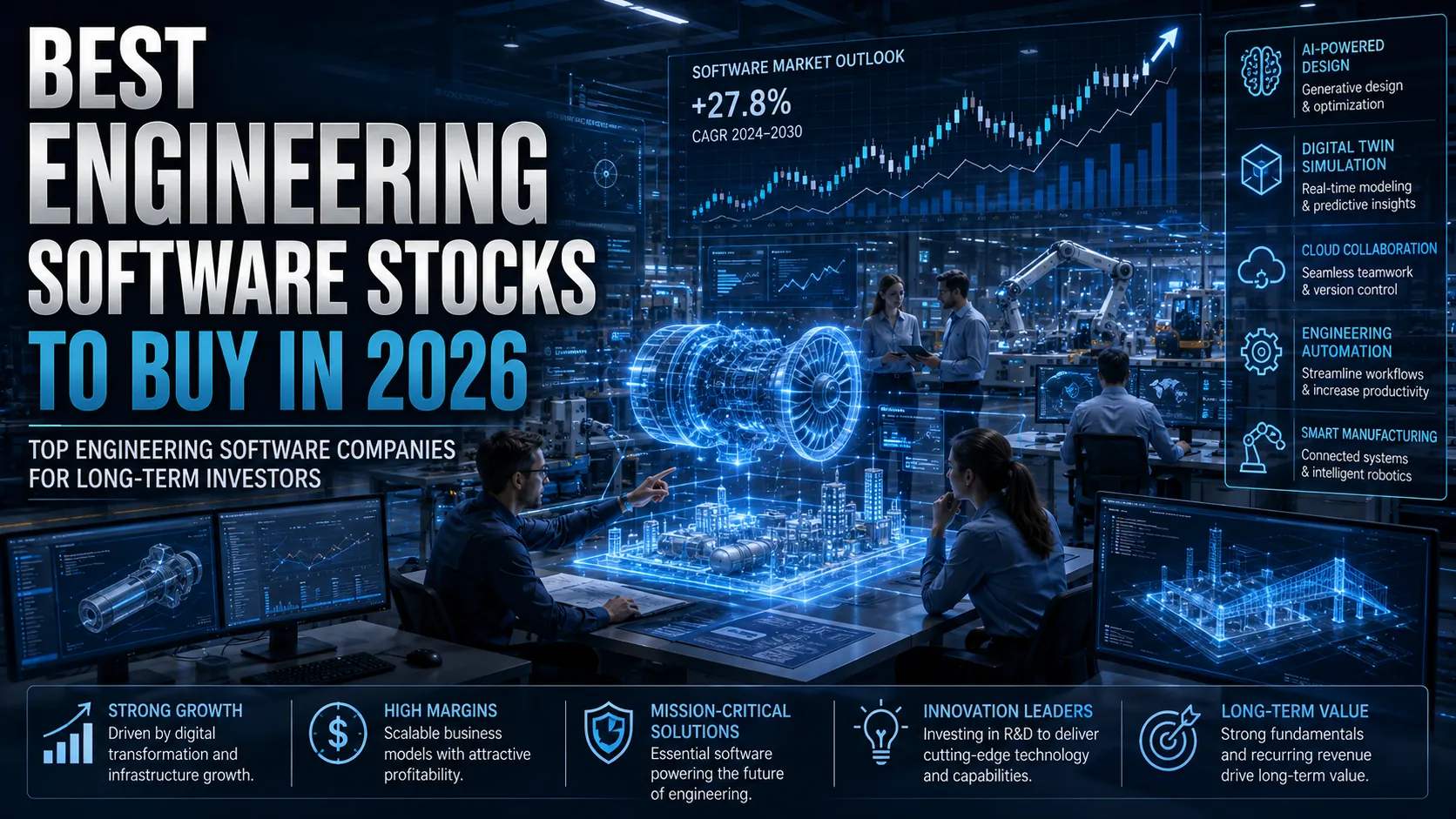
Best Engineering Software Stocks to Buy in 2026 (Top Engineering Software Companies for Long-Term Investors)
Introduction
Best Engineering Software Stocks to Buy in 2026 are gaining significant attention as engineering firms, manufacturers, architects, and industrial companies accelerate digital transformation. Engineering software has become essential for designing products, simulating real-world performance, managing construction projects, and developing the next generation of industrial technologies.
From computer-aided design (CAD) and engineering simulation to Building Information Modeling (BIM), Product Lifecycle Management (PLM), and digital twins, engineering software enables organizations to improve efficiency, reduce costs, shorten development cycles, and bring innovative products to market faster.
Artificial intelligence (AI) is further transforming engineering software by automating design processes, optimizing simulations, generating engineering recommendations, and improving collaboration across teams. Cloud computing is also making advanced engineering tools more accessible, allowing organizations to work on complex projects from anywhere while benefiting from scalable computing resources.
Several industries are driving demand for engineering software in 2026, including aerospace, automotive, construction, energy, semiconductor manufacturing, industrial automation, healthcare, and infrastructure development. As governments and private companies continue investing in smart infrastructure, renewable energy, and advanced manufacturing, engineering software providers are expected to benefit from strong long-term growth.
For investors seeking exposure to digital engineering, industrial innovation, and AI-powered design technologies, engineering software companies represent an attractive long-term investment opportunity.
In this guide, we’ll explore the best Engineering Software stocks to buy in 2026, examine the industry’s biggest growth drivers, and highlight companies leading the future of digital engineering.
Why Engineering Software Matters in 2026
Engineering software is becoming a critical component of modern product development and industrial innovation.
Several long-term trends continue supporting market growth.
Artificial Intelligence
AI is transforming engineering workflows by helping engineers generate optimized designs, automate repetitive tasks, analyze simulation results, and accelerate product development.
AI-powered engineering tools improve productivity while reducing development costs.
Digital Twins
Digital twin technology enables organizations to create virtual models of products, factories, buildings, and infrastructure.
Engineers can simulate real-world performance before physical production, reducing errors and accelerating innovation.
Smart Manufacturing
Industry 4.0 continues driving demand for engineering software used in automation, robotics, industrial IoT, and digital manufacturing.
Manufacturers increasingly rely on integrated software platforms to optimize production and improve operational efficiency.
Infrastructure Modernization
Governments worldwide continue investing in transportation systems, utilities, renewable energy, and smart cities.
Engineering software plays a central role in designing and managing these large-scale infrastructure projects.
What Makes a Good Engineering Software Stock?
Investors should evaluate several characteristics when selecting engineering software companies.
Market Leadership
Companies with established software ecosystems and strong customer relationships often benefit from high switching costs.
Recurring Revenue
Subscription-based software generates stable cash flow and predictable long-term earnings.
AI Integration
Companies successfully integrating AI into engineering workflows may strengthen their competitive advantage and expand market share.
Industry Diversification
Engineering software providers serving multiple industries—including aerospace, automotive, construction, energy, and manufacturing—may achieve more stable long-term growth.
Best Engineering Software Stocks to Buy in 2026
Autodesk (NASDAQ: ADSK)
Autodesk is one of the world’s leading engineering software companies, offering solutions for architecture, engineering, construction, manufacturing, and product design. Its software portfolio includes AutoCAD, Revit, Inventor, and Fusion, which are widely used by engineers and designers worldwide.
Why Autodesk Is a Top Pick
CAD Leadership
AutoCAD remains one of the most widely used computer-aided design platforms across multiple industries.
Cloud-Based Engineering
Autodesk continues expanding cloud collaboration tools that improve engineering productivity and project management.
AI Innovation
The company is integrating AI into design automation, generative design, and construction workflows.
ANSYS (NASDAQ: ANSS)
ANSYS develops advanced engineering simulation software used across aerospace, automotive, electronics, healthcare, and industrial manufacturing.
Its software allows engineers to test products virtually before building physical prototypes.
Why Investors Like ANSYS
Simulation Leadership
ANSYS is considered one of the industry’s leading engineering simulation platforms.
AI-Enhanced Modeling
Artificial intelligence improves simulation accuracy, optimization, and engineering productivity.
High Customer Retention
Long-term enterprise customers generate recurring software revenue and strong profitability.
Dassault Systèmes (EPA: DSY)
Dassault Systèmes develops industry-leading engineering software through its 3DEXPERIENCE platform. The company provides CAD, PLM, engineering simulation, and digital twin technologies used by many of the world’s largest manufacturers.
Why Dassault Systèmes Stands Out
Comprehensive Engineering Platform
Its integrated software supports the entire product development lifecycle.
Broad Industry Exposure
Customers include aerospace, automotive, healthcare, industrial manufacturing, and life sciences organizations.
Long-Term Innovation
Continuous investment in AI, cloud computing, and simulation technologies supports future growth.
Bentley Systems (NASDAQ: BSY)
Bentley Systems specializes in engineering software for infrastructure projects including roads, bridges, airports, railways, utilities, and smart cities.
Its digital engineering solutions help organizations design, build, and manage critical infrastructure throughout its lifecycle.
Why Bentley Systems Deserves Attention
Infrastructure Leadership
Bentley is a market leader in infrastructure engineering software.
Digital Twin Integration
Its software integrates digital twins with engineering workflows to improve project planning and asset management.
Government Infrastructure Spending
Global infrastructure investment continues creating long-term demand for Bentley’s software.
PTC Inc. (NASDAQ: PTC)
PTC is a global leader in Product Lifecycle Management (PLM), Computer-Aided Design (CAD), Industrial IoT, and digital engineering software. Its solutions help manufacturers design products, manage engineering data, and optimize production throughout the entire product lifecycle.
Why Investors Like PTC
Product Lifecycle Management Leadership
PTC’s Windchill platform enables companies to manage complex engineering projects from initial design through manufacturing and maintenance.
CAD Innovation
Its Creo software provides advanced 3D CAD capabilities used by engineers across aerospace, automotive, industrial equipment, and electronics industries.
AI and Digital Twins
PTC continues integrating artificial intelligence and digital twin technologies into its engineering software portfolio to improve productivity and product quality.
Hexagon AB (STO: HEXA-B)
Hexagon AB specializes in engineering software, industrial measurement, geospatial technologies, and digital reality solutions. Its software helps organizations create precise digital models for manufacturing, construction, mining, and infrastructure projects.
Why Hexagon AB Stands Out
Precision Engineering
Hexagon combines engineering software with advanced sensors, metrology equipment, and industrial automation technologies.
Smart Manufacturing
Its platforms support quality control, factory automation, robotics, and Industrial IoT deployments.
Infrastructure Applications
Hexagon’s engineering software is widely used for construction, transportation, utilities, and smart city development.
Siemens (ETR: SIE)
Siemens is one of the world’s largest industrial technology companies. Through Siemens Digital Industries Software, it provides engineering software covering CAD, simulation, PLM, manufacturing execution systems (MES), and digital twins.
Why Siemens Is a Top Pick
Comprehensive Engineering Ecosystem
Siemens offers one of the broadest engineering software portfolios available, serving industries from automotive and aerospace to electronics and energy.
AI-Powered Engineering
Artificial intelligence enhances design optimization, predictive maintenance, manufacturing planning, and industrial automation across Siemens’ software ecosystem.
Industrial Leadership
Its strong presence in automation, smart factories, and digital manufacturing creates significant cross-selling opportunities.
Nemetschek Group (ETR: NEM)
Nemetschek is a leading provider of software for architecture, engineering, construction, and media industries. Its solutions support Building Information Modeling (BIM), project collaboration, structural engineering, and digital construction management.
Why Nemetschek Deserves Attention
BIM Leadership
Nemetschek is one of the world’s leading providers of Building Information Modeling software, helping engineers and architects design complex infrastructure projects.
Cloud Collaboration
The company continues expanding cloud-based engineering workflows, improving collaboration across global project teams.
Sustainable Construction
Its software helps optimize resource usage, reduce construction waste, and improve project efficiency.
Comparison of the Best Engineering Software Stocks
| Company | Primary Business | Dividend | Risk Level | Growth Potential |
|---|---|---|---|---|
| Autodesk | CAD & Design Software | No | Medium | High |
| ANSYS | Engineering Simulation | No | Medium | Very High |
| Dassault Systèmes | CAD, PLM & Digital Twins | Yes | Low | High |
| Bentley Systems | Infrastructure Engineering | No | Medium | High |
| PTC | PLM & CAD Software | No | Medium | Very High |
| Hexagon AB | Engineering & Measurement Software | Yes | Medium | High |
| Siemens | Industrial Engineering Software | Yes | Low | High |
| Nemetschek | BIM & Construction Software | Yes | Medium | High |
Risks to Consider
Slower Capital Spending
Engineering software demand may slow if manufacturers, construction firms, or industrial companies reduce technology investments during economic downturns.
Competitive Market
The industry is highly competitive, with software vendors continuously investing in AI, cloud platforms, simulation technologies, and engineering innovation.
Technology Disruption
Rapid advances in AI and cloud-native engineering platforms require continuous research and development, increasing operating costs.
Customer Concentration
Some engineering software providers depend heavily on industries such as aerospace, automotive, or construction, making them vulnerable to sector-specific slowdowns.
Valuation Risk
Many engineering software companies trade at premium valuations because investors expect strong long-term growth.
Long-Term Outlook
The engineering software industry is expected to benefit from multiple long-term growth drivers.
Artificial Intelligence
AI is transforming engineering by automating design optimization, improving simulations, generating engineering recommendations, and reducing product development cycles.
Digital Engineering
Companies increasingly rely on digital engineering to improve collaboration, reduce costs, and accelerate innovation.
Smart Infrastructure
Governments continue investing in transportation, utilities, renewable energy, and smart cities, creating sustained demand for engineering software.
Advanced Manufacturing
Industry 4.0, robotics, automation, and digital twins are expanding the use of engineering software throughout modern manufacturing.
Cloud-Based Collaboration
Cloud engineering platforms enable distributed teams to collaborate in real time, supporting productivity and faster project delivery.
Final Thoughts
Engineering software plays a vital role in modern product development, industrial automation, construction, and infrastructure management. As AI, cloud computing, digital twins, and Industry 4.0 continue reshaping global industries, demand for advanced engineering platforms is expected to grow.
The best Engineering Software stocks to buy in 2026 include Autodesk, ANSYS, Dassault Systèmes, Bentley Systems, PTC, Hexagon AB, Siemens, and Nemetschek. These companies are well positioned to benefit from long-term trends in digital engineering, smart manufacturing, and infrastructure modernization.
For investors seeking exposure to AI-powered engineering, industrial innovation, and software-driven productivity, engineering software stocks offer compelling long-term investment opportunities.
Frequently Asked Questions
What is engineering software?
Engineering software includes applications used for computer-aided design (CAD), engineering simulation, Building Information Modeling (BIM), Product Lifecycle Management (PLM), and digital engineering.
Why invest in engineering software stocks?
Many investors choose the best Engineering Software stocks to buy in 2026 because these companies benefit from long-term trends such as AI adoption, digital twins, Industry 4.0, infrastructure modernization, and cloud-based engineering.
Which company is the leader in engineering software?
Autodesk, ANSYS, Dassault Systèmes, Siemens, Bentley Systems, and PTC are among the global leaders, each specializing in different engineering software markets.
Are engineering software stocks good long-term investments?
Engineering software companies generally have attractive long-term growth potential due to recurring subscription revenue, high switching costs, and increasing demand for digital engineering solutions.
What are the biggest risks?
Major risks include slower industrial spending, strong competition, rapid technological change, premium valuations, and dependence on construction and manufacturing activity.
Internal Linking :
- Best Digital Twin Stocks to Buy in 2026
- Best Enterprise Software Stocks to Buy in 2026
- Best Industrial IoT Stocks to Buy in 2026
- Best Industrial Automation Stocks to Buy in 2026
- Best Robotics Stocks to Watch in 2026
- Best AI Infrastructure Stocks to Buy in 2026
- Best Data Center Stocks to Buy in 2026
- Best Semiconductor Stocks to Buy in 2026