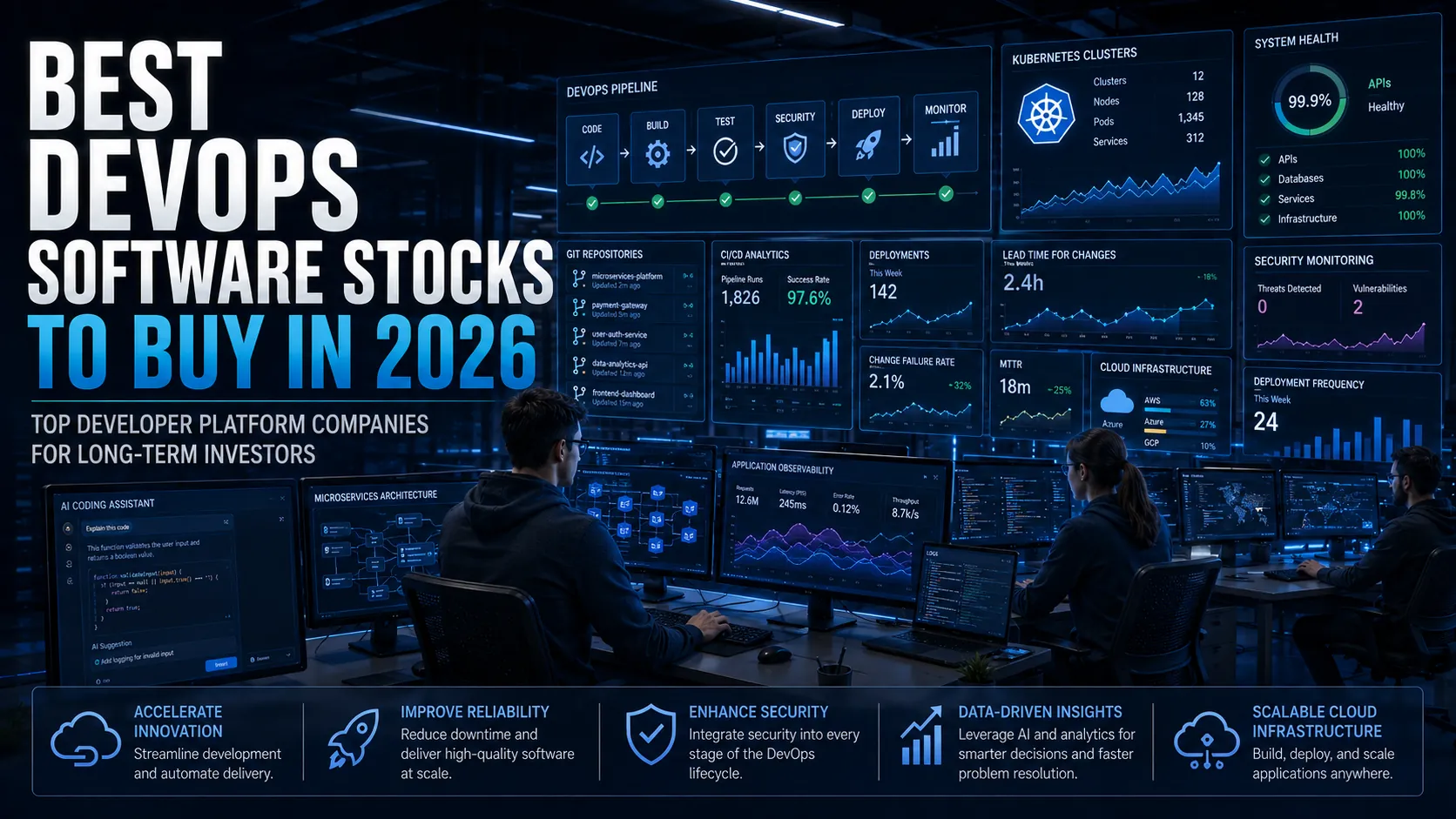
Best DevOps Software Stocks to Buy in 2026 (Top Developer Platforms)
Introduction
The best DevOps software stocks to buy in 2026 offer investors exposure to the technologies helping companies build, test, deploy, secure, and monitor software faster.
Modern businesses depend heavily on software. Banks, retailers, manufacturers, healthcare companies, cloud providers, media platforms, and technology companies continuously release new applications and digital services.
This growing dependence on software has made DevOps an important part of modern technology infrastructure.
DevOps combines software development and IT operations into integrated workflows designed to accelerate application delivery while improving reliability, automation, security, and collaboration.
Instead of development teams building applications independently and handing them to operations teams for deployment, DevOps encourages continuous collaboration throughout the software lifecycle.
Modern DevOps platforms can support source code management, continuous integration and continuous delivery (CI/CD), infrastructure automation, application security, cloud deployment, container management, monitoring, and incident response.
Artificial intelligence is creating another major transformation.
AI coding assistants can generate code, explain software, identify vulnerabilities, create tests, automate documentation, and help developers troubleshoot technical problems.
At the same time, AI agents are beginning to automate more complex software development workflows.
These trends could make DevOps platforms increasingly important as organizations attempt to develop software faster without sacrificing reliability or security.
In this guide, we’ll explore the best DevOps software stocks to buy in 2026, examine the industry’s biggest growth drivers, and highlight publicly traded companies positioned to benefit from the continued expansion of cloud-native software development.
Why DevOps Software Matters in 2026
Software development has become a strategic capability for companies across nearly every industry.
Organizations continuously build customer applications, internal platforms, AI systems, APIs, websites, automation tools, and digital services.
DevOps technologies help development teams manage this growing complexity.
Several major trends are supporting long-term demand.
Artificial Intelligence Coding
Generative AI is rapidly changing software development.
AI coding assistants can help developers:
- Generate code
- Explain existing code
- Detect errors
- Create automated tests
- Produce documentation
- Identify security vulnerabilities
- Refactor applications
- Accelerate debugging
AI does not eliminate the need for software development infrastructure.
Instead, faster code generation may increase the amount of software organizations need to test, secure, deploy, and monitor.
This could strengthen demand for comprehensive DevOps platforms.
Cloud-Native Development
Modern applications increasingly run across public clouds and distributed infrastructure.
Development teams use technologies such as:
- Kubernetes
- Containers
- Serverless computing
- Microservices
- APIs
- Infrastructure as Code
These architectures provide flexibility and scalability but can also increase operational complexity.
DevOps platforms help automate deployment and infrastructure management across these environments.
Continuous Integration and Delivery
Companies increasingly release software continuously rather than relying on large updates several times per year.
Continuous integration and continuous delivery allow developers to automatically build, test, and deploy software whenever changes are made.
This approach can shorten development cycles and help organizations respond more quickly to customers.
DevSecOps
Cybersecurity is becoming integrated directly into software development.
This approach is commonly called DevSecOps.
Instead of testing applications for vulnerabilities only near the end of development, security tools can analyze software throughout the development lifecycle.
DevSecOps platforms may provide:
- Code scanning
- Dependency analysis
- Secret detection
- Container security
- Vulnerability management
- Compliance automation
- Cloud security
Security integration represents an important growth opportunity for DevOps software companies.
Developer Productivity
Software engineers are expensive and highly valuable employees.
Companies therefore have strong incentives to improve developer productivity.
Automation, AI assistants, reusable components, standardized workflows, and integrated development platforms can reduce repetitive work and allow engineers to focus on higher-value projects.
What Is DevOps Software?
DevOps software includes tools that help development and IT operations teams collaborate throughout the software development lifecycle.
Rather than representing one individual product category, DevOps includes multiple technologies.
Source Code Management
Source code management platforms allow developers to store, version, review, and collaborate on software code.
Git has become the dominant version-control technology across modern software development.
CI/CD
Continuous integration and continuous delivery platforms automate software testing, building, and deployment.
Automation can reduce manual errors and accelerate software releases.
Infrastructure as Code
Infrastructure as Code allows developers to define computing infrastructure using configuration files rather than manually configuring servers and cloud resources.
This makes infrastructure easier to automate, reproduce, and manage.
Application Security
DevSecOps tools identify vulnerabilities throughout the development process.
Security is increasingly integrated directly into developer workflows.
Observability
After software reaches production, developers need to understand whether applications are operating correctly.
Observability platforms analyze logs, metrics, traces, infrastructure, and application performance.
Cloud and Container Management
DevOps teams increasingly manage applications running inside containers and Kubernetes environments across multiple clouds.
Automation platforms help organizations deploy and manage this infrastructure at scale.
What Makes a Good DevOps Software Stock?
Investors evaluating the best DevOps software stocks to buy in 2026 should consider several characteristics.
Large Developer Ecosystem
Developer adoption can create powerful network effects.
When developers become familiar with a platform, organizations may standardize around those tools.
Recurring Revenue
Many DevOps companies generate subscription or consumption-based revenue.
Recurring revenue can improve financial visibility and create opportunities for customer expansion.
Platform Expansion
Companies that provide multiple DevOps products may have stronger cross-selling opportunities.
A platform could combine:
- Code management
- CI/CD
- Security
- Cloud deployment
- Infrastructure automation
- Observability
- AI development tools
Artificial Intelligence Strategy
AI is becoming deeply integrated into software development.
Companies that successfully embed AI assistants and autonomous agents into developer workflows may gain competitive advantages.
Enterprise Adoption
Large enterprises can generate significant recurring revenue because they employ thousands of developers and operate complex technology environments.
Strong Cloud Integrations
DevOps platforms must integrate with AWS, Microsoft Azure, Google Cloud, Kubernetes, databases, cybersecurity tools, and enterprise applications.
Best DevOps Software Stocks to Buy in 2026
1. Microsoft (NASDAQ: MSFT)
Microsoft has become one of the most important companies in modern software development.
Its developer ecosystem includes GitHub, GitHub Actions, GitHub Copilot, Azure DevOps, Visual Studio, Visual Studio Code, .NET, and Microsoft Azure.
Together, these technologies give Microsoft exposure to nearly every stage of the software development lifecycle.
Why Investors Like Microsoft
GitHub Ecosystem
GitHub is one of the world’s most important software development platforms.
Developers use GitHub to store source code, collaborate on projects, review changes, manage development workflows, and distribute open-source software.
Its massive developer ecosystem provides Microsoft with a strategically valuable position within global software development.
GitHub Copilot
GitHub Copilot has become a major component of Microsoft’s AI strategy for developers.
The technology uses generative AI to assist developers with coding, debugging, documentation, testing, and software development tasks.
As AI-assisted programming becomes more common, GitHub could become an increasingly important distribution platform for developer-focused AI.
GitHub Actions
GitHub Actions provides CI/CD automation directly within GitHub.
Developers can automatically test, build, and deploy applications whenever changes are made to a code repository.
Integrating CI/CD with source code management can simplify DevOps workflows.
Azure DevOps
Microsoft also operates Azure DevOps, which provides services for repositories, pipelines, testing, project management, and software delivery.
This creates another entry point into large enterprise development teams.
Azure Integration
Microsoft can connect its developer tools directly with Azure cloud infrastructure.
Organizations can develop applications on GitHub and deploy them to Azure using integrated workflows.
This ecosystem represents a major competitive advantage.
Risks for Microsoft Investors
Microsoft is highly diversified.
DevOps represents only one component of a much larger investment thesis involving Azure, Microsoft 365, artificial intelligence, enterprise software, gaming, cybersecurity, and other businesses.
2. GitLab (NASDAQ: GTLB)
GitLab represents one of the most direct publicly traded investments in the DevOps software industry.
The company provides an integrated DevSecOps platform designed to support the entire software development lifecycle.
Organizations can use GitLab for planning, source code management, CI/CD, application security, compliance, deployment, and software development analytics.
Why Investors Like GitLab
Complete DevSecOps Platform
GitLab’s major competitive advantage is its integrated platform approach.
Instead of combining many independent development tools, organizations can consolidate multiple workflows onto GitLab.
This can reduce complexity and simplify administration.
Enterprise Adoption
GitLab targets large organizations that manage significant software development operations.
Enterprise customers can deploy the platform across thousands of developers and numerous development teams.
Security Integration
GitLab incorporates security directly into development workflows.
Capabilities include vulnerability scanning, dependency analysis, container scanning, secret detection, and compliance tools.
This supports the growing DevSecOps trend.
AI-Powered Development
GitLab continues integrating artificial intelligence across its software development platform.
AI can assist with code creation, explanation, testing, security analysis, and development workflows.
The transition toward AI-assisted software engineering could create significant opportunities for integrated DevOps platforms.
Risks for GitLab Investors
GitLab operates in an intensely competitive market.
Major competitors include Microsoft GitHub, Atlassian, cloud providers, open-source technologies, and specialized DevOps vendors.
As a growth-oriented software company, GitLab’s stock can also be sensitive to valuation changes and shifts in enterprise technology spending.
3. Atlassian (NASDAQ: TEAM)
Atlassian develops collaboration and productivity software widely used by software development and IT teams.
Its major products include Jira, Confluence, Jira Service Management, Bitbucket, and numerous developer collaboration tools.
Atlassian therefore occupies an important position between software development, project management, IT operations, and enterprise collaboration.
Why Investors Like Atlassian
Jira Leadership
Jira has become one of the most widely recognized project management platforms for software development teams.
Developers use Jira to track:
- Features
- Bugs
- Development tasks
- Software releases
- Technical projects
- Agile workflows
Its strong position within development teams gives Atlassian access to a large global developer ecosystem.
Enterprise Collaboration
Confluence allows development teams to create documentation and share knowledge.
Combining Jira and Confluence creates an integrated environment for planning, development, documentation, and collaboration.
IT Service Management
Jira Service Management expands Atlassian’s reach beyond software development into IT operations and incident management.
This creates opportunities across both DevOps and enterprise IT workflows.
Artificial Intelligence
Atlassian is integrating AI into its software ecosystem to improve search, documentation, automation, knowledge management, and workflow productivity.
AI-powered features could increase the value of Atlassian’s platform for large organizations.
Risks for Atlassian Investors
Atlassian faces strong competition from Microsoft, ServiceNow, GitLab, and other enterprise software companies.
The company must also successfully manage its cloud transition while maintaining growth among enterprise customers.
4. Datadog (NASDAQ: DDOG)
Datadog occupies an important position at the operations side of the DevOps lifecycle.
While developers use platforms such as GitHub and GitLab to build and deploy applications, Datadog helps teams monitor those applications once they are running in production.
Its platform combines observability, application performance monitoring, infrastructure monitoring, logs, security, cloud management, and developer tools.
Why Investors Like Datadog
DevOps Monitoring
DevOps does not end when software is deployed.
Teams must continuously monitor applications to identify performance problems, infrastructure failures, and unexpected behavior.
Datadog provides this visibility across complex cloud environments.
Unified Observability Platform
The company’s platform covers areas including:
- Application performance
- Infrastructure
- Logs
- Databases
- Networks
- Cloud services
- User experiences
- Security
- AI applications
This allows development and operations teams to analyze multiple systems from one platform.
Cloud-Native Exposure
Datadog benefits from the growth of Kubernetes, containers, microservices, serverless computing, and multi-cloud infrastructure.
These technologies create increasingly complex environments that require sophisticated monitoring.
AI Operations
AI-powered analysis can help development teams investigate incidents, identify root causes, and automate operational workflows.
This creates another potential long-term growth opportunity for Datadog.
Risks for Datadog Investors
Datadog competes with Dynatrace, Cisco Splunk, Elastic, cloud providers, and numerous monitoring vendors.
The company may also experience volatility if enterprise customers reduce or optimize cloud consumption.
5. Dynatrace (NYSE: DT)
Dynatrace is another major player in observability and DevOps software.
The company provides an AI-powered platform that helps development, operations, security, and business teams understand the performance of applications and infrastructure across complex cloud environments.
For DevOps teams, Dynatrace can help detect software problems, investigate incidents, monitor deployments, and understand how application changes affect performance.
Why Investors Like Dynatrace
Automated Observability
Modern applications may include thousands of interconnected components.
Dynatrace uses automation and AI-powered analysis to help organizations understand relationships between applications, infrastructure, containers, databases, and cloud services.
This can reduce the amount of manual investigation required when technical problems occur.
Enterprise Cloud Environments
Dynatrace focuses heavily on large organizations operating hybrid and multi-cloud infrastructure.
These enterprises often have complex technology environments that require sophisticated monitoring and automation.
DevSecOps Opportunity
Security is becoming increasingly integrated into software development and operations.
Dynatrace combines observability data with application security capabilities, helping organizations identify vulnerabilities and understand potential risks within production environments.
AI-Powered Operations
Artificial intelligence can help DevOps teams analyze large volumes of telemetry and identify unusual system behavior.
As applications become increasingly distributed, automated analysis may become more valuable for large technology organizations.
Risks for Dynatrace Investors
Dynatrace competes with Datadog, Cisco Splunk, Elastic, cloud providers, and other observability companies.
The company must continue innovating as OpenTelemetry, AI applications, Kubernetes, and cloud-native development reshape the monitoring industry.
6. Cisco Systems (NASDAQ: CSCO)
Cisco gained significantly greater exposure to DevOps and modern IT operations through its acquisition of Splunk.
Splunk provides security analytics and observability technologies used by development, operations, cybersecurity, and IT teams.
Its platform helps organizations analyze machine-generated data from applications, infrastructure, cloud services, and security systems.
Why Investors Like Cisco
Splunk Ecosystem
Splunk provides tools for application monitoring, infrastructure visibility, log analytics, incident investigation, and security operations.
These capabilities make it relevant across both DevOps and cybersecurity workflows.
Networking and Observability
Cisco already operates one of the world’s largest enterprise networking businesses.
Combining networking telemetry with observability and security analytics creates opportunities to provide organizations with broader visibility across their technology infrastructure.
Enterprise Customer Base
Cisco has long-standing relationships with corporations, telecommunications companies, governments, and other large organizations.
These relationships create opportunities to introduce additional software and observability products.
Recurring Software Revenue
Cisco has been expanding its subscription and software businesses as it moves beyond its traditional networking hardware model.
Splunk strengthens this transition.
Risks for Cisco Investors
Cisco is significantly more diversified than pure-play DevOps companies.
Networking hardware, cybersecurity, enterprise infrastructure, and other businesses can have a larger impact on overall financial performance than DevOps software.
7. Amazon (NASDAQ: AMZN)
Amazon Web Services provides a broad collection of technologies used throughout modern DevOps workflows.
AWS offers development, deployment, infrastructure automation, monitoring, containers, serverless computing, and cloud management services.
Organizations can therefore build and operate complete DevOps pipelines inside the AWS ecosystem.
Why Investors Like Amazon
AWS Ecosystem
AWS provides developers with access to computing, databases, storage, networking, containers, artificial intelligence, analytics, and security services.
This extensive ecosystem makes AWS an important platform for modern software development.
Infrastructure Automation
Cloud infrastructure can be created and managed programmatically rather than configured manually.
This approach supports Infrastructure as Code and automated DevOps workflows.
Kubernetes and Containers
AWS provides managed container and Kubernetes technologies that help organizations deploy cloud-native applications at scale.
Containers have become an important part of modern DevOps architectures.
Artificial Intelligence Development
Developers increasingly use AWS to build generative AI and machine learning applications.
As AI application development expands, organizations may consume additional cloud infrastructure, developer services, security tools, and monitoring capabilities.
Risks for Amazon Investors
DevOps represents only a portion of AWS and an even smaller part of Amazon’s overall business.
Investors must evaluate Amazon based on cloud computing, e-commerce, advertising, logistics, artificial intelligence, and other businesses.
8. Alphabet (NASDAQ: GOOGL)
Alphabet participates in DevOps primarily through Google Cloud.
Google Cloud provides technologies for application development, Kubernetes, CI/CD, infrastructure management, observability, APIs, artificial intelligence, and cloud-native deployment.
Google’s historical role in creating Kubernetes also gives the company significant influence within modern cloud-native software development.
Why Investors Like Alphabet
Kubernetes Leadership
Google originally developed Kubernetes before contributing the technology to the open-source ecosystem.
Kubernetes has since become one of the most important platforms for deploying and managing containerized applications.
Its widespread adoption has helped shape modern DevOps practices.
Google Cloud
Google Cloud provides developers with infrastructure, databases, AI platforms, security technologies, analytics, and application development tools.
This allows organizations to build complete cloud-native development environments.
Artificial Intelligence
Alphabet is one of the global leaders in artificial intelligence.
AI-assisted software development could strengthen demand for Google Cloud as developers build and deploy increasingly sophisticated AI applications.
Developer Technologies
Google maintains numerous open-source technologies, developer frameworks, cloud services, and AI tools.
This gives the company significant exposure to the global developer ecosystem.
Risks for Alphabet Investors
DevOps is not a standalone business within Alphabet.
Advertising remains a major driver of the company’s financial performance, while Google Cloud and AI represent broader technology growth opportunities.
Comparison of the Best DevOps Software Stocks
| Company | DevOps Exposure | Primary Strength | Risk Level | Growth Potential |
|---|---|---|---|---|
| Microsoft | Very High | GitHub, Copilot, Azure DevOps | Low-Medium | High |
| GitLab | Very High | Integrated DevSecOps Platform | High | Very High |
| Atlassian | High | Jira & Developer Collaboration | Medium | High |
| Datadog | High | Cloud Observability | Medium-High | Very High |
| Dynatrace | High | Enterprise Observability | Medium | High |
| Cisco | Medium | Splunk & IT Operations | Low-Medium | Medium |
| Amazon | High | AWS Cloud Infrastructure | Medium | High |
| Alphabet | High | Google Cloud & Kubernetes | Medium | High |
For investors seeking direct exposure to DevOps software, GitLab represents one of the industry’s clearest pure-play opportunities.
Microsoft provides broader exposure through GitHub, GitHub Copilot, Azure DevOps, and Azure.
Datadog and Dynatrace provide greater exposure to the operational and observability side of DevOps.
Amazon and Alphabet offer diversified exposure through their large cloud computing ecosystems.
Major Growth Drivers for DevOps Software
Several structural trends could continue supporting the best DevOps software stocks to buy in 2026 over the long term.
Generative AI
Generative AI could dramatically increase developer productivity.
If developers can produce more software in less time, organizations may need more infrastructure for testing, security, deployment, monitoring, and governance.
This creates opportunities across the entire DevOps ecosystem.
AI Coding Agents
AI development tools are evolving beyond basic code completion.
Future AI agents may autonomously:
- Create software features
- Write tests
- Review code
- Detect vulnerabilities
- Fix bugs
- Deploy applications
- Analyze incidents
- Update documentation
These workflows will still require secure development platforms and infrastructure.
Cloud Migration
Organizations continue migrating applications away from traditional data centers toward cloud environments.
Cloud-native applications often rely heavily on DevOps automation.
Kubernetes
Kubernetes remains an important technology for deploying containerized applications.
Managing large Kubernetes environments creates demand for automation, security, deployment, and observability tools.
DevSecOps
Cybersecurity is moving earlier into the software development lifecycle.
Developers increasingly need to identify vulnerabilities before applications reach production.
DevSecOps platforms that integrate security directly into developer workflows may benefit from this transition.
Risks to Consider
Artificial Intelligence Disruption
AI represents both an opportunity and a risk.
AI coding agents could increase demand for DevOps infrastructure, but they could also disrupt existing developer tools.
Companies must continuously adapt their products as software development becomes increasingly automated.
Intense Competition
The DevOps market includes major technology companies, specialized software vendors, cloud providers, and open-source projects.
Competition can place pressure on pricing and customer acquisition.
Open-Source Software
Many important DevOps technologies are available through open-source communities.
Commercial vendors must provide enough additional value through security, hosting, automation, enterprise support, and integrations to convince customers to pay for premium products.
Enterprise Technology Spending
DevOps companies depend heavily on corporate technology budgets.
Economic slowdowns may cause organizations to delay software purchases or optimize cloud spending.
High Software Valuations
Fast-growing software stocks can trade at premium valuations.
If revenue growth slows or profitability disappoints investors, share prices may experience significant declines.
Long-Term Outlook
The long-term outlook for DevOps software remains attractive because software continues becoming more important across nearly every industry.
Organizations are building more applications, APIs, cloud services, AI systems, and digital platforms.
At the same time, software architectures are becoming increasingly complex.
Development teams must manage cloud infrastructure, containers, microservices, cybersecurity requirements, databases, APIs, and distributed applications.
Automation will therefore remain essential.
Artificial intelligence may accelerate this transformation even further.
AI coding assistants and autonomous software engineering agents could dramatically increase the amount of code produced by organizations.
However, more code also creates additional requirements for testing, security, deployment, infrastructure management, and monitoring.
The companies that successfully combine AI with comprehensive DevOps platforms could become important beneficiaries of this transition.
Final Thoughts
The best DevOps software stocks to buy in 2026 provide investors with exposure to the technologies powering modern software development.
Microsoft has built one of the industry’s strongest developer ecosystems through GitHub, GitHub Copilot, Azure DevOps, and Microsoft Azure.
GitLab offers more concentrated exposure through its integrated DevSecOps platform, while Atlassian remains deeply embedded in software development and collaboration workflows.
Datadog and Dynatrace provide exposure to observability and production operations, while Cisco has strengthened its position through Splunk.
Amazon and Alphabet provide broader DevOps exposure through AWS and Google Cloud.
The sector still faces risks from competition, valuations, open-source technologies, and rapid technological change.
However, cloud computing, artificial intelligence, cybersecurity, Kubernetes, and continuous software development should continue supporting long-term demand for DevOps technologies.
For investors interested in enterprise software and cloud infrastructure, DevOps remains an important technology category to watch throughout 2026 and beyond.
Frequently Asked Questions
What is DevOps software?
DevOps software helps development and IT operations teams build, test, secure, deploy, monitor, and maintain applications.
The category includes source code management, CI/CD, Infrastructure as Code, observability, security, cloud deployment, and collaboration tools.
What are the best DevOps software stocks to buy in 2026?
Companies with significant DevOps exposure include Microsoft, GitLab, Atlassian, Datadog, Dynatrace, Cisco, Amazon, and Alphabet.
Each company provides different exposure to software development, cloud infrastructure, observability, security, or automation.
Is GitLab a pure-play DevOps stock?
GitLab is one of the closest publicly traded companies to a pure-play DevOps investment.
Its platform combines source code management, CI/CD, security, compliance, and other software development lifecycle capabilities.
How does Microsoft benefit from DevOps?
Microsoft owns GitHub and provides GitHub Copilot, GitHub Actions, Azure DevOps, Visual Studio, and Microsoft Azure.
Together, these technologies give Microsoft extensive exposure to software development and cloud deployment.
Will AI replace DevOps engineers?
AI is more likely to automate portions of DevOps workflows than eliminate the need for DevOps entirely.
AI can help generate code, identify problems, create tests, investigate incidents, and automate repetitive processes.
Organizations will still need platforms for infrastructure management, security, deployment, governance, and application reliability.
Why is observability important for DevOps?
DevOps teams need visibility into applications after deployment.
Observability platforms analyze logs, metrics, traces, infrastructure, and application performance to help engineers identify and resolve problems.
What is DevSecOps?
DevSecOps integrates cybersecurity into the software development lifecycle.
Security testing can occur continuously during coding, testing, deployment, and production rather than only at the end of software development.
Internal Linking :
- Best Observability Software Stocks to Buy in 2026
- Best API Management Stocks to Buy in 2026
- Best Enterprise Software Stocks to Buy in 2026
- Best Engineering Software Stocks to Buy in 2026
- Best Industrial IoT Stocks to Buy in 2026
- Best Digital Twin Stocks to Buy in 2026
- Top Cybersecurity Stocks to Watch in 2026
- Alphabet Stock Forecast 2026: Is GOOGL Still a Top AI Investment?