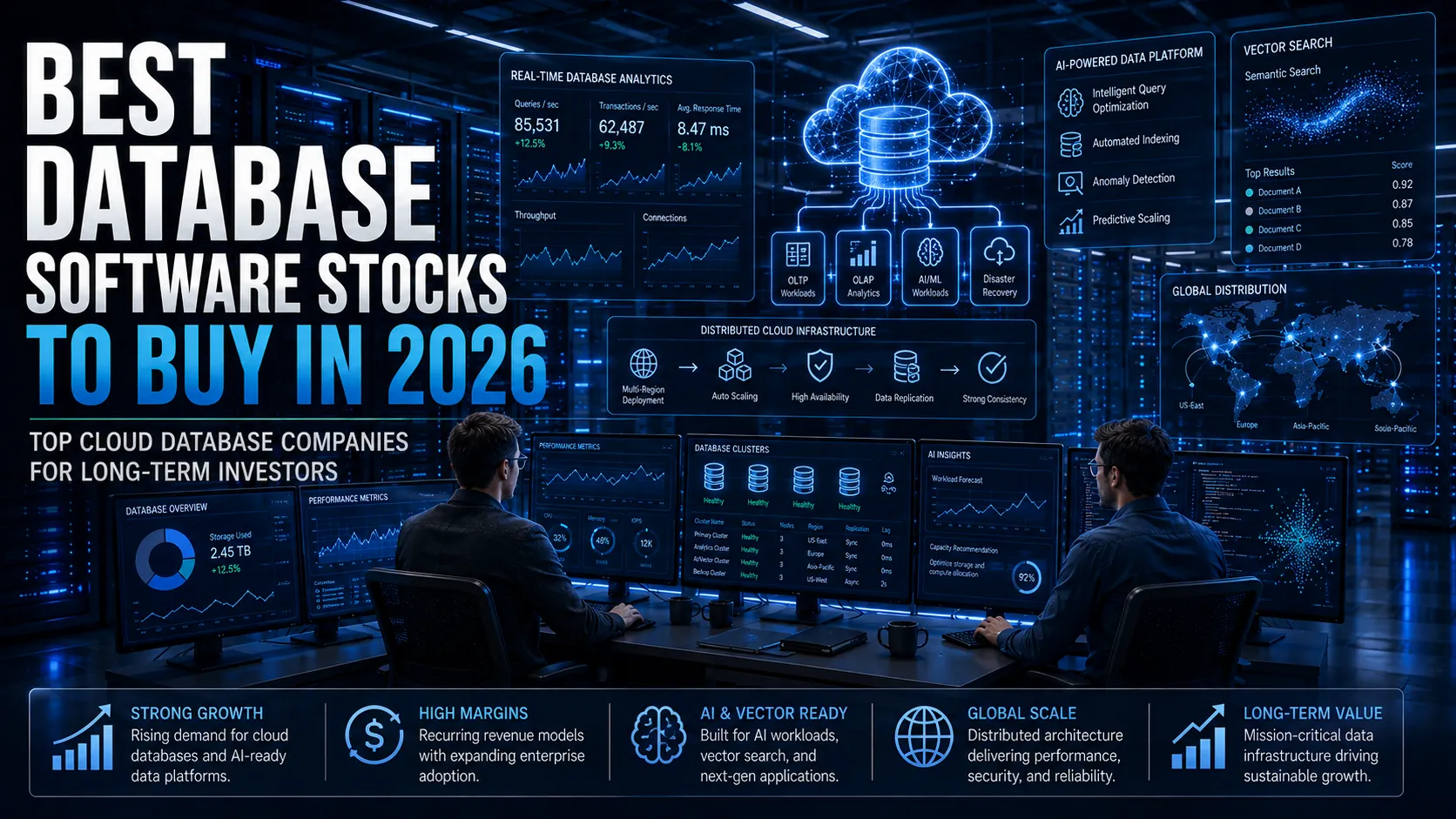
Best Database Software Stocks to Buy in 2026 (Top Cloud Database Companies)
Introduction
The best database software stocks to buy in 2026 give investors exposure to one of the most fundamental technologies powering cloud computing, artificial intelligence, enterprise software, and the digital economy.
Almost every modern application depends on databases.
Banks use databases to process transactions. E-commerce companies use them to manage customers, products, and orders. Social media platforms store enormous amounts of user information. Enterprises rely on databases to operate financial systems, customer relationship management platforms, supply chains, and internal applications.
Artificial intelligence is making data infrastructure even more important.
Generative AI applications need access to enormous amounts of structured and unstructured information. AI agents must retrieve business data, maintain context, search documents, and interact with enterprise applications.
This is increasing demand for cloud databases, distributed databases, vector search, real-time analytics, and AI-ready data platforms.
At the same time, companies continue migrating traditional databases from private data centers to cloud infrastructure.
Instead of purchasing servers and database licenses upfront, organizations increasingly consume database technology through cloud-based subscription and usage models.
This transition creates long-term opportunities for companies providing database software and cloud data infrastructure.
In this guide, we’ll explore the best database software stocks to buy in 2026, examine the industry’s major growth drivers, and highlight publicly traded companies positioned to benefit from the continued expansion of cloud computing, artificial intelligence, and enterprise data.
Why Database Software Matters in 2026
Data has become one of the most valuable resources in the global economy.
Organizations continuously generate information from applications, websites, payments, sensors, cloud services, AI systems, customers, employees, and connected devices.
Databases allow companies to store, organize, retrieve, and analyze this information efficiently.
Several long-term trends continue increasing demand for database technologies.
Artificial Intelligence
Artificial intelligence depends heavily on data.
AI applications need access to information for training, inference, retrieval, personalization, and automated decision-making.
Generative AI has also increased interest in vector databases and vector search.
These technologies allow AI applications to identify relationships between pieces of information based on meaning rather than relying only on traditional keyword matching.
This capability is particularly important for Retrieval-Augmented Generation applications that connect large language models with enterprise data.
Cloud Database Migration
Many organizations still operate traditional databases inside private data centers.
Moving these workloads to the cloud can reduce infrastructure management requirements while providing greater scalability.
Cloud providers increasingly offer managed database services that automatically handle tasks such as:
- Backups
- Software updates
- Scaling
- Replication
- Availability
- Security
- Disaster recovery
Database-as-a-Service could therefore continue gaining adoption as organizations modernize legacy applications.
Real-Time Applications
Consumers increasingly expect applications to respond instantly.
Payments, online gaming, e-commerce, financial markets, cybersecurity platforms, logistics systems, and social networks generate information continuously.
Modern databases must process large volumes of data with extremely low latency.
This is increasing demand for distributed and real-time database architectures.
Enterprise Digital Transformation
Large organizations continue replacing legacy applications with modern cloud-based platforms.
Every new digital application creates additional requirements for storing and managing data.
Database companies therefore benefit indirectly from broader enterprise digital transformation.
Growing Data Volumes
The amount of digital information generated globally continues expanding.
AI, video, IoT devices, connected vehicles, industrial sensors, financial transactions, and cloud applications contribute to this growth.
As organizations accumulate more data, they require increasingly powerful infrastructure to store, process, search, and protect it.
What Is Database Software?
Database software allows organizations to create, store, organize, retrieve, modify, and manage digital information.
Different database architectures are optimized for different workloads.
Relational Databases
Relational databases organize information into structured tables containing rows and columns.
SQL is commonly used to interact with these systems.
Examples include:
- Oracle Database
- Microsoft SQL Server
- PostgreSQL
- MySQL
Relational databases remain widely used for financial systems, enterprise applications, customer records, and transaction processing.
NoSQL Databases
NoSQL databases provide greater flexibility for applications that do not fit traditional relational structures.
They can be useful for large-scale web applications, content platforms, IoT systems, and rapidly changing datasets.
MongoDB is one of the most recognized companies associated with this category.
Distributed Databases
Distributed databases store information across multiple servers or geographic locations.
This architecture can improve scalability, resilience, and global application performance.
Distributed systems have become increasingly important for large cloud-native applications.
Data Warehouses
Data warehouses are designed primarily for analytical workloads.
Organizations consolidate large amounts of business information into these platforms to support reporting, business intelligence, analytics, and artificial intelligence.
Cloud platforms have transformed data warehousing by allowing organizations to scale computing and storage resources more dynamically.
Vector Search and AI Databases
Generative AI is creating demand for technologies capable of storing and searching vector embeddings.
Vector search helps applications retrieve information based on semantic similarity.
Traditional database companies and newer data platforms are increasingly adding vector capabilities directly to their products.
What Makes a Good Database Software Stock?
Investors evaluating database companies should consider several important characteristics.
Cloud Revenue Growth
The database industry continues shifting toward cloud-based consumption.
Companies with rapidly growing managed database services may benefit from this transition.
Artificial Intelligence Exposure
AI applications require large amounts of data infrastructure.
Database companies offering vector search, AI integrations, real-time analytics, and scalable cloud infrastructure may be positioned to benefit.
Enterprise Customer Base
Databases often contain mission-critical business information.
Once an organization builds applications around a database platform, migrating to another provider can become difficult and expensive.
This can create significant customer switching costs.
Developer Adoption
Developers often influence which databases organizations adopt.
Strong developer communities can help database technologies spread organically across startups and enterprises.
Recurring Revenue
Cloud subscriptions and usage-based pricing can generate recurring revenue.
As customers store more data or run more workloads, spending may increase over time.
Profitability and Cash Flow
Rapid growth alone does not guarantee attractive long-term investment returns.
Investors should also evaluate margins, free cash flow, stock-based compensation, and valuation.
Best Database Software Stocks to Buy in 2026
1. Oracle (NYSE: ORCL)
Oracle is one of the most important database companies in the history of enterprise computing.
Oracle Database has powered mission-critical applications for banks, governments, telecommunications companies, healthcare organizations, retailers, and multinational corporations for decades.
Today, Oracle is transforming its database business through cloud computing and artificial intelligence.
Why Investors Like Oracle
Database Leadership
Oracle maintains a strong position in large enterprise database environments.
Many mission-critical applications rely on Oracle technology, creating significant switching costs.
Replacing these systems can require expensive migrations, application modifications, testing, and employee training.
This installed base provides Oracle with durable customer relationships.
Oracle Cloud Infrastructure
Oracle Cloud Infrastructure allows customers to run databases and enterprise applications in the cloud.
The expansion of OCI provides Oracle with an opportunity to migrate existing database customers toward cloud-based consumption models.
Autonomous Database
Oracle has invested in automation designed to simplify database administration.
Automated technologies can help manage security patches, optimization, backups, scaling, and other operational tasks.
This could reduce administration costs for enterprise customers.
Artificial Intelligence
Oracle is expanding AI capabilities throughout its database and cloud ecosystem.
Enterprise customers increasingly want to connect generative AI applications with proprietary business information.
Oracle’s large installed database base could become strategically important as organizations deploy AI across internal applications.
Mission-Critical Workloads
Database migrations can be complicated and risky.
Organizations may therefore continue using Oracle for workloads where reliability, security, performance, and regulatory compliance are critical.
Risks for Oracle Investors
Oracle faces competition from Microsoft, Amazon Web Services, Google Cloud, MongoDB, open-source databases, and numerous specialized data platforms.
The company must continue converting traditional database customers toward cloud services while competing in the rapidly evolving AI infrastructure market.
2. Microsoft (NASDAQ: MSFT)
Microsoft is one of the world’s largest database software providers through SQL Server and its expanding Azure data ecosystem.
Its database portfolio includes technologies designed for traditional enterprise applications, cloud-native systems, analytics, and globally distributed workloads.
Why Investors Like Microsoft
SQL Server
Microsoft SQL Server remains widely used across enterprise applications.
Organizations have built extensive software ecosystems around SQL Server, creating long-term customer relationships.
Azure SQL
Azure allows customers to consume Microsoft’s relational database technologies as managed cloud services.
This simplifies infrastructure management while creating recurring cloud revenue for Microsoft.
Azure Cosmos DB
Cosmos DB is Microsoft’s globally distributed database designed for modern cloud applications requiring scalability and low latency.
It gives Microsoft exposure beyond traditional relational databases.
Artificial Intelligence Ecosystem
Microsoft’s investments in generative AI strengthen the strategic importance of its data infrastructure.
Organizations building AI applications on Azure require databases for storing operational information, application data, user context, and AI-related workloads.
Enterprise Distribution
Microsoft already has deep relationships with organizations through Microsoft 365, Azure, Dynamics, Windows, GitHub, cybersecurity products, and developer tools.
These relationships provide a powerful distribution channel for database services.
Risks for Microsoft Investors
Database software represents only one component of Microsoft’s much larger business.
Investors buying Microsoft receive diversified exposure to cloud computing, artificial intelligence, productivity software, cybersecurity, gaming, developer tools, and enterprise applications.
3. Amazon (NASDAQ: AMZN)
Amazon Web Services has built one of the industry’s broadest portfolios of managed database services.
Rather than relying on one database architecture, AWS provides specialized technologies designed for different application requirements.
Its database ecosystem includes Amazon Aurora, Amazon RDS, DynamoDB, DocumentDB, Neptune, ElastiCache, and other services.
Why Investors Like Amazon
AWS Cloud Leadership
AWS hosts enormous numbers of applications across startups, governments, and global enterprises.
Applications running on AWS frequently consume database services from the same cloud platform.
This creates natural demand for managed databases.
Amazon Aurora
Aurora is a cloud-native relational database compatible with MySQL and PostgreSQL.
It is designed to combine familiar relational database technologies with cloud scalability and managed infrastructure.
DynamoDB
DynamoDB provides a managed NoSQL database designed for applications requiring high scalability and low-latency performance.
It is used for web applications, gaming, commerce, and other large-scale digital workloads.
Broad Database Portfolio
Different applications require different database technologies.
AWS can offer customers relational, key-value, document, graph, caching, and other database services within one cloud ecosystem.
Artificial Intelligence
AI applications running on AWS require databases and storage infrastructure.
As generative AI adoption expands, AWS could benefit from increased consumption across computing, databases, networking, security, and developer services.
Risks for Amazon Investors
AWS competes aggressively with Microsoft Azure, Google Cloud, Oracle Cloud, and specialized database vendors.
Database services also represent only one component of AWS and a relatively small part of Amazon’s overall business.
4. MongoDB (NASDAQ: MDB)
MongoDB provides investors with one of the most direct publicly traded opportunities in modern database software.
The company developed a document-oriented database designed to provide developers with greater flexibility than traditional relational database architectures.
MongoDB Atlas has transformed the company into a cloud database platform serving applications across major public cloud providers.
Why Investors Like MongoDB
Developer Adoption
MongoDB has built a large global developer community.
Developers often choose database technologies during the early stages of application development.
Strong developer adoption can therefore help MongoDB expand from individual projects into larger enterprise deployments.
MongoDB Atlas
Atlas is MongoDB’s managed cloud database service.
Customers can deploy MongoDB across AWS, Microsoft Azure, and Google Cloud without managing the underlying database infrastructure themselves.
Atlas is central to MongoDB’s long-term growth strategy.
Flexible Data Model
Modern applications frequently process rapidly changing or semi-structured information.
MongoDB’s document model provides developers with flexibility when application data does not fit neatly into traditional relational tables.
Artificial Intelligence Opportunity
MongoDB has added capabilities designed to support AI-powered applications, including vector search.
Developers can combine operational application data with vector search capabilities when building generative AI applications.
This potentially expands MongoDB’s addressable market.
Multi-Cloud Strategy
Unlike database services tied directly to one hyperscale cloud provider, MongoDB Atlas can operate across AWS, Azure, and Google Cloud.
This provides customers with greater deployment flexibility.
Risks for MongoDB Investors
MongoDB competes with database services offered directly by Amazon, Microsoft, Google, and Oracle as well as open-source technologies and specialized database vendors.
As a growth-oriented software company, MongoDB can also experience significant stock volatility when revenue growth or customer consumption changes.
5. Alphabet (NASDAQ: GOOGL)
Alphabet participates in the database software market primarily through Google Cloud, which provides a broad portfolio of managed database technologies for enterprise, cloud-native, analytics, and artificial intelligence workloads.
Google Cloud’s database portfolio includes Cloud SQL, Cloud Spanner, Bigtable, Firestore, AlloyDB, and other data services.
These technologies allow organizations to build applications ranging from traditional enterprise systems to globally distributed digital platforms.
Why Investors Like Alphabet
Google Cloud Growth
Google Cloud has become one of the world’s largest cloud computing platforms.
As more organizations migrate applications to Google Cloud, demand for managed databases can increase alongside computing, storage, analytics, security, and AI consumption.
Cloud Spanner
Cloud Spanner is a globally distributed relational database designed for applications requiring scalability, consistency, and high availability.
It is particularly relevant for large applications operating across multiple geographic regions.
AlloyDB
AlloyDB is Google’s PostgreSQL-compatible database designed for demanding enterprise workloads.
PostgreSQL has become extremely popular among developers, and Google’s investment in compatible managed services could help it capture additional cloud database workloads.
Artificial Intelligence
Alphabet is one of the world’s largest artificial intelligence companies.
Gemini and Google Cloud’s AI ecosystem create opportunities to connect enterprise applications with databases and proprietary business information.
As organizations deploy more AI applications, data infrastructure could become an increasingly important component of Google Cloud’s growth.
Data and Analytics Ecosystem
Google Cloud combines databases with technologies for analytics, machine learning, data warehousing, cybersecurity, and application development.
This integrated ecosystem can encourage customers to consolidate additional workloads onto the platform.
Risks for Alphabet Investors
Database software represents only a small component of Alphabet’s overall business.
Investors buying Alphabet receive much broader exposure to advertising, YouTube, Google Cloud, artificial intelligence, consumer technology, and other businesses.
6. Snowflake (NYSE: SNOW)
Snowflake is primarily known as a cloud data platform rather than a traditional transactional database provider.
However, the company has expanded beyond its original data warehousing focus into data engineering, application development, artificial intelligence, analytics, and broader data infrastructure.
This makes Snowflake an important company to consider when evaluating the future of enterprise database and data software.
Why Investors Like Snowflake
Cloud-Native Architecture
Snowflake was designed specifically for cloud infrastructure.
Its architecture separates computing and storage resources, allowing organizations to scale workloads according to their requirements.
This model has helped Snowflake become a major platform for enterprise analytics.
Enterprise Data Consolidation
Large organizations often store information across numerous databases, applications, and cloud environments.
Snowflake allows companies to consolidate and analyze large quantities of enterprise information through a centralized cloud platform.
Artificial Intelligence Opportunity
Generative AI has increased the strategic importance of enterprise data.
Companies want AI models and agents to interact securely with proprietary business information.
Snowflake is investing in technologies that allow organizations to build AI and machine learning applications closer to their existing enterprise data.
Data Sharing
Snowflake enables organizations to share data securely without creating numerous traditional copies.
Data sharing can improve collaboration between departments, customers, suppliers, and business partners.
Expanding Platform
Snowflake continues moving beyond traditional data warehousing.
Its broader strategy includes:
- Data engineering
- Analytics
- Application development
- Artificial intelligence
- Machine learning
- Data governance
- Enterprise data sharing
This expansion could increase the company’s long-term addressable market.
Risks for Snowflake Investors
Snowflake competes with Amazon Web Services, Microsoft Azure, Google Cloud, Oracle, Databricks, and other data infrastructure companies.
It is also important for investors to understand that Snowflake is not a traditional database company in the same sense as Oracle or MongoDB.
Its investment thesis is more closely tied to cloud data platforms, analytics, and AI infrastructure.
7. IBM (NYSE: IBM)
IBM has decades of experience in enterprise database technology.
Its Db2 database platform remains used across large organizations for transactional workloads, analytics, and mission-critical enterprise applications.
IBM’s broader strategy combines databases with hybrid cloud infrastructure, artificial intelligence, automation, and enterprise consulting.
Why Investors Like IBM
Enterprise Database Experience
IBM has longstanding relationships with banks, governments, insurance companies, healthcare organizations, and multinational enterprises.
Many of these customers operate mission-critical applications requiring reliable database infrastructure.
Db2 Platform
IBM Db2 supports transactional and analytical workloads across enterprise environments.
The platform can operate across traditional infrastructure, cloud environments, and hybrid architectures.
Hybrid Cloud Strategy
Many large organizations are unlikely to move every application into one public cloud.
IBM focuses heavily on hybrid environments where customers combine private infrastructure with public cloud services.
This strategy can support database workloads that must remain close to legacy applications or regulated information.
Artificial Intelligence
IBM continues integrating watsonx and other AI technologies into its enterprise software portfolio.
As companies connect AI applications with proprietary information, database management and data governance become increasingly important.
Consulting Relationships
IBM Consulting works directly with large organizations on cloud modernization, artificial intelligence, cybersecurity, and digital transformation projects.
These relationships can create opportunities to introduce additional IBM software and data technologies.
Risks for IBM Investors
IBM’s database business faces intense competition from cloud providers, Oracle, Microsoft, MongoDB, open-source technologies, and modern data platforms.
Database software also represents only one component of IBM’s broader enterprise technology strategy.
8. Elastic (NYSE: ESTC)
Elastic is best known for Elasticsearch, a distributed search and analytics engine used by developers and enterprises worldwide.
Although Elastic is not a traditional relational database company, its technology plays an important role in modern data infrastructure.
Organizations use Elasticsearch to search, analyze, and retrieve large quantities of structured and unstructured information.
The growth of generative AI has also increased interest in Elastic’s search and vector capabilities.
Why Investors Like Elastic
Elasticsearch Ecosystem
Elasticsearch has become widely adopted among developers building applications that require fast search and analytics.
Use cases include:
- Website search
- Enterprise search
- Application logs
- Security analytics
- Observability
- E-commerce search
- Application data
- AI retrieval
This broad ecosystem provides Elastic with exposure to multiple software markets.
AI and Vector Search
Generative AI applications increasingly require technologies capable of finding relevant information within large datasets.
Vector search allows applications to retrieve information based on semantic relationships.
Elastic’s search infrastructure can therefore play a role in Retrieval-Augmented Generation and enterprise AI applications.
Search AI Platform
Elastic is positioning its technology as infrastructure for AI-powered search and retrieval.
Organizations can combine traditional keyword search with semantic and vector capabilities to build more intelligent applications.
Cloud Revenue
Elastic Cloud allows organizations to consume Elastic technologies as managed services rather than operating infrastructure themselves.
Cloud adoption supports recurring revenue while reducing infrastructure management requirements for customers.
Multiple Growth Markets
Elastic operates across three major areas:
- Search
- Observability
- Security
Artificial intelligence creates another potential layer of growth across all three categories.
Risks for Elastic Investors
Elastic faces competition from cloud providers, specialized search technologies, observability companies, security platforms, and open-source alternatives.
The company must continue differentiating its technology while improving profitability and maintaining developer adoption.
Comparison of the Best Database Software Stocks
| Company | Primary Database Exposure | Risk Level | Dividend | Growth Potential |
|---|---|---|---|---|
| Oracle | Enterprise & Cloud Databases | Medium | Yes | High |
| Microsoft | SQL Server & Azure Databases | Low-Medium | Yes | High |
| Amazon | AWS Managed Databases | Medium | No | High |
| MongoDB | Document Database & Atlas | High | No | Very High |
| Alphabet | Google Cloud Databases | Medium | Yes | High |
| Snowflake | Cloud Data Platform | High | No | Very High |
| IBM | Enterprise & Hybrid Databases | Low-Medium | Yes | Medium |
| Elastic | Search & AI Data Retrieval | High | No | High |
For investors seeking relatively direct exposure to database software, MongoDB represents one of the clearest growth-oriented opportunities.
Oracle provides substantial exposure to traditional enterprise databases while increasingly benefiting from cloud infrastructure and AI.
Microsoft, Amazon, and Alphabet provide diversified exposure through their hyperscale cloud platforms.
Snowflake and Elastic provide more specialized exposure to cloud data, analytics, search, and AI-related workloads.
Major Growth Drivers for Database Software
Several long-term technology trends could continue supporting database companies throughout 2026 and beyond.
Generative AI
Artificial intelligence could become one of the most important growth drivers for database infrastructure.
AI applications require access to enormous amounts of information.
Enterprise AI systems may need to retrieve:
- Customer records
- Product information
- Financial data
- Documents
- Application data
- Support tickets
- Internal knowledge
- Transaction histories
Databases and search technologies provide the infrastructure connecting AI systems with this information.
Vector Search
Vector search has become increasingly important because of generative AI.
Instead of searching only for exact keywords, vector technologies can identify information based on semantic similarity.
Database companies are increasingly integrating vector capabilities directly into existing platforms.
Retrieval-Augmented Generation
Retrieval-Augmented Generation allows AI models to retrieve external information before generating responses.
This can help companies build AI applications using proprietary business information without relying entirely on knowledge embedded inside the underlying language model.
Databases, search platforms, and vector technologies can therefore become critical components of enterprise RAG architectures.
Cloud Migration
Organizations continue moving database workloads from private data centers toward managed cloud services.
This transition could create long-term recurring revenue opportunities for AWS, Microsoft Azure, Google Cloud, Oracle Cloud, MongoDB Atlas, and other providers.
Data Growth
Businesses continue generating larger quantities of digital information.
IoT devices, artificial intelligence, financial transactions, e-commerce, connected vehicles, industrial systems, and digital applications all contribute to global data growth.
More information requires additional storage, processing, search, governance, and database infrastructure.
Risks to Consider
Intense Competition
Database software is one of the most competitive areas of enterprise technology.
Oracle, Microsoft, Amazon, Google, MongoDB, IBM, Snowflake, Elastic, and numerous open-source projects compete for enterprise workloads.
Open-Source Databases
PostgreSQL, MySQL, and other open-source technologies remain extremely popular.
Cloud providers can offer managed versions of these technologies, increasing competition for proprietary database companies.
Cloud Concentration
Some database companies depend heavily on AWS, Azure, or Google Cloud infrastructure.
Changes in cloud pricing or competitive relationships could affect operating costs and margins.
Artificial Intelligence Disruption
AI creates enormous opportunities for database companies, but technology architectures can change quickly.
New AI-native databases and specialized vector platforms could challenge established vendors.
High Valuations
Growth-oriented database and data infrastructure stocks may trade at high valuation multiples.
Slower customer spending or weaker revenue growth can therefore cause significant share-price volatility.
Long-Term Outlook
Database software should remain a critical component of the digital economy.
Applications cannot operate without reliable access to data.
Artificial intelligence makes this infrastructure even more important because AI systems require large quantities of high-quality information to produce useful results.
The database market is also becoming increasingly diverse.
Traditional relational databases remain important for financial transactions and enterprise applications, while NoSQL databases support flexible application development.
Distributed databases enable global cloud applications.
Cloud data platforms support analytics and machine learning.
Vector search technologies connect generative AI systems with enterprise information.
These categories may increasingly converge as vendors add multiple database and AI capabilities to unified platforms.
Companies capable of combining cloud infrastructure, developer adoption, artificial intelligence, security, and data management could therefore be positioned for attractive long-term growth.
Final Thoughts
The best database software stocks to buy in 2026 provide investors with exposure to the data infrastructure powering cloud computing, enterprise applications, artificial intelligence, and the broader digital economy.
Oracle remains one of the industry’s most important enterprise database providers while expanding aggressively into cloud and AI infrastructure.
Microsoft, Amazon, and Alphabet provide database exposure through their massive cloud ecosystems.
MongoDB represents a more concentrated growth opportunity centered on modern application development and cloud databases.
Snowflake provides exposure to cloud data platforms and analytics, while IBM remains important within mission-critical enterprise environments.
Elastic provides specialized exposure to search, observability, security, vector search, and AI retrieval.
No single company represents the perfect database investment.
Investors should consider growth, profitability, competitive positioning, valuation, and portfolio diversification before investing.
However, the long-term importance of data continues increasing, making database software an important technology sector to watch throughout 2026 and beyond.
Frequently Asked Questions
What are database software stocks?
Database software stocks are publicly traded companies that develop technologies used to store, organize, process, search, retrieve, or analyze digital information.
Examples include Oracle, MongoDB, Microsoft, Amazon, Alphabet, IBM, Snowflake, and Elastic.
What are the best database software stocks to buy in 2026?
Investors looking for database exposure may research Oracle, Microsoft, Amazon, MongoDB, Alphabet, Snowflake, IBM, and Elastic.
Each company provides different exposure to traditional databases, cloud databases, analytics, search, or AI infrastructure.
Is MongoDB a database stock?
Yes. MongoDB is one of the most direct publicly traded database software companies.
Its MongoDB Atlas platform provides managed database services across major cloud providers.
Is Oracle still a major database company?
Yes. Oracle remains a major provider of enterprise database technology while expanding its cloud infrastructure and AI capabilities.
How will AI affect database companies?
AI applications require access to large quantities of enterprise information.
This could increase demand for cloud databases, vector search, real-time data processing, retrieval systems, and data governance.
What is a vector database?
A vector database stores and searches numerical representations of information known as embeddings.
These technologies allow applications to retrieve information based on semantic similarity and are commonly associated with generative AI and Retrieval-Augmented Generation.
Is Snowflake a database company?
Snowflake is more accurately described as a cloud data platform.
Its technology overlaps with database software through data storage, processing, analytics, application development, and AI workloads.
Internal Linking :
- Best DevOps Software Stocks to Buy in 2026
- Best API Management Stocks to Buy in 2026
- Best Observability Software Stocks to Buy in 2026
- Best Enterprise Software Stocks to Buy in 2026
- Best Engineering Software Stocks to Buy in 2026
- Best Industrial IoT Stocks to Buy in 2026
- Best Digital Twin Stocks to Buy in 2026
- Alphabet Stock Forecast 2026: Is GOOGL Still a Top AI Investment?