
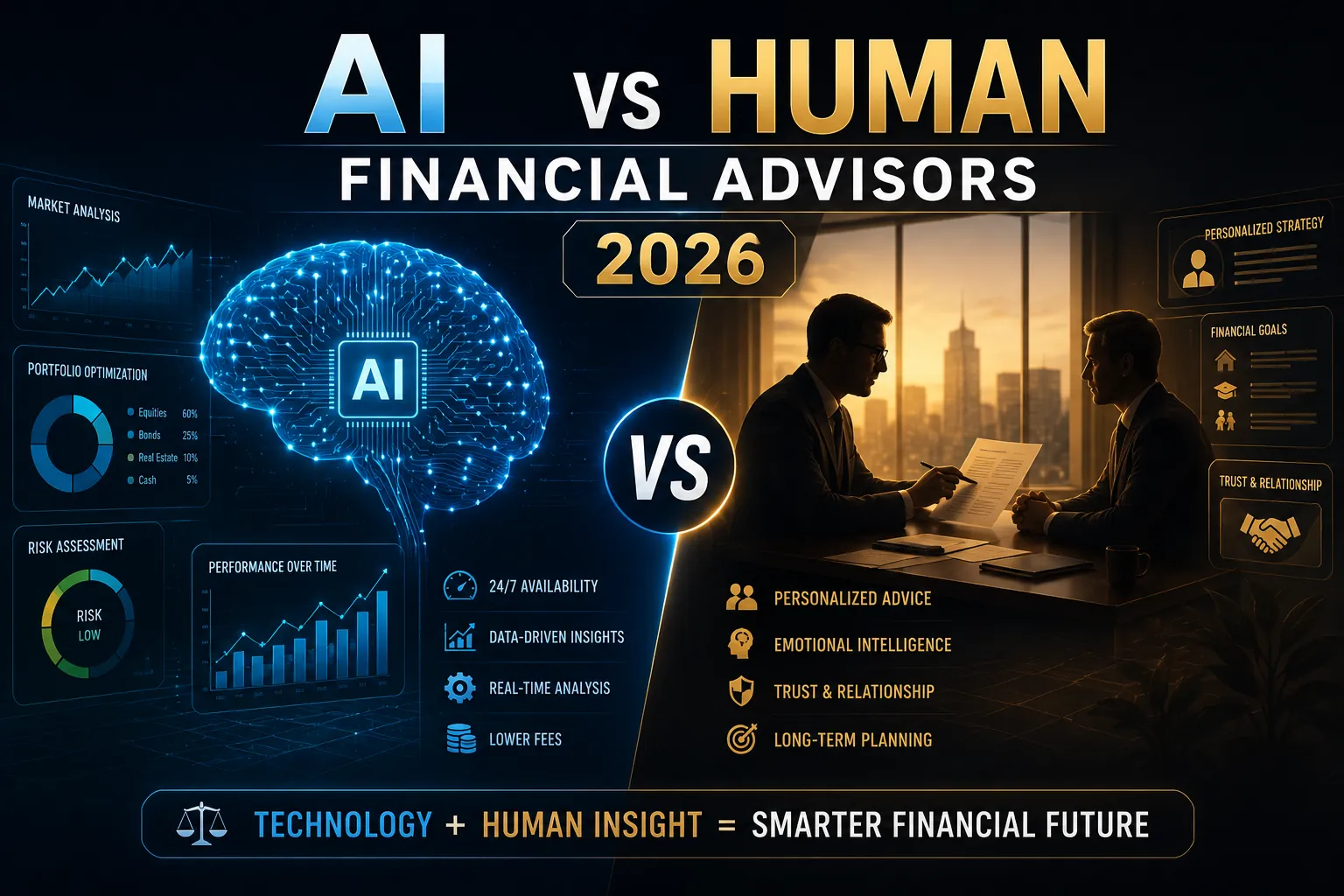
AI vs Human Financial Advisors 2026: Which Is Better for Your Money?
Introduction
AI vs human financial advisors 2026 — this is the debate reshaping how millions of people manage their money. AI-powered robo-advisors now manage over $1.8 trillion in assets globally, up from $1 trillion in 2023. The robo-advisory market reached $18.7 billion in 2026, growing at over 30 percent annually. Yet the number of Certified Financial Planners in the U.S. has grown to approximately 102,000, suggesting human advisors remain in high demand.
The reality in 2026 is not a simple either-or choice. AI financial tools can now handle tax-loss harvesting, retirement income planning, estate coordination, and even real-time portfolio adjustments based on market conditions. Meanwhile, human advisors provide judgment, emotional coaching, accountability, and expertise that software still cannot fully replicate.
In this guide, we compare AI robo-advisors and human financial advisors in 2026, helping you decide which approach is best for your financial situation, goals, and portfolio size.
How AI Financial Advisors Work in 2026
AI financial advisors have evolved far beyond the simple portfolio allocation tools of early robo-advisors. In 2026, they handle complex financial tasks that previously required expensive human professionals.
Modern AI advisors build diversified portfolios using low-cost ETFs based on your risk tolerance and goals. They automatically rebalance portfolios when allocations drift from targets. Tax-loss harvesting runs continuously, capturing losses to reduce your tax bill. Some platforms now offer AI-powered financial planning conversations that feel remarkably similar to sitting with a human advisor. Direct indexing is available for taxable accounts above certain thresholds.
The leading AI advisor platforms in 2026 include Betterment and Wealthfront, which both charge 0.25 percent annually and manage a combined $70 billion or more in assets. Schwab Intelligent Portfolios charges zero management fees. Vanguard Digital Advisor charges 0.20 percent. SoFi Automated Investing charges zero fees and includes access to human advisors.
These platforms work best for investors with straightforward goals who want professional portfolio management at a fraction of traditional advisor costs.
How Human Financial Advisors Work in 2026
Human financial advisors provide comprehensive financial planning that goes far beyond investment management. They consider your entire financial picture including taxes, estate planning, insurance, business interests, and family dynamics.
Human advisors serve as behavioral coaches, preventing you from making emotional decisions during market crashes. They provide legal accountability as fiduciaries who must act in your best interest. Complex situations like business sales, equity compensation, divorce, and multi-state taxes require human judgment. Estate planning, trust coordination, and intergenerational wealth transfer need personalized guidance. Advisors coordinate with your accountant, attorney, and insurance agents.
The typical human financial advisor charges 1.0 percent of assets under management annually. Some charge hourly fees of $150 to $400 per hour or flat fees of $2,000 to $10,000 per year. The fee difference between a robo-advisor at 0.25 percent and a human advisor at 1.0 percent equals $7,500 per year on a $1 million portfolio.
Human advisors are most valuable when your financial life becomes complex or when you need someone to hold you accountable to a long-term plan during stressful periods.
AI vs Human Advisors: The Fee Comparison
Fees are the most significant measurable difference between AI and human advisors. Over a lifetime of investing, fee differences compound into hundreds of thousands of dollars.
On a $100,000 portfolio, a robo-advisor at 0.25 percent costs $250 per year while a human advisor at 1.0 percent costs $1,000 per year. The annual savings with AI is $750.
On a $500,000 portfolio, a robo-advisor costs $1,250 per year while a human advisor costs $5,000 per year. The annual savings with AI is $3,750.
On a $1,000,000 portfolio, a robo-advisor costs $2,500 per year while a human advisor costs $10,000 per year. The annual savings with AI is $7,500.
Over 30 years, the fee difference on a $500,000 portfolio invested at 7 percent average returns equals approximately $200,000 or more in additional wealth retained by the investor using a robo-advisor. This is a massive advantage for AI-powered investing when complex planning is not needed.
However, if a human advisor prevents just one emotional panic sale during a crash, that single intervention could save far more than decades of advisory fees.
When to Choose an AI Robo-Advisor
AI robo-advisors are the better choice for most investors in specific situations.
Choose AI if your portfolio is under $500,000 and your financial situation is straightforward. If your goals are standard like retirement, house down payment, or general wealth building, AI handles this perfectly. If you want tax-loss harvesting and automatic rebalancing without paying 1 percent annually, robo-advisors deliver this efficiently. If you are disciplined enough to stay invested during market downturns without needing someone to talk you through it, AI saves you thousands in fees. If you are a younger investor building wealth and want maximum compounding with minimum fees, robo-advisors are ideal.
The data supports this recommendation. For most investors under $500,000 with straightforward goals, a robo-advisor provides comparable investment outcomes at 75 percent lower fees than human advisors.
When to Choose a Human Financial Advisor
Human advisors earn their fees in situations where judgment, coordination, and emotional coaching provide measurable value.
Choose a human advisor if your portfolio exceeds $500,000 and involves complex tax planning or estate coordination. If you are going through a major life transition like selling a business, divorcing, inheriting wealth, or retiring, a human advisor provides essential guidance. If you have equity compensation from your employer including stock options or RSUs, a human advisor can optimize exercise timing and diversification. If you know you are likely to panic sell during market crashes, a human advisor provides the behavioral coaching that protects long-term returns. If your situation involves multiple entities, trusts, or cross-border tax issues, AI cannot handle this complexity.
The value of a human advisor often comes from what they prevent rather than what they provide. Preventing one emotional decision during a 30 percent market decline can be worth tens or hundreds of thousands of dollars.
The Hybrid Model: Best of Both Worlds
The fastest-growing segment in wealth management is the hybrid model that combines AI efficiency with human expertise. Several platforms now offer this approach.
Betterment Premium charges 0.65 percent and provides unlimited access to certified financial planners alongside AI portfolio management. Vanguard Personal Advisor charges 0.30 percent and combines algorithmic investing with human advisor access for portfolios over $50,000. Schwab Intelligent Portfolios Premium charges $300 initial fee plus $30 per month for AI investing with unlimited CFP access. SoFi offers free automated investing with complimentary access to financial planners.
Hybrid models work well for investors who want low-cost AI portfolio management but also value occasional human guidance for major decisions. You get 90 percent of the benefit of a full human advisor at 30 to 65 percent of the cost.
For many investors in 2026, the hybrid model represents the optimal balance between cost efficiency and personalized guidance.
Performance Comparison: Does AI Beat Humans?
The honest answer is that performance differences between AI and human advisors are smaller than most people expect. Both approaches typically invest in diversified portfolios of index funds or ETFs.
AI robo-advisors typically deliver market returns minus small fees of 0.20 to 0.25 percent. Human advisors typically deliver market returns minus higher fees of 0.75 to 1.25 percent including underlying fund costs. The primary performance difference comes from fees rather than investment selection. Tax-loss harvesting by AI can add 0.5 to 1.5 percent in tax alpha for taxable accounts. Human advisors may add value through behavioral coaching that prevents costly emotional mistakes.
Studies consistently show that the average investor significantly underperforms the market due to emotional buying and selling. If a human advisor prevents this behavior, they easily justify their fee. If you are disciplined enough to stay the course without human intervention, the AI approach delivers better net returns due to lower fees.
What AI Financial Advisors Cannot Do in 2026
Despite remarkable advances, AI financial advisors still have meaningful limitations.
AI cannot serve as a legal fiduciary who is personally accountable for acting in your best interest. It cannot provide the emotional support and confidence that comes from a trusted human relationship. AI struggles with novel situations that fall outside its training data or programmed rules. It cannot coordinate effectively with your attorney, accountant, and insurance agent as a unified team. AI cannot understand the full context of family dynamics, personal values, and life goals the way a human can.
These limitations matter less for simple portfolios but become critical as wealth and complexity increase.
The Decision Framework
Use this simple framework to decide which approach is right for you in 2026.
If your portfolio is under $250,000 with simple goals, use a pure robo-advisor. You will save thousands in fees with comparable investment outcomes.
If your portfolio is $250,000 to $500,000 with moderate complexity, consider a hybrid model. You get AI efficiency with human access for major decisions.
If your portfolio exceeds $500,000 or your situation involves business ownership, equity compensation, estate planning, or major transitions, a dedicated human advisor likely earns their fee through tax savings, behavioral coaching, and coordination.
If you are unsure, start with a robo-advisor. You can always upgrade to a human advisor as your wealth and complexity grow. The reverse is harder because switching costs and inertia make leaving a human advisor more difficult.
Final Thoughts
The AI vs human financial advisors debate in 2026 is not about which is universally better. It is about which is better for your specific situation, portfolio size, and emotional temperament.
AI robo-advisors are clearly superior for cost-conscious investors with straightforward financial lives. They deliver professional portfolio management, tax optimization, and automatic rebalancing at 75 percent lower cost than traditional advisors.
Human advisors remain essential for complex financial situations where judgment, coordination, and emotional coaching provide value that algorithms cannot replicate. Their fee is justified when they prevent catastrophic emotional decisions or optimize complex tax situations.
For most people in 2026, the answer is starting with AI and adding human guidance as needed. The hybrid model gives you the best of both worlds at a reasonable cost.
Frequently Asked Questions
Are robo-advisors better than human financial advisors?
For investors with portfolios under $500,000 and straightforward goals, robo-advisors provide comparable outcomes at 75 percent lower fees. For complex situations involving business sales, estate planning, or equity compensation, human advisors provide value that justifies their higher cost.
How much do robo-advisors charge in 2026?
Leading robo-advisors charge 0 to 0.25 percent annually. Betterment and Wealthfront charge 0.25 percent. Schwab Intelligent Portfolios and SoFi charge zero management fees. This compares to 1.0 percent typically charged by human advisors.
Can AI replace financial advisors?
AI cannot fully replace human advisors in 2026. While AI handles portfolio management, tax harvesting, and rebalancing effectively, it cannot provide behavioral coaching, serve as a legal fiduciary, or navigate complex life situations requiring human judgment and empathy.
What is the best robo-advisor in 2026?
Wealthfront is best for tax optimization and hands-off investors. Betterment is best for investors who want the option of human advice. Schwab is best for zero-fee investing. The right choice depends on your priorities and portfolio size.
How much money do I need for a human financial advisor?
Most human advisors require $250,000 to $500,000 minimum. Below this threshold, robo-advisors or hybrid models are more cost-effective. Above $500,000, the value of tax planning, estate coordination, and behavioral coaching often justifies the 1 percent advisory fee.
INTERNAL LINKING:
- Best AI Investing Tools for Beginners in 2026
- AI Tools Every Investor Should Know in 2026
- Best AI Stock Analysis Tools in 2026
- AI and Personal Finance in 2026
- How AI Is Changing Investing in 2026
- Best Investing Apps for Beginners in 2026
- Best AI Tools for Personal Finance in 2026
- How to Start Investing With $100 in 2026