
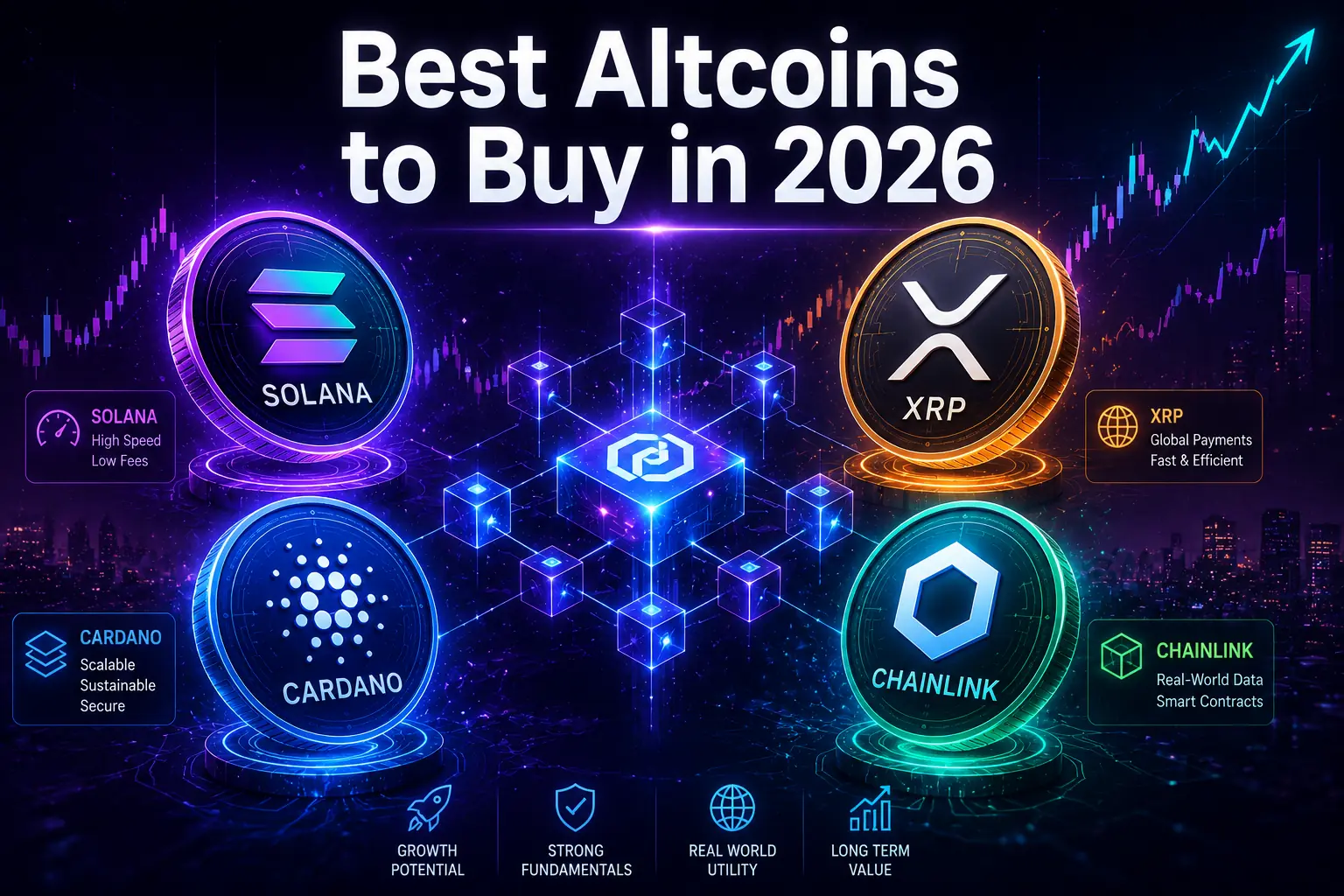
Best Altcoins to Buy in 2026: Top Crypto Beyond Bitcoin and Ethereum
Introduction
Best altcoins to buy in 2026 — this is what crypto investors are asking as the market enters a critical inflection point. After a brutal selloff that brought many altcoins 50 to 80 percent below their 2025 highs, analysts are spotting early signs of a potential altcoin season with Glassnode’s Altcoin Cycle Signal hitting 86 in late June 2026.
The crypto landscape has shifted dramatically. Capital is concentrating in projects that generate real revenue, attract users, and solve tangible problems rather than flowing broadly into speculative tokens. The RWA tokenization market surpassed $12 billion in March 2026. Seven spot XRP ETFs now trade in the U.S. with cumulative inflows of $1.43 billion. Solana reached 4.16 million daily active users in June 2026.
In this guide, we explore the best altcoins to buy in 2026 for both short-term traders and long-term investors, focusing on projects with strong fundamentals, real adoption, and clear catalysts ahead.
Why Altcoins Are at a Turning Point in 2026
The altcoin market is showing conflicting signals that suggest a major move is coming.
Glassnode’s Altcoin Cycle Signal reached 86 on June 22, 2026, returning to altcoin season territory. However, the CoinMarketCap Altcoin Season Index remains at 42 to 45, far below the 75 threshold that confirms a full altcoin season. This divergence suggests early rotation is happening but has not yet broadened.
Bitcoin dominance holds near 58 percent, and altcoin spot selling hit a five-year high. Analysts say 99 percent of altcoins should be rejected in favor of projects with real revenue, DeFi utility, and RWA tokenization exposure.
The message is clear. This is not the broad altseason of 2017 or 2021 where everything pumps together. Capital will concentrate in fundamentally strong projects. Choosing the right altcoins matters more than ever.
Regulatory clarity is also improving. The SEC and CFTC formally classified XRP as a commodity in March 2026. The Senate Banking Committee advanced the CLARITY Act. Spot ETFs for multiple altcoins are now trading in the U.S. These developments reduce regulatory risk for legitimate projects.
Solana (SOL) — The Speed and Stablecoin Leader
Solana is the highest-revenue Layer 1 blockchain, processing transactions significantly faster and cheaper than Ethereum. It has become the dominant chain for consumer crypto applications, memecoins, stablecoins, and DeFi.
Solana reached 4.16 million daily active users on June 5, 2026, its highest ever recorded. Application revenue reached roughly $2.4 billion in 2025 with $1.4 billion in real economic value accruing to the chain. SOL currently trades near $66 to $95, down roughly 70 percent from its all-time high of $293 set in January 2025. Analysts expect SOL to reach $100 or above by end of 2026 with bull scenarios targeting $200 or more.
Solana leads in memecoins, RWA tokenization, stablecoins, and consumer applications. The upcoming Alpenglow upgrade promises further performance improvements. Despite the price decline, user activity remains strong.
Risk level is high because the token has experienced significant drawdowns and faces competition from Ethereum Layer 2 solutions.
Best for investors who believe in high-speed blockchain adoption and want exposure to the leading alternative Layer 1 ecosystem.
XRP (Ripple) — The Regulatory Clarity Play
XRP has achieved what no other altcoin has in 2026 — full regulatory clarity. The SEC and CFTC formally classified XRP as a commodity in March 2026, removing the legal cloud that hung over the project for years.
Seven spot XRP ETFs now trade in the U.S. with cumulative inflows of approximately $1.43 billion since their November 2025 launch. May 2026 saw record monthly inflows near $132 million. Goldman Sachs holds $153.8 million in XRP ETFs. XRP currently trades near $1.04 to $1.45. Analysts project a range of $1.62 to $5.00 depending on adoption scenarios.
Ripple has landed partnerships with JPMorgan, Deutsche Bank, and SBI. It launched its stablecoin in Japan with SBI. The CLARITY Act advancing through the Senate provides additional regulatory tailwinds for XRP and the broader crypto market.
Risk level is moderate because XRP has regulatory clarity and institutional ETF backing, but price has underperformed despite positive fundamentals.
Best for investors who want a regulated, institutional-grade altcoin with ETF access and major banking partnerships.
Chainlink (LINK) — The Oracle and RWA Tokenization King
Chainlink is the leading oracle network providing real-world data to smart contracts across all major blockchains. It has become the critical infrastructure layer for the $12 billion and growing RWA tokenization market.
Chainlink secures over $30 billion in total value across DeFi protocols in 2026. The RWA tokenization market surpassed $12 billion in March 2026 with Chainlink ranked as the number one infrastructure provider. Analysts flag a breakout setup with potential 170 percent upside for LINK. The CCIP cross-chain protocol enables secure value transfer between different blockchains. Chainlink powers stablecoin settlements, RWA tokenization, and DeFi across fragmented ecosystems.
Chainlink is not a speculative memecoin. It provides essential infrastructure that DeFi, NFTs, and tokenized assets cannot function without. As institutional adoption of tokenized real-world assets grows, demand for Chainlink oracles grows proportionally.
Risk level is moderate because Chainlink has proven utility and institutional adoption, though it remains dependent on broader DeFi and RWA growth.
Best for investors who want exposure to blockchain infrastructure and the institutional tokenization trend rather than speculative tokens.
Sui (SUI) — The Next-Generation Layer 1
Sui is a high-performance Layer 1 blockchain built by former Meta engineers using the Move programming language. It is designed for consumer applications, gaming, and high-throughput financial applications.
Sui has emerged as one of the fastest-growing blockchain ecosystems in 2026. The network processes thousands of transactions per second with sub-second finality. TVL and developer activity have grown significantly. Multiple analyst firms include Sui among their top altcoin picks for 2026. The Move programming language offers enhanced security compared to Solidity.
Sui represents the next generation of blockchain infrastructure purpose-built for mainstream consumer applications. Its technical architecture solves many scalability challenges that older blockchains face.
Risk level is high because Sui is still relatively new compared to established Layer 1 competitors and must prove long-term adoption.
Best for investors seeking early exposure to a next-generation blockchain with strong technical fundamentals and growing ecosystem.
Cardano (ADA) — The Deep Value Contrarian Pick
Cardano is trading near six-year lows at approximately $0.14 to $0.17 in June 2026, representing one of the most dramatic developer-to-price disconnects in crypto history. While the price suggests a dying project, development activity tells the opposite story with approximately 900 weekly commits.
ADA is currently trading near $0.14 to $0.17, down over 90 percent from its all-time high. Development activity remains extremely high with approximately 900 weekly code commits. The Midnight privacy sidechain recently went live. A 60x performance upgrade has been implemented. Analysts project ADA could reach $0.28 to $0.30 by late 2026 if governance reforms succeed.
Cardano is the ultimate contrarian play. If you believe that development activity eventually reflects in price, ADA at current levels represents extreme deep value. However, governance paralysis and declining user activity are real concerns.
Risk level is very high because the price continues making new lows despite strong development metrics, and governance issues remain unresolved.
Best for contrarian investors willing to bet that extreme developer activity will eventually translate into price recovery.
How to Build an Altcoin Portfolio in 2026
A balanced altcoin portfolio should reflect the new market reality where fundamentals matter more than hype.
For core altcoin positions with lower relative risk, XRP offers regulatory clarity and ETF backing, while Chainlink provides essential infrastructure for the growing tokenization market.
For growth exposure, Solana leads in user activity and real revenue generation. Its ecosystem is the most vibrant in crypto despite price weakness.
For emerging opportunities, Sui represents next-generation blockchain technology with growing adoption and strong technical foundations.
For deep value speculation, Cardano offers extreme risk-reward at six-year lows if development activity eventually translates to user adoption and price recovery.
Position sizing should reflect risk. Core positions can be larger while speculative picks should remain smaller portions of a portfolio.
Key Risks of Altcoin Investing in 2026
Altcoin investing carries significant risks that all investors should understand.
Most altcoins lose 90 percent or more of their value during bear markets. The 2025-2026 drawdown has already demonstrated this with many tokens down 70 to 90 percent from highs.
Bitcoin dominance may continue rising, further compressing altcoin valuations before any rotation begins.
Regulatory actions can still impact specific projects despite improving clarity for some tokens.
Many altcoins will never recover their all-time highs. The traditional broad altcoin season where everything pumps may be over permanently, replaced by selective capital flows to fundamentally strong projects.
Liquidity in smaller altcoins can dry up quickly, making it difficult to exit positions during panic selling.
Final Thoughts
The best altcoins to buy in 2026 are fundamentally different from previous cycles. This is no longer about buying any random token and waiting for a rising tide to lift all boats. Capital is concentrating in projects with real revenue, institutional backing, regulatory clarity, and genuine utility.
Solana leads in user activity and real economic value. XRP offers institutional access through ETFs and regulatory certainty. Chainlink powers the infrastructure behind tokenized assets. Sui represents next-generation technology. And Cardano offers deep-value speculation for contrarians willing to go against the crowd.
The altcoin market in 2026 rewards research and patience. Choose projects with real fundamentals, size positions appropriately for the risk, and remember that in crypto, timing matters as much as selection.
Frequently Asked Questions
What is the best altcoin to buy in 2026?
XRP and Solana are considered the strongest altcoins in 2026. XRP offers regulatory clarity with seven spot ETFs trading in the U.S. Solana leads in daily active users and real blockchain revenue. Both have clear fundamental catalysts.
Is it altcoin season in 2026?
Early signs are emerging. Glassnode’s signal hit 86 in late June, but the CoinMarketCap index remains at 42 to 45, below the 75 confirmation level. Analysts expect selective rotation into fundamentally strong altcoins rather than a broad altseason.
Is Solana a good investment in 2026?
Solana has strong fundamentals with 4.16 million daily active users and $2.4 billion in application revenue. However, SOL is down 70 percent from its January 2025 high. It offers significant upside if adoption continues but carries meaningful volatility risk.
Should I buy XRP in 2026?
XRP has the clearest regulatory status of any altcoin after being classified as a commodity by the SEC and CFTC. Seven spot ETFs with $1.43 billion in inflows provide institutional backing. Price targets range from $1.62 to $5.00 depending on adoption scenarios.
What happened to Cardano in 2026?
Cardano’s ADA token fell to six-year lows near $0.14 despite extremely high development activity. The disconnect stems from governance paralysis, declining user metrics, and capital flowing to competing chains. It remains a high-risk contrarian bet.
Internal Links:
- Bitcoin Price Prediction 2026
- Ethereum Price Prediction 2026
- Best Crypto Apps for Beginners in 2026
- Best Crypto Wallets for Beginners in 2026
- Ethereum vs Bitcoin: Which Crypto Has More Potential in 2026
- Best AI Trading Bots for Beginners in 2026
- How to Start Investing With $100 in 2026
- Best AI Passive Income Ideas for Beginners in 2026