
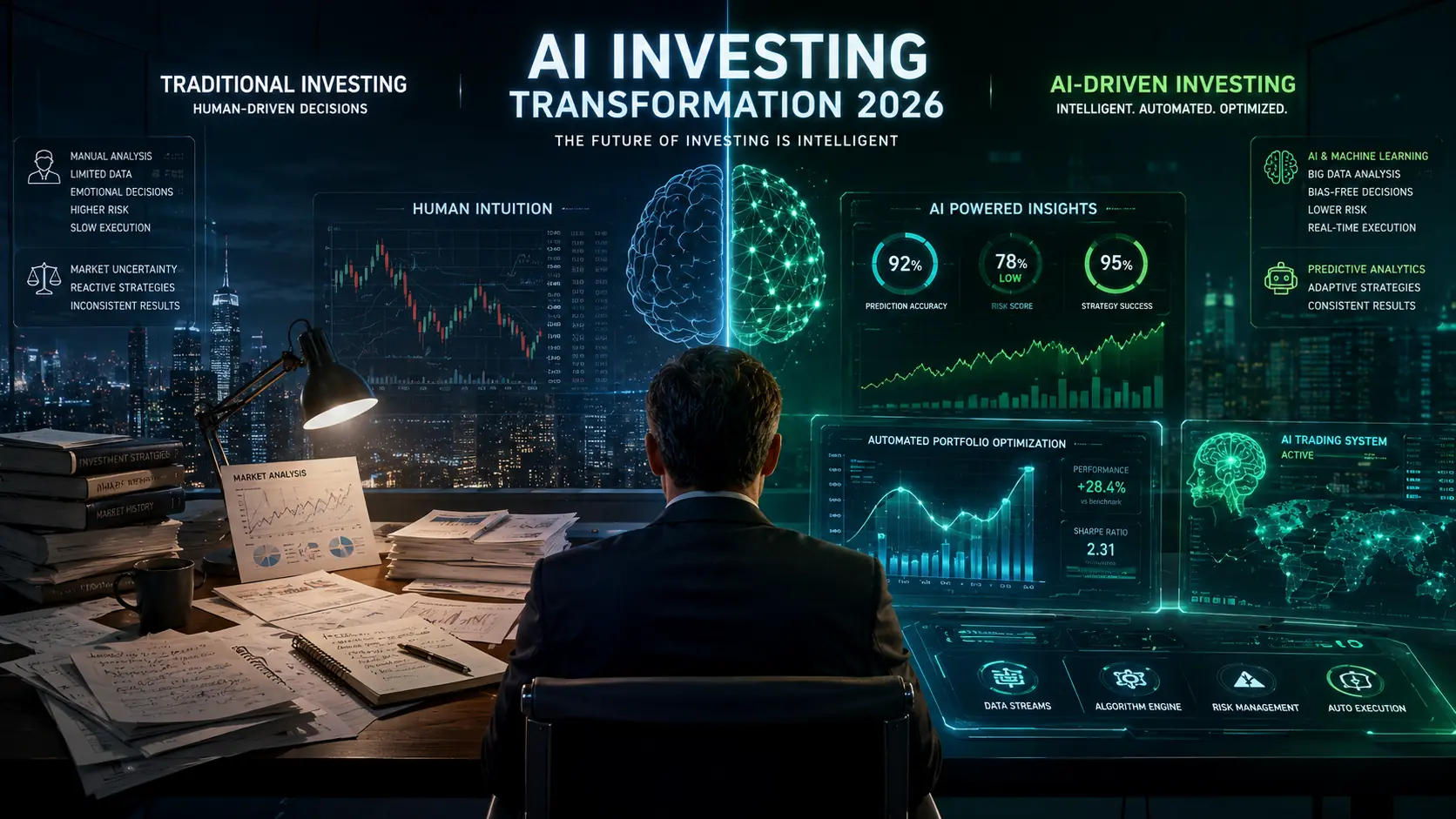
How AI Is Changing Investing in 2026 (From Human Decisions to Smart Algorithms)
Introduction
How AI is changing investing in 2026 is one of the most important financial shifts in modern markets. Artificial intelligence is no longer just an investment sector — it is now actively transforming how investors analyze markets, build portfolios, and make financial decisions.
In 2026, AI is replacing many traditional investing processes with automated systems that can analyze millions of data points in seconds. From hedge funds to retail investors, AI-powered tools are reshaping the way investment strategies are created and executed.
This transformation is not just about picking AI stocks — it is about AI becoming the decision-maker in investing itself.
What makes this shift even more important is the speed at which it is happening. In the past, financial innovation took decades to reshape markets. Today, AI is changing investing behavior in just a few years, making it one of the fastest transformations in financial history.
1. AI Is Replacing Traditional Market Analysis
Before AI, investors relied heavily on manual research and human judgment. This process was slow, emotional, and often incomplete.
Traditional investing methods included:
- Financial reports and balance sheets
- Manual chart and technical analysis
- News interpretation and market sentiment reading
- Human intuition and experience
While these methods are still used today, they are increasingly being enhanced or replaced by AI systems.
Now AI systems can:
- Scan global markets in real time
- Detect hidden patterns across millions of data points
- Analyze sentiment from news, earnings calls, and social media
- Predict risk scenarios and volatility changes
👉 This makes investing significantly faster, more scalable, and more data-driven than ever before.
AI does not eliminate human investors, but it changes their role from “data analyzers” to “strategy decision-makers”.
2. Algorithmic Investing Is Becoming Mainstream
In 2026, algorithmic investing is no longer limited to hedge funds or large financial institutions. It is now widely available to retail investors through modern platforms.
Today, investors can access:
- AI trading bots
- Robo-advisors
- Automated portfolio managers
- AI-powered signal generators
- Smart rebalancing tools
These systems execute trades based on pre-defined algorithms and real-time data instead of emotional decision-making.
👉 The biggest advantage of algorithmic investing is consistency. While humans often react emotionally to market movements, AI follows structured rules without fear or greed.
However, it is important to understand that algorithms are only as good as the data and models behind them.
3. Human Emotion Is Being Reduced in Investing
One of the biggest weaknesses in investing has always been human emotion.
Common emotional mistakes include:
- Panic selling during market crashes
- Greed-driven buying during market bubbles
- Holding losing positions too long
- Overtrading based on fear or hype
AI helps reduce these problems by introducing discipline into the investment process.
It does this by:
- Following strict data-driven rules
- Using probability-based decision models
- Removing emotional bias from trade execution
- Applying consistent risk management strategies
👉 As a result, portfolios become more stable and less influenced by short-term market noise.
However, emotional discipline does not disappear completely — investors still control strategy selection and risk tolerance.
4. AI Is Improving Portfolio Management
Portfolio management has become significantly more efficient thanks to AI systems.
AI now helps investors:
- Build diversified portfolios across sectors
- Optimize risk vs reward ratios
- Rebalance portfolios automatically
- Adjust exposure based on market conditions
- Identify underperforming assets early
This level of automation was previously only available to institutional investors.
👉 In 2026, even individual investors can benefit from institutional-grade portfolio management tools.
AI also enables dynamic portfolio adjustments, meaning portfolios can adapt continuously instead of being manually updated every few months.
5. The Rise of AI Investment Ecosystems
Investing today is no longer limited to buying and selling stocks.
Instead, investors are part of a larger AI-driven financial ecosystem that includes:
- AI ETFs
- AI trading systems
- Smart investing apps
- Predictive analytics platforms
- Automated wealth management tools
👉 This ecosystem connects data, analysis, and execution into one integrated system.
As a result, investors no longer rely on a single method or platform. Instead, they combine multiple AI tools to create a more intelligent investment approach.
Risks of AI-Driven Investing
Despite its advantages, AI investing is not risk-free.
Key risks include:
- Incorrect predictions during unexpected market events
- Over-reliance on automated systems
- Market “black swan” events that AI cannot predict
- Data bias affecting model accuracy
- Technical failures or system errors
👉 AI should be viewed as a decision-support tool, not a guaranteed profit system.
The best investors use AI as an assistant, not a replacement for financial understanding.
Internal Linking
- Best AI Investment Strategy in 2026
- Best AI Stock Analysis Tools in 2026
- AI ETFs vs AI Stocks in 2026
- AI Stock Analysis Tools
- AI Investment Strategy 2026
- AI ETFs vs AI Stocks 2026
FAQ
Is AI replacing human investors?
Not completely. AI is reducing manual analysis, but humans still control strategy and risk decisions.
Can AI predict stock markets accurately?
AI improves analysis and probability modeling, but it cannot guarantee perfect predictions.
Are AI investing tools reliable?
They are useful for decision support, but should not be used blindly without understanding risk.
What is the biggest advantage of AI in investing?
The biggest advantage is speed and data processing, allowing investors to make faster and more informed decisions.
Conclusion
AI is fundamentally transforming investing in 2026. From market analysis to portfolio management, artificial intelligence is becoming an essential part of modern financial systems.
However, the most successful investors are those who combine AI technology with human judgment, discipline, and long-term thinking.
The future of investing is not AI versus humans — it is AI working together with humans to build smarter and more efficient investment strategies.