
Best AI Investment Strategy in 2026 (How to Build a Winning AI Portfolio for Long-Term Growth)
Introduction
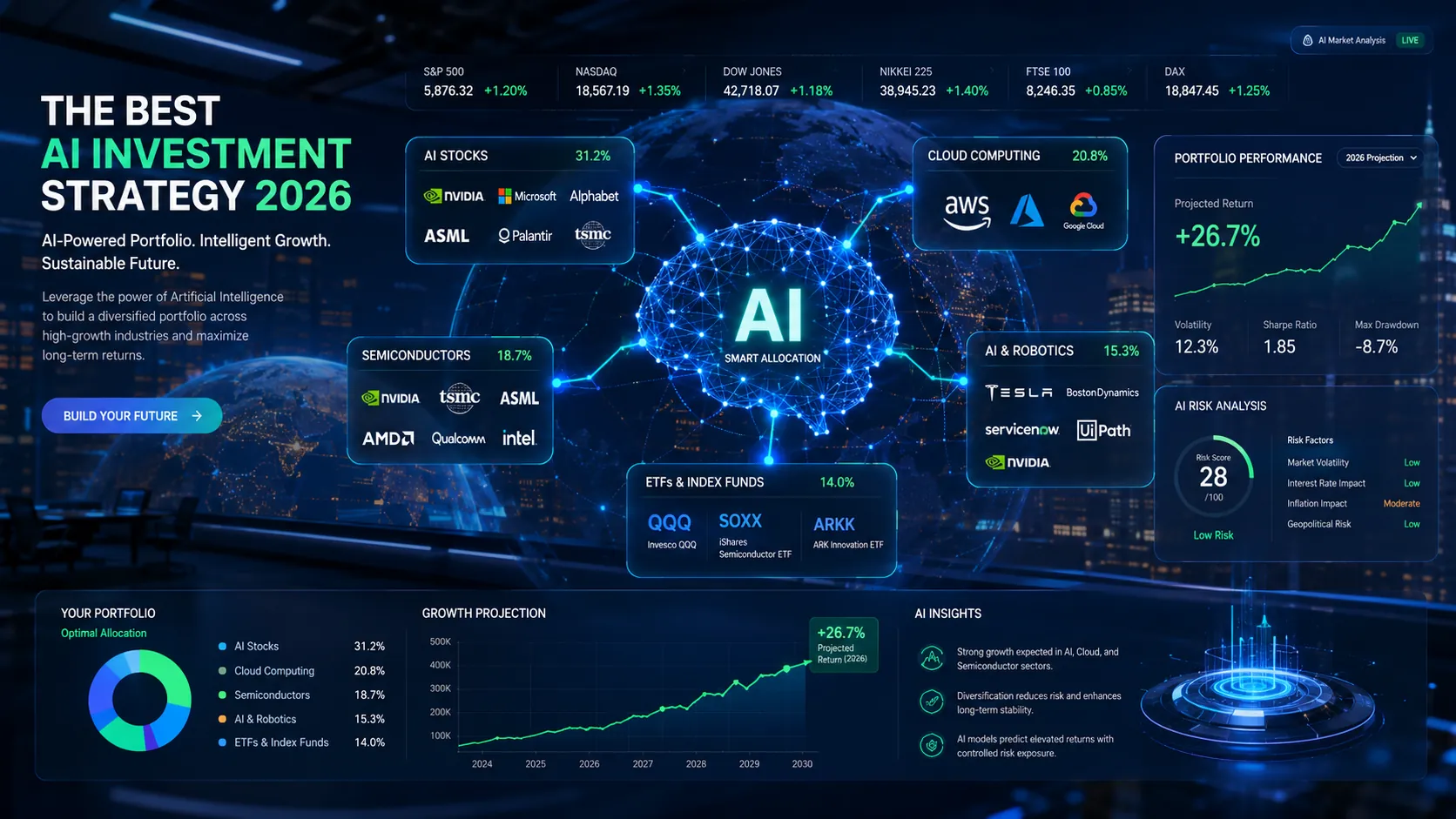
Best AI investment strategy in 2026 is focused on building a diversified, long-term portfolio that captures the explosive growth of artificial intelligence across global markets. AI has evolved into a core economic engine powering cloud computing, semiconductors, robotics, healthcare, and financial systems.
In 2026, artificial intelligence is no longer considered an emerging technology — it has become a fundamental driver of global productivity and corporate profitability. From data centers powering large language models to AI-driven automation in industries like logistics and healthcare, the impact of AI is expanding at an unprecedented speed. As a result, investors are increasingly shifting their focus toward AI-related assets as a key part of long-term wealth building strategies.
However, despite the massive opportunity, many investors still struggle with how to approach this sector properly. The biggest mistake is treating AI investing as short-term speculation rather than a structured, long-term strategy. Many beginners lose money by chasing hype-driven stocks during market rallies, without understanding valuation, business models, or risk exposure.
Another common issue is overconcentration. Investors often put too much capital into a single high-performing company or trend, such as semiconductor leaders or popular AI software stocks. While these companies may continue to grow, relying on a single segment increases volatility and exposes the portfolio to unnecessary risk.
A successful approach to AI investing in 2026 requires a clear framework. Instead of focusing on individual stock predictions, investors should think in terms of an ecosystem. This includes AI infrastructure companies that provide computing power, cloud platforms that host AI models, and software companies that apply AI to real-world use cases. Diversification across these layers helps reduce risk while maintaining exposure to long-term growth potential.
Additionally, AI investing should not be driven purely by hype cycles or media attention. The most effective investors focus on fundamentals such as revenue growth, profitability, competitive advantage, and technological leadership. Companies with strong balance sheets and real AI adoption are more likely to survive and dominate over the long term.
This guide explains a clear and practical AI investment strategy in 2026 designed to help investors build sustainable wealth. It focuses on structured portfolio allocation, risk management, and long-term thinking rather than short-term speculation. By following a disciplined approach, investors can better position themselves to benefit from one of the most transformative technological revolutions in modern history.
Ultimately, the goal is not just to invest in AI, but to invest in the entire AI ecosystem in a balanced and intelligent way that supports long-term financial growth while minimizing unnecessary risk.
Core AI Investment Strategy (2026 Framework)
A strong AI portfolio should be divided into three layers:
1. AI Infrastructure (Core Holdings)
These companies power the AI revolution:
- NVIDIA (AI chips & GPUs)
- Microsoft (Azure cloud + AI ecosystem)
- Amazon (AWS infrastructure)
- Alphabet (AI research + cloud services)
👉 These are long-term “foundation stocks”.
2. AI Growth Layer
Companies using AI to scale revenue:
- Meta Platforms (AI advertising systems)
- Enterprise SaaS companies integrating AI
- Cloud-based AI solution providers
3. High-Risk AI Opportunities
- AI ETFs (diversified exposure)
- Early-stage AI startups
- Robotics & automation niche companies
Example AI Portfolio (2026)
A balanced strategy could look like:
- 50% AI infrastructure stocks
- 30% AI growth companies
- 20% AI ETFs & high-risk plays
👉 This balance reduces risk while keeping upside potential.
Key Mistakes to Avoid
- Investing only in hype-driven AI stocks
- No diversification across sectors
- Ignoring valuation metrics
- Emotional buying during market spikes
Useful Resources (Internal + External Links)
Internal Links
- Best AI Stocks to Buy in 2026
- Top AI ETFs to Buy in 2026
- Microsoft Stock Forecast 2026
- NVIDIA Stock Forecast 2026
External References
- https://www.mckinsey.com/capabilities/quantumblack/our-insights
- https://www.cnbc.com/ai-artificial-intelligence/
FAQ (Frequently Asked Questions)
1. What is the best AI investment strategy in 2026?
The best AI investment strategy in 2026 is a diversified portfolio combining AI infrastructure stocks, growth companies, and AI ETFs to balance risk and long-term returns.
2. Are AI stocks safe for long-term investment?
AI stocks can be volatile in the short term, but companies with strong fundamentals like NVIDIA, Microsoft, and Amazon are considered suitable for long-term investing.
3. Should I invest in AI stocks or AI ETFs?
AI stocks offer higher returns but higher risk, while AI ETFs provide diversification and stability. A combination of both is usually the best approach.
4. How much should I invest in AI?
It depends on your risk tolerance, but many investors allocate 10%–40% of their portfolio to AI-related investments.
5. Will AI continue to grow in the future?
Yes, AI is expected to remain one of the strongest long-term growth sectors driven by automation, cloud computing, and data-driven technologies.
Conclusion
The best AI investment strategy 2026 is not about picking random stocks — it’s about building a structured, diversified portfolio that captures the entire AI ecosystem. Investors who focus on long-term fundamentals rather than short-term hype are more likely to benefit from the AI revolution.