
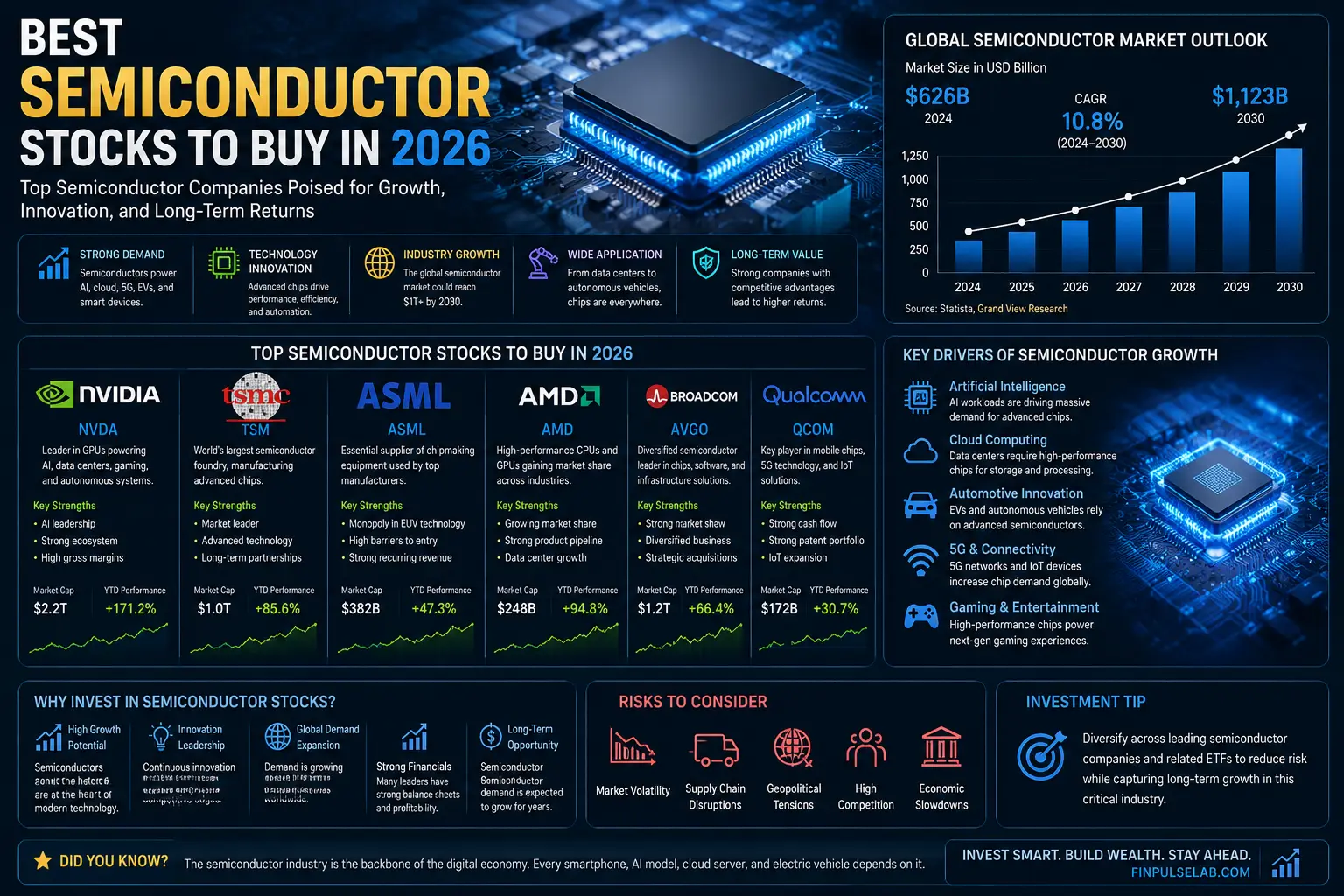
Best Semiconductor Stocks to Buy in 2026 (AI Chip Boom Investment Guide)
Introduction
The best semiconductor stocks to buy in 2026 are at the center of one of the most powerful investment trends in the technology sector.
Artificial intelligence is driving enormous demand for GPUs, AI accelerators, high-bandwidth memory, advanced networking chips, semiconductor manufacturing equipment, and leading-edge foundry capacity.
But the AI semiconductor opportunity extends far beyond NVIDIA.
Every AI data center requires an entire ecosystem of chips and technologies. Advanced processors must be manufactured by foundries, connected through high-speed networking, supplied with high-bandwidth memory, and produced using some of the most sophisticated equipment ever developed.
That creates investment opportunities across multiple parts of the semiconductor supply chain.
In this guide, we compare six of the best semiconductor stocks to buy in 2026: NVIDIA, Taiwan Semiconductor Manufacturing, Broadcom, AMD, ASML, and Micron Technology.
We also examine the AI semiconductor stocks outlook for 2026, the major investment trends driving the industry, and the risks investors should consider before buying semiconductor stocks.
Why Semiconductor Stocks Matter in 2026
Semiconductors are the foundation of the modern digital economy.
Chips power smartphones, computers, cloud platforms, automobiles, industrial equipment, telecommunications networks, robotics, and artificial intelligence.
In 2026, however, AI infrastructure has become one of the industry’s most important growth engines.
AI Computing Demand
Training and running advanced AI models requires enormous computing power.
This demand has accelerated investment in:
- GPUs
- AI accelerators
- Custom AI chips
- High-bandwidth memory
- Advanced packaging
- High-speed networking
- Leading-edge semiconductor manufacturing
Hyperscalers and technology companies continue investing heavily in infrastructure capable of training and serving increasingly sophisticated AI models.
High-Bandwidth Memory
AI accelerators require enormous quantities of data to be transferred rapidly between memory and processors.
High-bandwidth memory, commonly known as HBM, has therefore become a critical component of AI infrastructure.
This trend creates opportunities for memory manufacturers such as Micron.
Advanced Semiconductor Manufacturing
The most advanced AI chips require leading-edge manufacturing processes.
Producing these chips requires enormous technical expertise and billions of dollars of capital investment.
Taiwan Semiconductor Manufacturing plays a central role in this ecosystem by manufacturing advanced processors for many leading chip designers.
Semiconductor Equipment
Chip manufacturers cannot produce increasingly advanced processors without sophisticated manufacturing equipment.
ASML occupies an especially important position because its extreme ultraviolet lithography systems are essential for manufacturing many leading-edge semiconductors.
AI Networking
Thousands of accelerators inside AI data centers need to communicate extremely quickly.
This creates demand for networking semiconductors, switches, connectivity technologies, and custom accelerators.
Broadcom is particularly exposed to this part of the AI infrastructure market.
Best Semiconductor Stocks to Buy in 2026 at a Glance
| Company | Ticker | Primary Semiconductor Exposure | Best For |
|---|---|---|---|
| NVIDIA | NVDA | GPUs & AI accelerators | AI computing leadership |
| TSMC | TSM | Advanced chip manufacturing | Foundry exposure |
| Broadcom | AVGO | AI networking & custom chips | Diversified AI infrastructure |
| AMD | AMD | CPUs, GPUs & AI accelerators | AI challenger |
| ASML | ASML | Semiconductor manufacturing equipment | Chip equipment |
| Micron Technology | MU | DRAM & high-bandwidth memory | AI memory |
Each company occupies a different position within the semiconductor ecosystem.
That distinction is important because investors do not need to predict a single winner in AI to gain exposure to semiconductor growth.
1. NVIDIA (NASDAQ: NVDA) — Best AI Semiconductor Stock
NVIDIA has become the defining company of the AI semiconductor boom.
Its GPUs are widely used for training and running artificial intelligence models in data centers around the world.
But NVIDIA’s competitive advantage extends beyond individual chips.
Why NVIDIA Leads AI Computing
NVIDIA has built an integrated computing ecosystem combining:
- GPUs
- Networking
- Systems
- CUDA software
- AI libraries
- Enterprise software
- Developer tools
CUDA is particularly important.
Developers have spent years building AI applications around NVIDIA’s software ecosystem, creating substantial switching costs and strengthening the company’s competitive position.
AI Data Center Opportunity
AI infrastructure requires increasingly powerful computing clusters.
NVIDIA has responded by developing complete data-center architectures rather than selling only individual GPUs.
This strategy allows the company to capture more value from AI infrastructure spending.
Growth Drivers
NVIDIA’s major long-term catalysts include:
- Generative AI
- AI inference
- AI agents
- Cloud computing
- Sovereign AI infrastructure
- Enterprise AI
- Robotics
- Autonomous systems
Inference could become particularly important as AI applications move from model development toward everyday deployment.
Every interaction with an AI assistant, agent, search system, or generative application requires computing resources.
NVIDIA Risks
NVIDIA’s enormous success also creates substantial expectations.
Potential risks include:
- Premium valuation
- Competition from AMD
- Custom chips developed by hyperscalers
- Export restrictions
- Supply constraints
- Slower AI capital expenditure
- Rapid technological change
NVIDIA remains one of the strongest AI semiconductor businesses, but investors should distinguish between an exceptional company and an attractive stock valuation.
2. Taiwan Semiconductor Manufacturing (NYSE: TSM) — Best Semiconductor Foundry Stock
Taiwan Semiconductor Manufacturing Company, commonly known as TSMC, is the world’s leading dedicated semiconductor foundry.
Instead of designing most chips itself, TSMC manufactures semiconductors designed by other companies.
Its customers include many of the world’s largest technology and semiconductor businesses.
Why TSMC Is Critical to AI
Leading AI chip designers depend on advanced manufacturing capacity.
Building a cutting-edge semiconductor fabrication ecosystem requires enormous capital investment, engineering expertise, process technology, and manufacturing scale.
TSMC’s technological leadership makes the company one of the most important businesses in the global AI supply chain.
Advanced Manufacturing
The semiconductor industry continues transitioning toward smaller and more advanced manufacturing nodes.
These processes can improve performance and energy efficiency, characteristics that are especially important for AI computing.
TSMC’s ability to manufacture leading-edge chips provides exposure to demand across multiple chip designers.
Advanced Packaging
AI systems increasingly require sophisticated packaging technologies capable of integrating processors and memory.
Advanced packaging has therefore become another important component of semiconductor manufacturing.
This provides TSMC with exposure not only to wafer fabrication but also to increasingly complex AI chip architectures.
Why Investors May Prefer TSMC
One advantage of TSMC is diversification across chip designers.
Instead of betting exclusively on NVIDIA or AMD, investors receive exposure to manufacturing demand from multiple semiconductor customers.
TSMC Risks
The largest risk is geopolitical.
Taiwan’s strategic importance to the semiconductor supply chain creates significant geopolitical uncertainty.
Other risks include:
- Enormous capital expenditure requirements
- Semiconductor cycles
- Customer concentration
- Manufacturing complexity
- International expansion costs
For investors comfortable with geopolitical risk, TSMC remains one of the most strategically important semiconductor companies in the world.
3. Broadcom (NASDAQ: AVGO) — Best AI Networking and Custom Chip Stock
Broadcom has become one of the most important beneficiaries of AI infrastructure spending outside the GPU market.
The company develops networking semiconductors, connectivity technologies, and custom AI accelerators for large technology customers.
Why Networking Matters for AI
Modern AI data centers can contain thousands of accelerators.
Those processors need to communicate with extremely low latency and enormous bandwidth.
Networking infrastructure therefore becomes increasingly important as AI clusters grow larger.
Broadcom provides technologies used to connect these systems.
Custom AI Accelerators
Large cloud companies are increasingly developing specialized processors optimized for their own AI workloads.
Broadcom participates in this trend by helping hyperscale customers develop custom accelerators.
Custom chips could become an increasingly important complement to general-purpose GPUs.
Diversified Business Model
Broadcom also provides semiconductor technologies across:
- Networking
- Broadband
- Wireless
- Storage
- Connectivity
Its acquisition of VMware added a major infrastructure software business.
This diversification differentiates Broadcom from more concentrated semiconductor companies.
Broadcom Risks
Broadcom’s AI opportunity is significant, but investors should consider:
- Customer concentration
- Premium valuation
- Dependence on hyperscaler spending
- Integration of large acquisitions
- Competition in networking and custom silicon
Broadcom provides one of the broadest ways to invest in AI infrastructure beyond GPUs.
4. AMD (NASDAQ: AMD) — Best NVIDIA Challenger
Advanced Micro Devices has developed into one of NVIDIA’s most important competitors in AI accelerators while maintaining strong positions in CPUs and other computing markets.
AMD’s investment case is based partly on the possibility that customers want alternatives to NVIDIA.
AI Accelerator Opportunity
AMD’s Instinct accelerator portfolio targets AI and high-performance computing workloads.
Large cloud providers and enterprises increasingly want multiple hardware options to reduce dependence on a single supplier.
That creates an opportunity for AMD.
Data Center CPUs
AMD also competes in server processors through its EPYC portfolio.
This is strategically important because AI data centers require both accelerators and traditional CPUs.
AMD can therefore participate in multiple parts of data-center computing.
Competitive Advantage
AMD has demonstrated an ability to compete successfully against much larger semiconductor companies.
Its combination of:
- CPUs
- GPUs
- AI accelerators
- Adaptive computing
provides diversified exposure to next-generation computing.
AMD Risks
AMD still faces a significant challenge in AI software.
NVIDIA’s CUDA ecosystem provides a powerful competitive moat.
AMD must continue improving its software environment while convincing developers and cloud customers to deploy its accelerators at scale.
Other risks include intense competition, valuation, and rapid product cycles.
5. ASML (NASDAQ: ASML) — Best Semiconductor Equipment Stock
ASML occupies one of the most unusual competitive positions in the entire semiconductor industry.
The company is the only supplier of extreme ultraviolet lithography systems used to manufacture many of the world’s most advanced semiconductors.
Why ASML Is Essential
Semiconductor manufacturers need lithography equipment to create extremely small patterns on silicon wafers.
As chip designs become more advanced, manufacturing complexity increases dramatically.
EUV technology allows semiconductor manufacturers to produce leading-edge processors used in AI, smartphones, and high-performance computing.
High-NA EUV
ASML is also developing and deploying High-NA EUV technology.
These systems are designed to support future generations of advanced semiconductor manufacturing.
If leading-edge chip complexity continues increasing, advanced lithography should remain strategically important.
2026 Semiconductor Demand
AI infrastructure spending is strengthening demand across the semiconductor manufacturing ecosystem.
ASML reported €8.8 billion in first-quarter 2026 net sales and said customers were accelerating capacity expansion plans as demand for chips outpaced supply.
The company subsequently expected 2026 net sales of approximately €36 billion to €40 billion.
ASML Risks
ASML faces several important risks:
- Export restrictions
- China exposure
- Semiconductor capital expenditure cycles
- Extremely complex manufacturing
- Customer concentration
- Geopolitical tensions
However, replicating ASML’s technological capabilities would be extraordinarily difficult.
That makes ASML one of the semiconductor industry’s most important infrastructure companies.
6. Micron Technology (NASDAQ: MU) — Best AI Memory Stock
Micron Technology provides exposure to one of the most important components of AI computing: memory.
AI accelerators need enormous memory bandwidth to process large datasets efficiently.
This has made high-bandwidth memory one of the most strategically important semiconductor products.
Why HBM Matters
Traditional computing systems transfer information between processors and memory.
AI workloads require dramatically larger quantities of data to move quickly.
HBM is designed to provide much greater bandwidth than conventional memory architectures.
As AI accelerators become more powerful, memory requirements can increase alongside computing performance.
Micron’s AI Opportunity
Micron participates in several memory markets, including:
- DRAM
- NAND
- Data-center memory
- High-bandwidth memory
AI infrastructure provides an important growth catalyst for HBM and advanced data-center memory.
Memory Cycle
Micron is different from NVIDIA or ASML because memory historically experiences significant supply-and-demand cycles.
Periods of tight supply can produce strong pricing and profitability.
However, excessive industry capacity can eventually pressure prices.
Micron Risks
Major risks include:
- Memory pricing cycles
- Capital-intensive manufacturing
- Competition
- Supply expansions
- Customer concentration
- Geopolitical exposure
Micron therefore provides potentially powerful AI exposure but generally carries greater cyclical risk.
AI Semiconductor Stocks Outlook for 2026
The AI semiconductor stocks outlook for 2026 remains closely tied to infrastructure investment.
The semiconductor opportunity is no longer limited to GPUs.
AI systems require an increasingly complex stack of technologies.
AI Accelerators
GPUs and specialized accelerators provide the computational power behind AI models.
NVIDIA currently occupies a leading position, while AMD and custom silicon providers create additional competition.
AI Inference
The first phase of generative AI focused heavily on training large models.
As AI applications reach more users, inference becomes increasingly important.
Inference occurs whenever a trained model processes new information and generates an output.
Large-scale deployment of AI assistants and agents could therefore create substantial ongoing semiconductor demand.
High-Bandwidth Memory
AI accelerators require increasingly sophisticated memory.
HBM has emerged as one of the semiconductor industry’s most important AI-related product categories.
This trend directly benefits memory manufacturers such as Micron.
Advanced Packaging
AI processors increasingly combine multiple components within sophisticated packages.
Advanced packaging capacity is becoming an important part of the semiconductor supply chain.
AI Networking
Larger AI clusters require faster communication between processors.
This creates opportunities for companies such as Broadcom that provide high-speed networking technologies.
Leading-Edge Manufacturing
More powerful AI processors require increasingly sophisticated semiconductor manufacturing.
TSMC and ASML provide two different ways to gain exposure to this trend.
Major AI Semiconductor Investment Trends in 2026
Search interest around AI semiconductor investment trends in 2026 reflects how quickly the industry is changing.
Several themes deserve particular attention.
1. AI Spending Is Expanding Beyond GPUs
GPUs remain critical, but AI infrastructure spending increasingly extends into:
- Memory
- Networking
- Storage
- Custom accelerators
- Advanced packaging
- Foundry capacity
- Semiconductor equipment
Investors should therefore think about AI as an ecosystem rather than a single-chip market.
2. Custom AI Chips Are Growing
Large technology companies increasingly design specialized processors for their own workloads.
Custom silicon can improve performance, power efficiency, and economics for specific applications.
This creates both an opportunity and a competitive threat for traditional chip designers.
3. Power Efficiency Is Becoming Critical
AI data centers consume substantial electricity.
Future processors will need to deliver greater computing performance without proportional increases in power consumption.
Energy efficiency could therefore become an increasingly important competitive differentiator.
4. HBM Is Becoming Strategically Important
Memory bandwidth can limit AI system performance.
As accelerator performance increases, advanced memory becomes increasingly valuable.
This makes HBM one of the most important semiconductor investment themes in 2026.
5. Semiconductor Manufacturing Capacity Is Expanding
AI demand is encouraging chip manufacturers to expand advanced manufacturing and packaging capacity.
That creates opportunities for foundries and semiconductor equipment companies.
Semiconductor Stocks Comparison
| Stock | AI Exposure | Competitive Position | Cyclicality | Key Risk |
|---|---|---|---|---|
| NVIDIA | Very High | AI accelerator leader | Moderate | Valuation & competition |
| TSMC | Very High | Leading foundry | Moderate | Geopolitics |
| Broadcom | Very High | Networking & custom silicon | Moderate | Customer concentration |
| AMD | High | AI challenger | High | NVIDIA competition |
| ASML | High | EUV lithography leader | Moderate | Export restrictions |
| Micron | High | AI memory/HBM | Very High | Memory cycle |
There is no universally « best » semiconductor stock.
The appropriate choice depends on an investor’s risk tolerance and preferred exposure within the semiconductor supply chain.
How to Invest in Semiconductor Stocks in 2026
For AI Growth Exposure
NVIDIA provides the most concentrated exposure among these companies to AI accelerated computing.
AMD provides a higher-risk alternative for investors expecting greater competition in AI accelerators.
For Semiconductor Manufacturing
TSMC provides exposure to leading-edge manufacturing across multiple chip designers.
For AI Infrastructure Beyond GPUs
Broadcom provides exposure to networking and custom AI silicon.
For Semiconductor Equipment
ASML provides exposure to the manufacturing equipment required for advanced chips.
For AI Memory
Micron provides direct exposure to HBM and the broader memory cycle.
For Diversification
Investors who do not want to select individual semiconductor companies may prefer diversified semiconductor ETFs.
This can reduce company-specific risk while maintaining exposure to the industry’s long-term growth.
Key Risks of Semiconductor Stocks
Semiconductor stocks can generate substantial returns, but the industry carries important risks.
Valuation Risk
AI-related stocks can trade at high valuation multiples.
Even strong earnings growth may not prevent share-price declines if investor expectations become too optimistic.
Semiconductor Cycles
Parts of the semiconductor industry remain cyclical.
Periods of shortages can encourage capacity expansion, eventually creating oversupply.
Geopolitical Risk
The semiconductor supply chain spans Taiwan, the United States, Europe, South Korea, Japan, China, and other regions.
Trade restrictions or geopolitical conflicts can disrupt supply chains.
Export Controls
Advanced semiconductor technologies increasingly face government restrictions.
These regulations can affect sales opportunities for chip designers and equipment manufacturers.
Competition
The AI semiconductor market is attracting enormous investment.
NVIDIA faces AMD and custom accelerators.
Foundries compete for advanced manufacturing.
Memory manufacturers compete aggressively on capacity and technology.
AI Spending Risk
Current semiconductor demand depends partly on enormous AI infrastructure spending.
If hyperscalers reduce capital expenditures or AI monetization disappoints, semiconductor growth expectations could weaken.
Semiconductor Stocks vs. Semiconductor ETFs
Investors can gain exposure to the semiconductor industry through individual stocks or ETFs.
Individual Semiconductor Stocks
Advantages
- Greater potential upside
- Ability to select specific AI themes
- Direct exposure to preferred companies
Disadvantages
- Greater company-specific risk
- Higher volatility
- More research required
Semiconductor ETFs
Advantages
- Instant diversification
- Exposure across multiple chip companies
- Lower company-specific risk
Disadvantages
- Expense ratios
- Less control over holdings
- Exposure to companies investors may not want to own
For newer investors, diversified semiconductor ETFs may provide a simpler way to participate in long-term industry growth.
Final Verdict: Are Semiconductor Stocks a Buy in 2026?
Semiconductors remain one of the most important investment themes of 2026.
Artificial intelligence is increasing demand across the entire semiconductor ecosystem, including processors, memory, networking, advanced packaging, foundries, and manufacturing equipment.
Among the companies covered in this guide:
- NVIDIA provides leading exposure to AI accelerated computing.
- TSMC provides exposure to advanced semiconductor manufacturing.
- Broadcom combines AI networking with custom silicon.
- AMD provides a challenger opportunity in AI accelerators and data-center computing.
- ASML provides exposure to critical semiconductor manufacturing equipment.
- Micron provides exposure to AI memory and HBM.
Investors should not assume that every semiconductor stock will perform equally well.
Valuation, competition, technological leadership, geopolitics, and semiconductor cycles remain important.
However, if AI computing continues expanding across cloud platforms, enterprises, governments, robotics, and consumer applications, semiconductor infrastructure could remain one of the most important areas of technology investment throughout 2026 and beyond.
Frequently Asked Questions
What are the best semiconductor stocks to buy in 2026?
Some of the leading semiconductor companies investors may research in 2026 include NVIDIA, TSMC, Broadcom, AMD, ASML, and Micron Technology.
Each company provides exposure to a different part of the semiconductor and AI infrastructure ecosystem.
What are the top AI semiconductor stocks in 2026?
NVIDIA has leading exposure to AI accelerators, while AMD provides an alternative accelerator platform. Broadcom provides exposure to AI networking and custom chips, Micron to high-bandwidth memory, TSMC to advanced manufacturing, and ASML to semiconductor manufacturing equipment.
What is the AI semiconductor outlook for 2026?
AI remains a major source of semiconductor demand in 2026.
Growth is expanding beyond GPUs into HBM, networking, custom accelerators, advanced packaging, foundry capacity, and semiconductor manufacturing equipment.
Which semiconductor stock benefits most from AI?
NVIDIA has among the most direct exposures to AI computing because of its position in GPUs, accelerators, networking, and AI software.
However, companies such as Broadcom, TSMC, Micron, AMD, and ASML can benefit from different parts of the AI infrastructure buildout.
Is TSMC a good way to invest in AI chips?
TSMC manufactures advanced processors for multiple semiconductor designers.
This means investors can gain exposure to overall advanced-chip manufacturing demand rather than relying exclusively on one chip designer.
The major risk is geopolitical uncertainty surrounding Taiwan.
Why is ASML important to the semiconductor industry?
ASML supplies EUV lithography systems required for manufacturing many advanced semiconductors.
Its technology gives the company a strategically important position within the global semiconductor supply chain.
Why is HBM important for AI?
High-bandwidth memory allows enormous quantities of data to move rapidly between memory and AI processors.
As AI accelerators become more powerful, memory bandwidth becomes increasingly important.
Are semiconductor stocks risky?
Yes.
Semiconductor stocks face risks from high valuations, industry cycles, competition, export restrictions, geopolitical tensions, capital expenditure requirements, and changes in AI infrastructure spending.
Should beginners buy individual semiconductor stocks?
Beginners can invest in semiconductor companies, but individual stocks can be volatile.
A diversified semiconductor ETF may be more appropriate for investors who want industry exposure without relying heavily on one company.
Related Investing Guides
Continue your research with:
- AI Stocks to Buy in 2026
- NVIDIA Stock Forecast 2026
- Top AI Stocks to Watch This Month
- Microsoft Stock Forecast 2026
- AI ETFs to Buy in 2026
- Cloud Computing Stocks in 2026
Disclaimer: This article is for informational and educational purposes only and does not constitute financial advice. Always conduct your own research and consider your financial situation and risk tolerance before investing.