
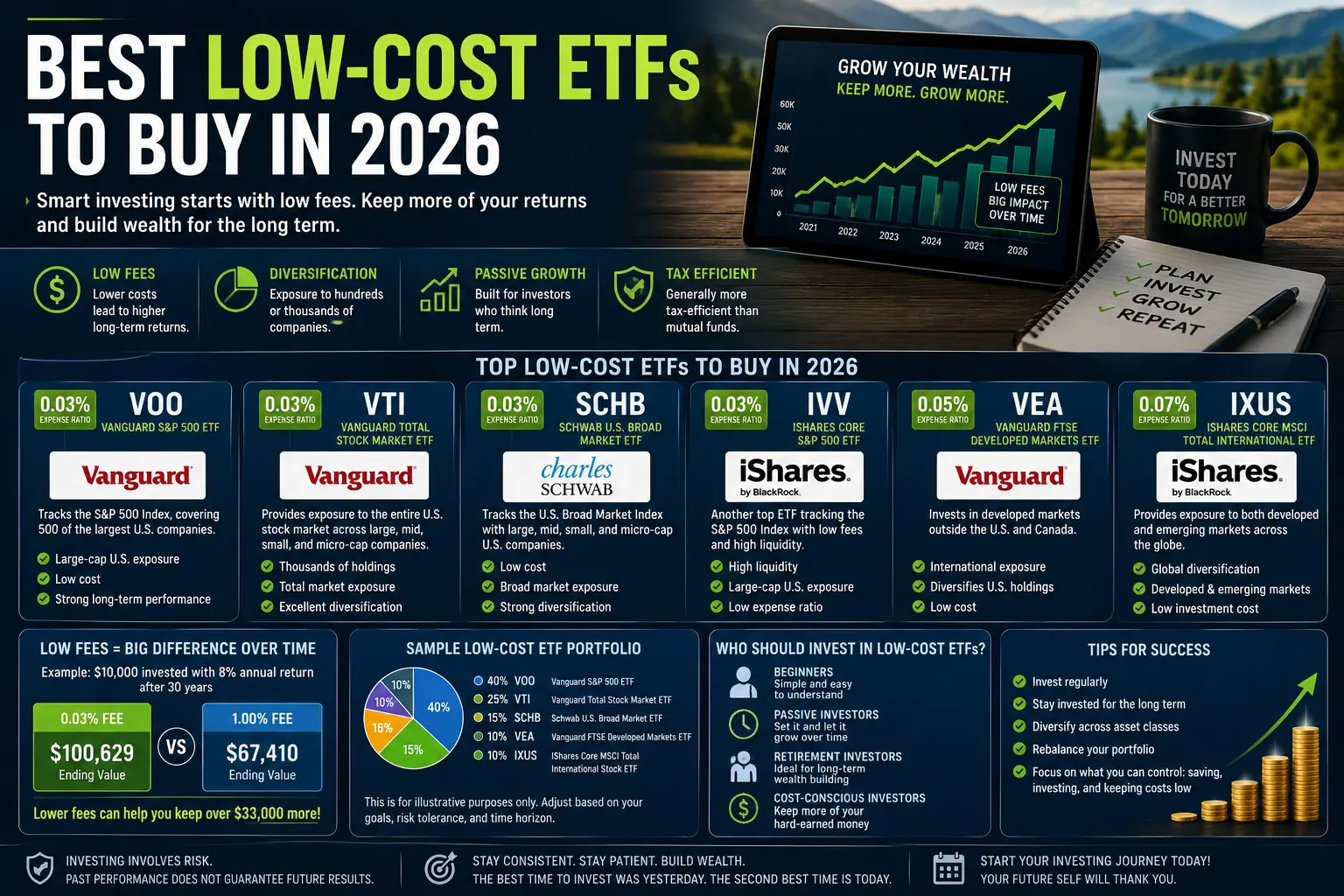
Best Low-Cost ETFs to Buy in 2026
Introduction
Low-Cost ETFs to Buy in 2026 are becoming increasingly popular among investors looking to build wealth while minimizing investment expenses. Exchange-Traded Funds (ETFs) offer diversification, simplicity, and low management fees, making them one of the best investment vehicles for long-term investors.
One of the biggest advantages of ETFs is their low expense ratio. Over time, lower fees can significantly improve investment returns, especially when combined with compound growth.
In this guide, we explore some of the best low-cost ETFs to buy in 2026, discuss their benefits, and explain why cost-efficient investing can play an important role in long-term financial success.
👉 Related article:
Best ETFs for Retirement Investing in 2026
Why Low-Cost ETFs Matter
Many investors focus primarily on returns while overlooking investment costs.
Even small fees can reduce portfolio performance over decades.
Example
Imagine two investors earning the same annual return.
- Investor A pays 0.03% annually
- Investor B pays 1.00% annually
After many years, Investor A may keep significantly more of their investment gains simply because of lower fees.
This is why low-cost ETFs remain attractive for long-term investors.
What Is an Expense Ratio?
The expense ratio represents the annual fee charged by an ETF.
For example:
- 0.03% expense ratio = $3 annually per $10,000 invested
- 1.00% expense ratio = $100 annually per $10,000 invested
Lower expense ratios generally allow investors to retain more of their returns.
Benefits of Investing in Low-Cost ETFs
Diversification
Most ETFs hold dozens, hundreds, or even thousands of securities.
Lower Fees
Reduced costs help maximize long-term returns.
Simplicity
ETFs provide broad market exposure through a single investment.
Long-Term Growth
Many low-cost ETFs track major indexes with strong historical performance.
Accessibility
Most investors can start with relatively small amounts of money.
Best Low-Cost ETFs to Buy in 2026
Vanguard S&P 500 ETF (VOO)
VOO tracks the S&P 500 Index and remains one of the most popular ETFs in the world.
Key Advantages
- Extremely low expense ratio
- Exposure to 500 large U.S. companies
- Strong long-term performance
Top Holdings
- Microsoft
- Apple
- Nvidia
- Amazon
- Alphabet
Ideal For
Investors seeking broad exposure to the U.S. stock market.
Vanguard Total Stock Market ETF (VTI)
VTI provides exposure to nearly the entire U.S. stock market.
Key Advantages
- Thousands of holdings
- Excellent diversification
- Low expense ratio
Ideal For
Investors looking for maximum diversification through a single ETF.
Schwab U.S. Broad Market ETF (SCHB)
SCHB tracks a broad index of U.S. companies.
Key Advantages
- Low management fees
- Broad market exposure
- Strong diversification
Ideal For
Long-term investors building low-cost portfolios.
iShares Core S&P 500 ETF (IVV)
IVV is another low-cost ETF tracking the S&P 500.
Key Advantages
- Competitive expense ratio
- High liquidity
- Exposure to leading U.S. companies
Ideal For
Investors seeking an alternative to VOO.
Vanguard FTSE Developed Markets ETF (VEA)
VEA focuses on developed international markets.
Key Advantages
- International diversification
- Low expense ratio
- Exposure to global economies
Ideal For
Investors seeking diversification beyond the United States.
iShares Core MSCI Total International Stock ETF (IXUS)
IXUS provides broad international exposure.
Key Advantages
- Developed and emerging markets
- Global diversification
- Low investment costs
Ideal For
Building a globally diversified portfolio.
Low-Cost ETFs vs Actively Managed Funds
Many actively managed funds charge higher fees.
Low-Cost ETFs
Benefits:
- Lower fees
- Greater transparency
- Tax efficiency
- Broad diversification
Actively Managed Funds
Benefits:
- Professional management
- Potential outperformance
However, many actively managed funds struggle to consistently outperform low-cost index ETFs after fees.
Sample Low-Cost ETF Portfolio
A simple diversified portfolio might look like:
40%
VOO
25%
VTI
15%
SCHB
10%
VEA
10%
IXUS
This allocation provides broad exposure to U.S. and international markets.
How Low Fees Improve Long-Term Returns
Scenario 1
Investment:
$10,000
Annual Return:
8%
Expense Ratio:
0.03%
Scenario 2
Investment:
$10,000
Annual Return:
8%
Expense Ratio:
1%
Over several decades, the investor paying lower fees may accumulate significantly more wealth.
This demonstrates the power of minimizing investment expenses.
Risks of ETF Investing
Although ETFs are generally considered diversified investments, risks still exist.
Market Risk
Stock markets can decline during economic downturns.
International Risk
Global ETFs may be affected by foreign market conditions.
Sector Concentration
Some ETFs focus heavily on specific industries.
Volatility
Short-term price fluctuations are normal.
Investors should maintain a long-term perspective.
Are Low-Cost ETFs Good for Beginners?
Yes.
Low-cost ETFs are often considered one of the best investment options for beginners because they offer:
- Diversification
- Simplicity
- Low fees
- Long-term growth potential
Many successful investors use ETFs as the foundation of their portfolios.
Who Should Invest in Low-Cost ETFs?
Low-cost ETFs may be suitable for:
Beginners
Simple and diversified investing.
Retirement Investors
Long-term wealth accumulation.
Passive Investors
Minimal portfolio maintenance.
Long-Term Investors
Focus on steady growth over decades.
Market Outlook for 2026
Several factors continue supporting ETF growth.
Increased ETF Adoption
More investors are choosing ETFs over traditional mutual funds.
Growing Financial Education
Investors increasingly understand the importance of low fees.
Technology and AI Growth
Many broad-market ETFs benefit from technology leaders driving innovation.
Long-Term Investing Trends
Passive investing continues gaining popularity worldwide.
Final Thoughts
Low-Cost ETFs to Buy in 2026 remain among the most effective tools for building long-term wealth. Funds such as VOO, VTI, SCHB, IVV, VEA, and IXUS provide diversified exposure to major markets while keeping investment costs low.
For investors seeking a simple, efficient, and cost-effective investment strategy, low-cost ETFs can serve as the foundation of a successful long-term portfolio.
FAQ
What is the best low-cost ETF in 2026?
Many investors consider VOO and VTI among the best low-cost ETFs because of their low expense ratios and broad diversification.
Are low-cost ETFs good for beginners?
Yes. They provide diversification, simplicity, and low fees.
Why are expense ratios important?
Lower expense ratios help investors keep more of their returns over time.
Can low-cost ETFs generate passive income?
Some ETFs pay dividends that can provide passive income.
How much money do I need to start investing in ETFs?
Many brokers allow investors to start with as little as $100 using fractional shares.