Best Index Funds for Beginners in 2026 (Simple Guide to Long-Term Investing)
Introduction
Best Index Funds for Beginners in 2026 are becoming increasingly popular among new investors looking for a simple and effective way to build long-term wealth. Instead of trying to pick individual stocks, many beginners choose index funds because they offer diversification, lower costs, and a passive investing approach.
Whether you are investing your first $100 or building a larger portfolio, index funds can provide exposure to hundreds of companies through a single investment.
In this guide, we will explain how index funds work, why they are popular, and which index funds beginners should consider in 2026.
👉 If you are completely new to investing, start with:
How to Start Investing With $100 in 2026
What Is an Index Fund?
An index fund is an investment fund designed to track the performance of a specific market index.
Examples include:
- S&P 500
- Nasdaq-100
- Dow Jones Industrial Average
- Total Stock Market Index
Instead of buying individual stocks, investors buy a fund that owns many companies within an index.
For example, an S&P 500 index fund provides exposure to 500 of the largest companies in the United States.
Why Beginners Love Index Funds
Index funds have become one of the most recommended investment options for beginners.
Diversification
One investment gives exposure to hundreds of companies.
Lower Risk
Diversification reduces the impact of a single company performing poorly.
Low Fees
Most index funds have very low expense ratios.
Simplicity
No need to analyze individual stocks every day.
Long-Term Performance
Historically, broad market index funds have delivered solid long-term returns.
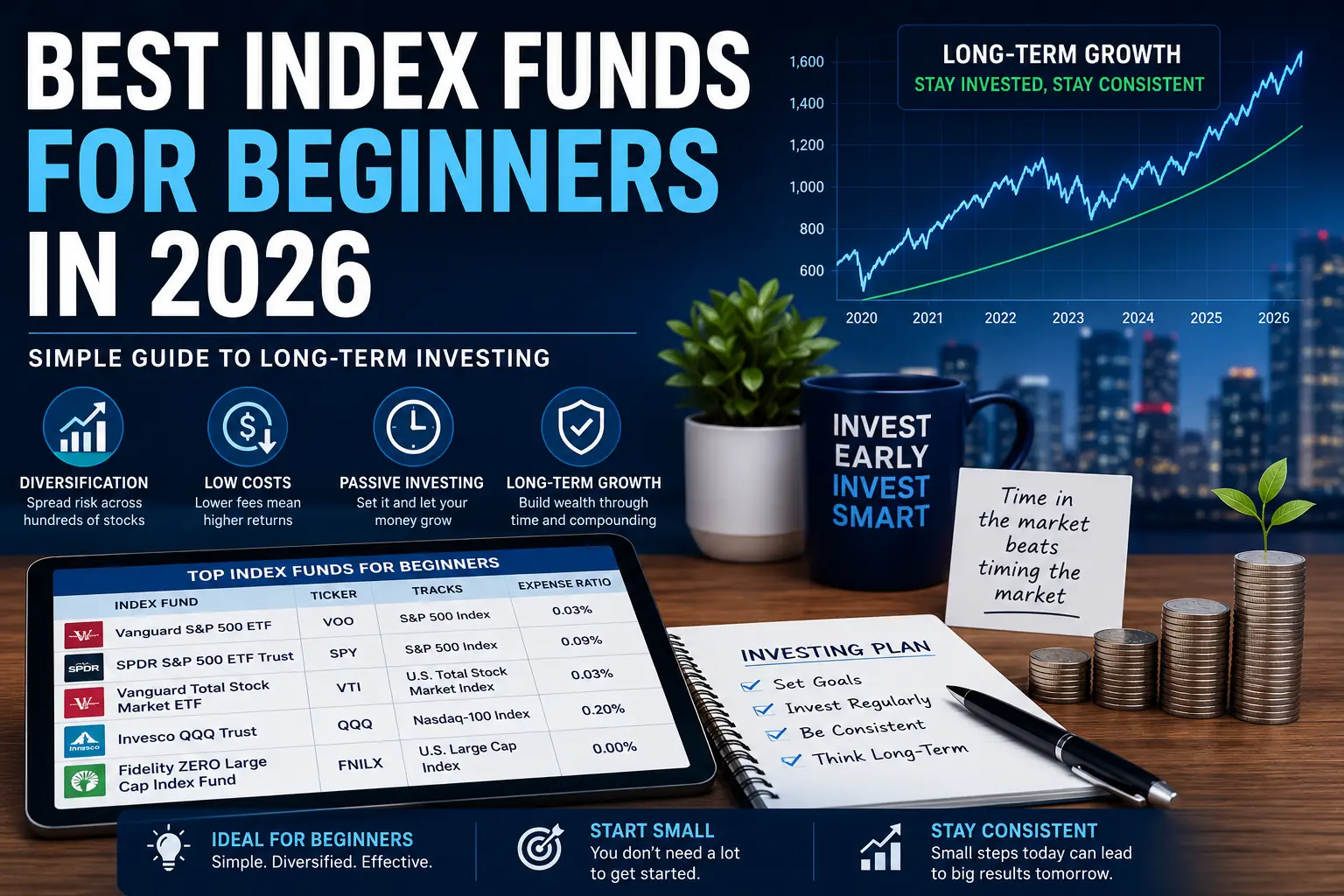
Best Index Funds for Beginners in 2026
1. Vanguard S&P 500 ETF (VOO)
VOO tracks the S&P 500 Index.
Top Holdings
- Microsoft
- Apple
- Nvidia
- Amazon
- Alphabet
Pros
- Very low fees
- Excellent diversification
- Strong historical performance
Cons
- Focused on large U.S. companies
2. SPDR S&P 500 ETF Trust (SPY)
SPY is one of the oldest and most popular ETFs in the world.
Pros
- High liquidity
- Easy to buy and sell
- Tracks the S&P 500
Cons
- Slightly higher expense ratio than VOO
3. Vanguard Total Stock Market ETF (VTI)
VTI offers exposure to nearly the entire U.S. stock market.
Pros
- Extremely diversified
- Includes small, medium, and large companies
- Excellent long-term option
Cons
- More broad exposure may reduce concentration in top performers
4. Invesco QQQ Trust (QQQ)
QQQ tracks the Nasdaq-100 Index.
Top Holdings
- Microsoft
- Nvidia
- Alphabet
- Amazon
- Meta
Pros
- Strong technology exposure
- Popular among growth investors
Cons
- More volatile than broad market funds
5. Fidelity ZERO Large Cap Index Fund (FNILX)
FNILX is designed for investors seeking low-cost exposure to large U.S. companies.
Pros
- Zero expense ratio
- Beginner-friendly
- Broad diversification
Cons
- Available only through Fidelity accounts
Index Funds vs Individual Stocks
Many beginners wonder whether they should buy index funds or individual stocks.
Index Funds
Advantages:
- Diversification
- Lower risk
- Simpler investing strategy
- Less research required
Individual Stocks
Advantages:
- Higher potential returns
- Direct exposure to favorite companies
Examples:
- Nvidia
- Microsoft
- Apple
- Meta
- Alphabet
For most beginners, index funds provide a safer starting point.
How Much Money Do You Need?
One of the biggest myths about investing is that you need thousands of dollars.
Today, many brokers allow:
- Fractional shares
- Automatic investing
- Small deposits
Many investors start with as little as $100.
👉 Read:
How to Start Investing With $100 in 2026
Benefits of Long-Term Index Investing
Successful investors often focus on long-term investing rather than short-term trading.
Benefits include:
Compound Growth
Your returns can generate additional returns over time.
Reduced Stress
No need to constantly monitor the market.
Lower Costs
Fewer transactions and lower fees.
Better Discipline
Encourages a consistent investment strategy.
Common Mistakes Beginners Should Avoid
Trying to Time the Market
Nobody can consistently predict short-term market movements.
Chasing Trending Stocks
Many investors lose money by following hype.
Investing Without a Plan
A long-term strategy is important.
Selling During Market Drops
Market corrections are normal.
Should You Invest Monthly?
Many successful investors use a strategy called Dollar-Cost Averaging (DCA).
This means investing a fixed amount regularly.
Example:
- $100 every month
- $200 every month
- $500 every month
Benefits:
- Reduces emotional investing
- Builds consistency
- Simplifies investing decisions
Are Index Funds Safe?
No investment is completely risk-free.
However, index funds are generally considered safer than investing in a few individual stocks because they are diversified.
Risks include:
- Market downturns
- Economic recessions
- Inflation
- Interest rate changes
Despite these risks, many financial experts recommend index funds for long-term investors.
Final Thoughts
Index funds remain one of the best investment options for beginners in 2026. They offer diversification, low fees, simplicity, and long-term growth potential.
Popular options such as VOO, SPY, VTI, QQQ, and FNILX allow investors to gain broad market exposure without needing to pick individual stocks.
For beginners looking to build wealth steadily over time, index funds can be an excellent foundation for a long-term portfolio.
FAQ
What is the best index fund for beginners?
Many beginners choose VOO or VTI because of their diversification and low costs.
Can I start investing in index funds with $100?
Yes. Many brokers allow fractional investing with small amounts.
Are index funds better than stocks?
For many beginners, index funds are easier and less risky due to diversification.
How often should I invest?
Many investors contribute monthly using a Dollar-Cost Averaging strategy.
Are index funds good for retirement?
Yes. Many retirement portfolios use index funds as their core investments.