
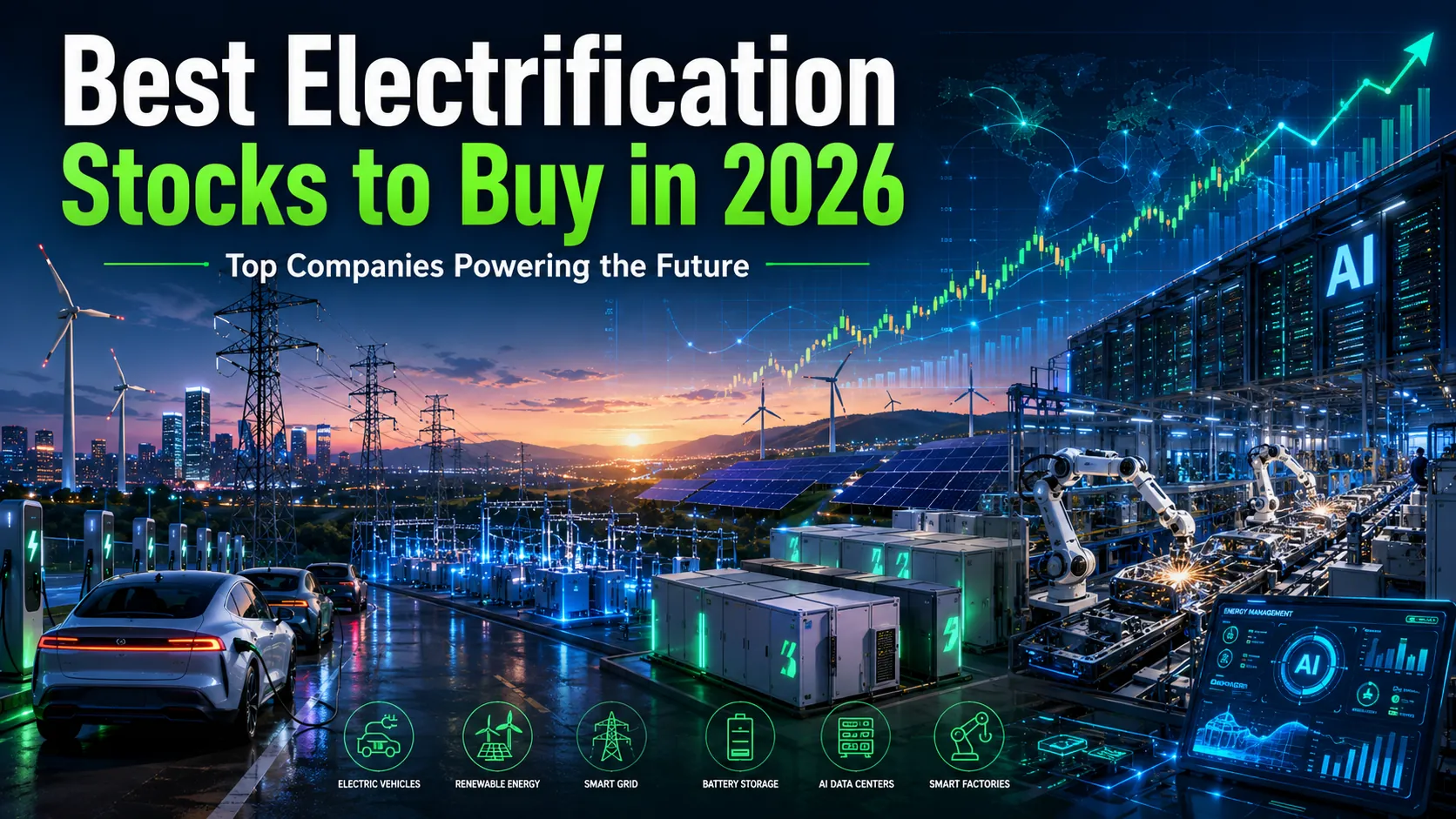
Best Electrification Stocks to Buy in 2026 (Top Companies Powering the Future)
Introduction
Electrification is rapidly becoming one of the most powerful long-term investment themes of the decade. Around the world, governments, businesses, and consumers are replacing fossil fuel-powered technologies with cleaner, more efficient electric alternatives. From electric vehicles and smart factories to AI data centers and renewable energy systems, electricity is becoming the backbone of the modern economy.
This transformation is not limited to transportation. Manufacturing, construction, industrial automation, commercial buildings, and even residential heating are increasingly relying on electricity instead of oil or natural gas. At the same time, the explosive growth of artificial intelligence is driving record electricity demand as hyperscale data centers require enormous amounts of reliable power.
To support this transition, utilities are investing billions of dollars in transmission lines, smart grids, substations, battery storage, and digital energy management systems. These investments create significant opportunities for companies that manufacture electrical equipment, automation technologies, power management solutions, and grid infrastructure.
For long-term investors, electrification represents more than a temporary trend. It is a structural shift expected to continue for decades. In this article, we’ll explore the best electrification stocks to buy in 2026, explain the forces driving the sector, and highlight companies that could benefit from one of the world’s largest infrastructure transformations.
What Is Electrification?
Electrification refers to replacing technologies powered by fossil fuels with systems powered by electricity. The goal is to improve efficiency, reduce emissions, lower operating costs, and support the transition toward cleaner energy.
Today, electrification is transforming nearly every major industry.
Transportation
Electric vehicles continue replacing gasoline and diesel-powered cars, buses, delivery vans, and commercial trucks.
Governments worldwide continue expanding EV charging infrastructure while automakers invest billions in new electric vehicle platforms.
Buildings
Residential and commercial buildings increasingly use electric heat pumps, smart HVAC systems, LED lighting, and intelligent energy management software.
These technologies reduce energy consumption while lowering operating costs.
Manufacturing
Factories are replacing mechanical and hydraulic equipment with electric motors, robotics, and automated production systems.
Industrial electrification improves productivity while reducing maintenance expenses.
Data Centers
Artificial intelligence has dramatically increased electricity demand from cloud computing facilities.
Modern AI data centers require advanced cooling systems, backup power equipment, intelligent electrical distribution, and sophisticated energy management solutions.
Renewable Energy
Solar farms, wind turbines, and battery storage systems all rely on advanced electrical infrastructure to deliver clean electricity safely and efficiently.
Without modern electrification technologies, the renewable energy transition would be impossible.
Why Electrification Is Accelerating in 2026
Several long-term trends continue supporting electrification across the global economy.
Artificial Intelligence
AI has become one of the largest consumers of electricity.
Training advanced language models and operating hyperscale cloud infrastructure require enormous computing resources.
Major technology companies continue investing billions of dollars into AI infrastructure, creating significant demand for electrical equipment manufacturers and power management companies.
As AI adoption expands across industries, electricity consumption is expected to increase substantially over the coming years.
Electric Vehicle Adoption
Electric vehicles continue gaining market share worldwide.
Every EV requires charging infrastructure, upgraded distribution networks, transformers, and smart energy management systems.
As millions of additional charging stations are deployed globally, electrical equipment suppliers are expected to benefit from rising infrastructure investments.
Renewable Energy Expansion
Wind and solar power continue growing rapidly.
Unlike conventional power plants, renewable energy sources require flexible grids capable of balancing fluctuating electricity production.
This creates strong demand for smart grid technologies, transmission equipment, digital substations, and automation software.
Industrial Automation
Manufacturers continue modernizing factories with robotics, automation systems, AI-powered monitoring, and digital control platforms.
These technologies improve efficiency while increasing electricity demand throughout industrial operations.
Government Infrastructure Spending
Many governments have announced long-term infrastructure programs supporting:
- Grid modernization
- Renewable energy
- Electric vehicle charging
- Industrial electrification
- Smart city development
- Transmission expansion
Public investment provides additional growth opportunities for companies serving the electrical infrastructure sector.
Characteristics of the Best Electrification Stocks
Not every industrial company benefits equally from electrification.
Investors should look for businesses with several competitive advantages.
Market Leadership
Industry leaders often maintain decades-long relationships with utilities, governments, and industrial customers.
These relationships create high barriers to entry for competitors.
Global Diversification
Companies serving customers across multiple regions are generally less dependent on a single economy.
Diversified revenue streams also improve financial stability.
Innovation
Businesses investing heavily in AI, software, digital automation, and smart energy management are often better positioned for future growth.
Strong Financial Performance
Healthy balance sheets, growing free cash flow, and consistent profitability allow companies to invest in expansion while returning capital to shareholders.
Best Electrification Stocks to Buy in 2026
Eaton (NYSE: ETN)
Eaton has become one of the world’s leading providers of intelligent power management solutions. The company’s products help utilities, commercial buildings, manufacturers, and data centers distribute electricity safely and efficiently.
Over the past several years, Eaton has benefited from accelerating investments in AI infrastructure, renewable energy, and industrial electrification.
Its diversified business model makes it one of the strongest long-term electrification investments available today.
Why Eaton Is a Top Pick
Strong Exposure to AI Infrastructure
The rapid expansion of AI data centers has significantly increased demand for Eaton’s electrical equipment.
Its switchgear, circuit protection systems, power distribution products, and backup power technologies are widely used throughout hyperscale facilities.
Electrification Leadership
The company operates across nearly every segment of modern electrical infrastructure, including utilities, commercial buildings, industrial facilities, and renewable energy projects.
Consistent Financial Performance
Eaton has delivered steady revenue growth, strong cash flow generation, and increasing profitability while maintaining disciplined capital allocation.
These characteristics make it attractive for long-term investors.
Schneider Electric (OTC: SBGSY)
Schneider Electric is one of the world’s largest specialists in energy management and industrial automation.
Its technologies help customers improve energy efficiency while supporting digital transformation across utilities, factories, commercial buildings, and data centers.
The company combines electrical equipment with advanced software, allowing customers to optimize energy consumption and reduce operational costs.
Why Schneider Electric Stands Out
Smart Energy Management
Schneider develops intelligent software that monitors energy usage in real time.
Its digital platforms improve efficiency while helping customers reduce electricity costs.
Data Center Growth
The company supplies power management equipment used extensively in AI and cloud computing facilities.
As hyperscale data centers continue expanding, Schneider remains well positioned to benefit.
Global Business
Operating in more than 100 countries, Schneider enjoys diversified revenue streams and strong international market leadership.
ABB Ltd. (NYSE: ABB)
ABB is a global technology leader specializing in electrification, robotics, industrial automation, and digital infrastructure.
Its electrical equipment supports power transmission, manufacturing, transportation, renewable energy, and utility modernization.
The company’s broad product portfolio makes it one of the most diversified electrification companies in the world.
Investment Highlights
Grid Modernization
ABB manufactures advanced transformers, switchgear, circuit breakers, and digital substation technologies used by utilities worldwide.
Industrial Automation
Its automation platforms help factories improve efficiency through robotics, AI monitoring, and digital control systems.
Renewable Energy Integration
ABB provides equipment that connects wind farms, solar projects, battery storage systems, and EV charging infrastructure to modern power grids.
Siemens AG (OTC: SIEGY)
Siemens AG is one of the world’s largest industrial technology companies and a major beneficiary of the global electrification trend. Through its Smart Infrastructure and Digital Industries divisions, Siemens provides solutions that help utilities, manufacturers, and commercial buildings transition toward a more efficient and sustainable future.
The company combines electrical hardware with software, artificial intelligence, and automation technologies, making it well-positioned for long-term growth as industries become increasingly digital and electricity demand continues rising.
Why Siemens Is a Strong Electrification Stock
Smart Infrastructure
Siemens supplies intelligent electrical systems for commercial buildings, factories, hospitals, airports, and power grids. These solutions improve energy efficiency while reducing operating costs.
Industrial Digitalization
Its automation software allows manufacturers to optimize production processes using AI, digital twins, and predictive maintenance technologies.
Renewable Energy Support
Siemens technologies help connect renewable energy projects to national electricity grids while improving grid stability.
GE Vernova (NYSE: GEV)
GE Vernova has become one of the most important companies supporting the global energy transition. Following its separation from General Electric, the company now focuses entirely on power generation, renewable energy, electrification, and grid technologies.
Its broad portfolio positions it to benefit from growing investments in electricity infrastructure worldwide.
Investment Thesis
Grid Equipment
GE Vernova manufactures transformers, switchgear, substations, and transmission technologies that utilities require to modernize aging electrical infrastructure.
AI-Driven Electricity Demand
The rapid expansion of AI data centers is creating unprecedented demand for electricity generation and transmission capacity.
As utilities expand their networks, GE Vernova is expected to secure additional infrastructure projects.
Energy Transition
The company participates in conventional power generation, renewable energy, and transmission infrastructure, offering diversified exposure to the electrification megatrend.
Quanta Services (NYSE: PWR)
Quanta Services is North America’s leading engineering and construction company specializing in electrical transmission and distribution infrastructure.
Unlike equipment manufacturers, Quanta generates revenue by designing, building, repairing, and upgrading electrical networks.
As governments and utilities continue investing in modern power infrastructure, Quanta remains one of the strongest long-term beneficiaries.
Why Investors Like Quanta Services
Massive Project Backlog
The company consistently reports record contract backlogs, providing strong revenue visibility for future years.
Utility Relationships
Quanta works with many of the largest electric utilities in North America, creating long-term recurring business opportunities.
Renewable Energy Projects
The company also builds infrastructure connecting solar farms, wind farms, and battery storage facilities to transmission networks.
Emerson Electric (NYSE: EMR)
Emerson Electric has successfully transformed itself into a leader in industrial automation and intelligent energy management.
Its products help manufacturers, utilities, and infrastructure operators improve operational efficiency through digital technologies and automation.
Why Emerson Deserves Consideration
Automation Leadership
The company develops software and control systems that optimize industrial operations while reducing energy consumption.
AI Integration
Emerson increasingly incorporates artificial intelligence into predictive maintenance, monitoring systems, and process optimization platforms.
Reliable Dividend
For income-focused investors, Emerson’s long history of dividend growth adds another attractive feature.
Rockwell Automation (NYSE: ROK)
Rockwell Automation specializes in factory automation, robotics, industrial software, and intelligent manufacturing systems.
As industries continue electrifying and digitizing production processes, Rockwell is positioned to benefit from increasing capital investment in smart factories.
Growth Opportunities
Smart Manufacturing
Manufacturers continue investing in automation to improve productivity while reducing labor costs.
Industrial AI
Rockwell integrates machine learning and AI into factory control systems, helping businesses optimize production and reduce downtime.
Digital Transformation
Its software enables manufacturers to collect and analyze operational data in real time, improving overall efficiency.
Comparison of the Best Electrification Stocks
| Company | Main Business | Primary Growth Driver | Investor Profile |
|---|---|---|---|
| Eaton | Power Management | AI Data Centers & Electrification | Growth Investors |
| Schneider Electric | Energy Management | Smart Buildings & AI Infrastructure | Global Diversification |
| ABB | Electrification & Automation | Grid Upgrades & Industrial Automation | Balanced Growth |
| Siemens | Smart Infrastructure | Digital Industries | Long-Term Investors |
| GE Vernova | Grid & Energy Equipment | Utility Modernization | Energy Transition Exposure |
| Quanta Services | Infrastructure Construction | Transmission Expansion | Infrastructure Investors |
| Emerson Electric | Industrial Automation | Digital Control Systems | Dividend Growth |
| Rockwell Automation | Smart Manufacturing | Factory Electrification | Industrial Technology |
Risks to Consider
Although electrification offers compelling long-term opportunities, investors should remain aware of potential risks.
High Valuations
Many leading electrification companies have significantly outperformed the broader market over recent years, resulting in premium valuations.
Economic Slowdowns
Large infrastructure and industrial projects may be delayed during periods of weaker economic growth.
Supply Chain Challenges
Manufacturers continue facing risks related to semiconductors, electrical components, copper prices, and logistics disruptions.
Interest Rates
Higher borrowing costs can delay utility and industrial capital spending projects.
Government Policy
Infrastructure incentives and renewable energy policies may change depending on political priorities.
Long-Term Outlook
The long-term outlook for electrification remains exceptionally strong.
Several structural trends continue supporting decades of investment:
Artificial Intelligence
AI computing is dramatically increasing electricity consumption across hyperscale data centers.
Electric Vehicles
Global EV adoption continues accelerating, creating sustained demand for charging infrastructure and power distribution equipment.
Renewable Energy
Governments and utilities continue investing in solar, wind, battery storage, and transmission expansion.
Smart Cities
Urban development increasingly relies on intelligent electrical infrastructure, automation, and energy-efficient buildings.
Industrial Automation
Manufacturers continue replacing traditional equipment with digitally connected electric systems.
These trends are unlikely to reverse anytime soon, making electrification one of the most attractive long-term investment themes available today.
Final Thoughts
Electrification is reshaping the global economy by transforming how electricity is generated, distributed, and consumed. From AI-powered data centers and electric vehicles to renewable energy projects and intelligent factories, demand for modern electrical infrastructure continues growing at an impressive pace.
Companies such as Eaton, Schneider Electric, ABB, Siemens, GE Vernova, Quanta Services, Emerson Electric, and Rockwell Automation are well positioned to benefit from this multi-decade transition.
While short-term market volatility is inevitable, investors with a long-term perspective may find electrification stocks to be valuable additions to a diversified portfolio. As always, it’s important to evaluate each company’s fundamentals, valuation, and competitive position before making investment decisions.
Frequently Asked Questions
What are electrification stocks?
Electrification stocks are companies that manufacture equipment, develop software, or provide services supporting the transition from fossil fuel-powered systems to electricity-based technologies.
Why is electrification important for investors?
Electrification is driven by long-term trends including artificial intelligence, electric vehicles, renewable energy, industrial automation, and smart infrastructure, creating sustained growth opportunities.
Which electrification stock has the strongest AI exposure?
Eaton, Schneider Electric, GE Vernova, and ABB all benefit from growing electricity demand created by AI data centers and digital infrastructure.
Are electrification stocks good long-term investments?
Many investors consider them attractive because global electricity demand is expected to increase for decades as economies become increasingly digital and electrified.
What industries benefit from electrification?
Transportation, manufacturing, utilities, renewable energy, commercial buildings, cloud computing, AI infrastructure, and industrial automation all benefit from electrification.