
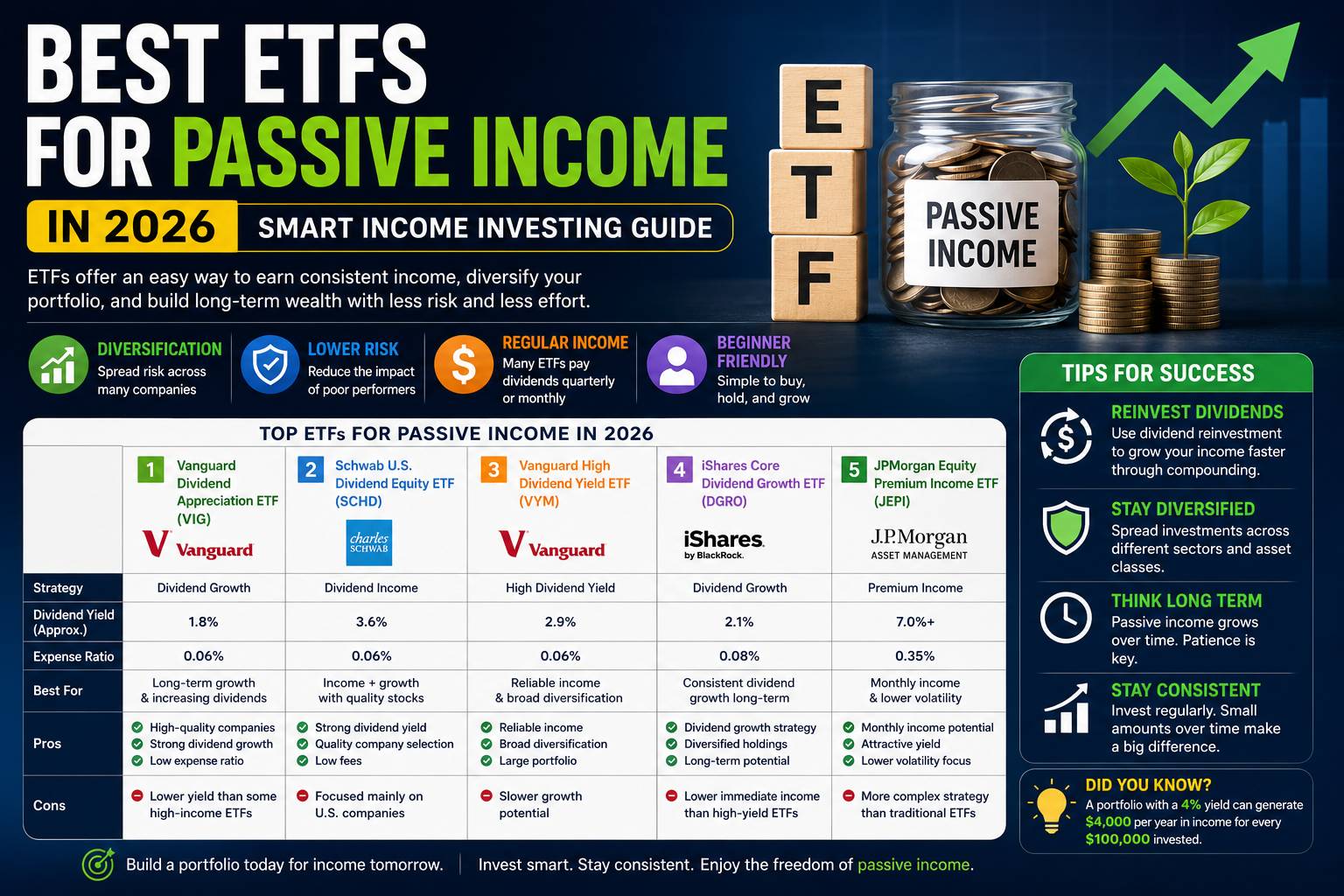
Best ETFs for Passive Income in 2026 (Smart Income Investing Guide)
Introduction
Best ETFs for Passive Income are becoming increasingly popular in 2026 as investors look for simple ways to generate recurring income while maintaining portfolio diversification.
Unlike individual dividend stocks, ETFs allow investors to own a basket of assets through a single investment. This reduces risk and makes passive income investing more accessible for beginners.
Whether your goal is monthly cash flow, long-term wealth building, or retirement planning, income-focused ETFs can play an important role in a balanced investment strategy.
👉 If you are new to investing, start with our guide on How to Start Investing With $100 in 2026.
What Is an ETF?
ETF stands for Exchange-Traded Fund.
An ETF is a collection of stocks, bonds, or other assets that trade on stock exchanges like regular stocks.
Benefits include:
- Diversification
- Lower risk
- Easy investing
- Professional management
- Low costs
Many ETFs focus specifically on dividend-paying companies to help investors generate passive income.
Why ETFs Are Great for Passive Income
Many investors prefer ETFs because they offer a balance between growth and income.
Benefits include:
Diversification
Instead of owning one company, investors own dozens or hundreds.
Lower Risk
Poor performance from one company has less impact on the overall portfolio.
Regular Dividend Payments
Many income ETFs distribute dividends quarterly.
Some even pay monthly.
Beginner-Friendly
ETFs are often easier to manage than selecting individual stocks.
Best ETFs for Passive Income in 2026
1. Vanguard Dividend Appreciation ETF (VIG)
VIG focuses on companies with a long history of increasing dividends.
Pros
- High-quality companies
- Strong dividend growth
- Low expense ratio
Cons
- Lower yield than some high-income ETFs
2. Schwab U.S. Dividend Equity ETF (SCHD)
SCHD remains one of the most popular dividend ETFs among long-term investors.
Pros
- Strong dividend yield
- Quality company selection
- Low fees
Cons
- Focused mainly on U.S. companies
3. Vanguard High Dividend Yield ETF (VYM)
VYM targets companies with above-average dividend yields.
Pros
- Reliable income
- Broad diversification
- Large portfolio
Cons
- Slower growth potential
4. iShares Core Dividend Growth ETF (DGRO)
DGRO focuses on companies with consistent dividend growth.
Pros
- Dividend growth strategy
- Diversified holdings
- Long-term potential
Cons
- Lower immediate income than high-yield ETFs
5. JPMorgan Equity Premium Income ETF (JEPI)
JEPI has become increasingly popular among income-focused investors.
Pros
- Monthly income potential
- Attractive yield
- Lower volatility focus
Cons
- More complex strategy than traditional ETFs
How Much Passive Income Can ETFs Generate?
Income depends on:
- Investment amount
- Dividend yield
- Market conditions
- Reinvestment strategy
For example:
A portfolio generating a 4% annual yield could produce:
- $40 per year on $1,000
- $400 per year on $10,000
- $4,000 per year on $100,000
Dividend reinvestment can further increase long-term growth.
ETF vs Dividend Stocks
Many beginners wonder whether ETFs or individual dividend stocks are better.
ETFs
Best for:
- Diversification
- Simplicity
- Lower risk
Dividend Stocks
Best for:
- Higher customization
- Individual company selection
- Potentially higher yields
👉 You may also enjoy Best Dividend Stocks for Beginners in 2026.
Tips for Building Passive Income With ETFs
Reinvest Dividends
Reinvesting dividends can accelerate portfolio growth through compounding.
Stay Diversified
Avoid concentrating investments in a single sector.
Think Long Term
Passive income investing works best over many years.
Stay Consistent
Adding funds regularly often matters more than trying to time the market.
👉 You may also enjoy Best Long-Term Stocks for Beginners in 2026.
Can AI Help ETF Investors?
Many investors now use AI-powered investing tools to research ETFs, monitor portfolios, and analyze market opportunities.
AI can help identify:
- Dividend trends
- Portfolio risks
- Asset allocation opportunities
👉 Explore Best AI Stock Analysis Tools in 2026.
Final Thoughts
ETFs remain one of the most beginner-friendly ways to generate passive income in 2026.
Funds such as VIG, SCHD, VYM, DGRO, and JEPI provide diversification, regular income, and long-term growth potential.
For most beginners, combining dividend-focused ETFs with patience and consistent investing can create a solid foundation for long-term financial success.
FAQ
What is the best ETF for passive income?
SCHD, VIG, VYM, DGRO, and JEPI are among the most popular passive income ETFs.
Are ETFs safer than individual stocks?
ETFs generally offer more diversification, which can reduce risk compared to investing in a single company.
Can beginners invest in ETFs?
Yes. ETFs are considered one of the easiest and safest investment options for beginners.
Do ETFs pay dividends?
Many ETFs distribute dividends regularly, depending on the fund’s strategy.
Internal Linking
- How to Start Investing With $100 in 2026
- Best Dividend Stocks for Beginners in 2026
- Best Long-Term Stocks for Beginners in 2026
- Best AI Stock Analysis Tools in 2026