
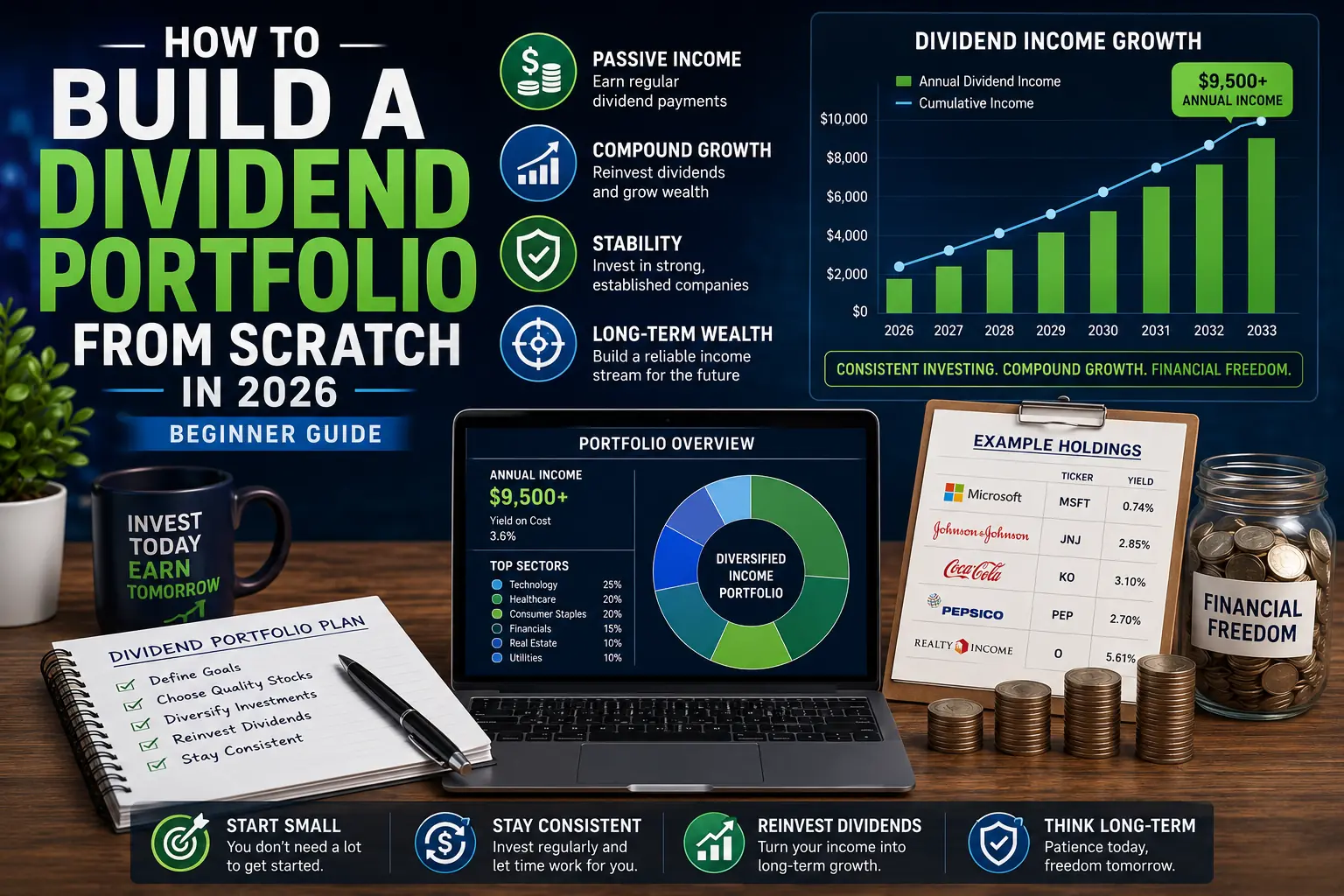
How to Build a Dividend Portfolio From Scratch in 2026 (Beginner Guide)
Introduction
Build a Dividend Portfolio From Scratch is one of the most common goals among beginner investors looking to generate passive income and long-term wealth. Dividend investing allows investors to earn regular payments from companies while also benefiting from potential stock price appreciation.
In 2026, dividend investing remains popular because it provides a balance between income generation and portfolio growth. Whether you are starting with $100 or several thousand dollars, building a dividend portfolio can be a smart long-term strategy.
In this guide, we will explain how to build a dividend portfolio from scratch, choose quality dividend stocks, and create a sustainable passive income plan.
👉 New to investing?
Read:
How to Start Investing With $100 in 2026
What Is a Dividend Portfolio?
A dividend portfolio is a collection of investments designed to generate regular dividend payments.
Dividends are cash distributions that companies pay to shareholders.
Examples include:
- Monthly dividends
- Quarterly dividends
- Annual dividends
Many investors use dividend portfolios to:
- Generate passive income
- Build retirement income
- Reinvest dividends for growth
- Reduce portfolio volatility
Why Dividend Investing Is Popular
Dividend investing offers several advantages.
Passive Income
Investors receive regular cash payments.
Compound Growth
Reinvested dividends can accelerate long-term returns.
Stability
Many dividend-paying companies are established businesses with strong cash flows.
Long-Term Wealth Building
Dividend stocks can generate both income and capital appreciation.
Step 1: Define Your Goals
Before buying any dividend stock, determine your objective.
Examples:
Income Focus
Generate regular cash flow.
Growth Focus
Reinvest dividends for long-term growth.
Retirement Planning
Build future income streams.
Your goal will influence the type of dividend investments you choose.
Step 2: Choose Strong Dividend Stocks
Not all dividend stocks are equal.
Look for companies with:
- Consistent dividend payments
- Strong earnings growth
- Healthy cash flow
- Sustainable payout ratios
- Competitive advantages
Examples of well-known dividend-paying companies:
Microsoft (MSFT)
Strong balance sheet and growing dividends.
Johnson & Johnson (JNJ)
Long history of dividend increases.
Coca-Cola (KO)
Popular dividend stock with global brand recognition.
Procter & Gamble (PG)
Reliable dividend growth company.
PepsiCo (PEP)
Consistent dividends and strong business model.
Step 3: Diversify Your Portfolio
Avoid concentrating all investments in a single company or sector.
Diversification helps reduce risk.
Example allocation:
Technology
- Microsoft
- Apple
Consumer Staples
- Coca-Cola
- PepsiCo
Healthcare
- Johnson & Johnson
Financials
- JPMorgan Chase
Real Estate
- REIT investments
A diversified portfolio is generally more resilient during market downturns.
Step 4: Consider Dividend ETFs
Many beginners prefer dividend ETFs because they provide instant diversification.
Popular dividend ETFs include:
Schwab U.S. Dividend Equity ETF (SCHD)
Popular among income investors.
Vanguard Dividend Appreciation ETF (VIG)
Focuses on companies with growing dividends.
iShares Core Dividend Growth ETF (DGRO)
Diversified dividend growth exposure.
SPDR S&P Dividend ETF (SDY)
Tracks dividend-paying companies with long histories.
Dividend ETFs can simplify portfolio management for beginners.
👉 You may also enjoy:
Best Dividend ETFs for Passive Income in 2026
Step 5: Reinvest Your Dividends
One of the most powerful strategies is dividend reinvestment.
Instead of spending dividends, investors can use them to purchase additional shares.
Benefits:
- Accelerates compound growth
- Increases future dividend income
- Builds wealth automatically
Over long periods, reinvested dividends can significantly increase total returns.
Step 6: Invest Consistently
Consistency is often more important than timing the market.
Many investors use Dollar-Cost Averaging (DCA).
Examples:
- $100 per month
- $250 per month
- $500 per month
Regular investing helps reduce emotional decision-making.
Common Mistakes to Avoid
Chasing High Dividend Yields
Extremely high yields may indicate financial problems.
Ignoring Diversification
Avoid concentrating your portfolio.
Buying Without Research
Always understand the company’s fundamentals.
Focusing Only on Income
Dividend growth is often just as important as dividend yield.
Panic Selling
Long-term investing requires patience.
Dividend Yield vs Dividend Growth
Many beginners focus only on yield.
However, dividend growth is equally important.
High Yield Stocks
Pros:
- Higher current income
Cons:
- Sometimes higher risk
Dividend Growth Stocks
Pros:
- Growing future income
- Often stronger businesses
Cons:
- Lower initial yield
Many successful investors combine both approaches.
Sample Beginner Dividend Portfolio
Example allocation:
30%
SCHD ETF
20%
Microsoft
15%
Johnson & Johnson
15%
PepsiCo
10%
Real Estate Investment Trusts (REITs)
10%
Cash or additional dividend ETF exposure
This is only an example and not investment advice.
How Much Dividend Income Can You Earn?
Dividend income depends on:
- Portfolio size
- Dividend yield
- Reinvestment strategy
Example:
| Portfolio Value | Yield | Annual Income |
|---|---|---|
| $10,000 | 3% | $300 |
| $25,000 | 3% | $750 |
| $50,000 | 3% | $1,500 |
| $100,000 | 3% | $3,000 |
Over time, reinvestment can increase these amounts significantly.
Final Thoughts
Building a dividend portfolio from scratch is one of the most effective ways to generate passive income and build long-term wealth. By focusing on quality companies, diversification, and consistent investing, beginners can create a portfolio that produces growing income over time.
Whether you choose individual dividend stocks, dividend ETFs, or a combination of both, the key is to remain patient and stay invested for the long term.
FAQ
What is the best dividend stock for beginners?
Many investors consider Microsoft, Johnson & Johnson, PepsiCo, and Coca-Cola strong beginner-friendly dividend stocks.
How much money do I need to start dividend investing?
Many investors start with as little as $100 thanks to fractional shares and dividend ETFs.
Are dividend ETFs better than individual stocks?
Dividend ETFs provide diversification, while individual stocks offer more direct control.
Should I reinvest dividends?
Many long-term investors reinvest dividends to maximize compound growth.
Can dividend investing create passive income?
Yes. Dividend investing is one of the most popular passive income strategies.