
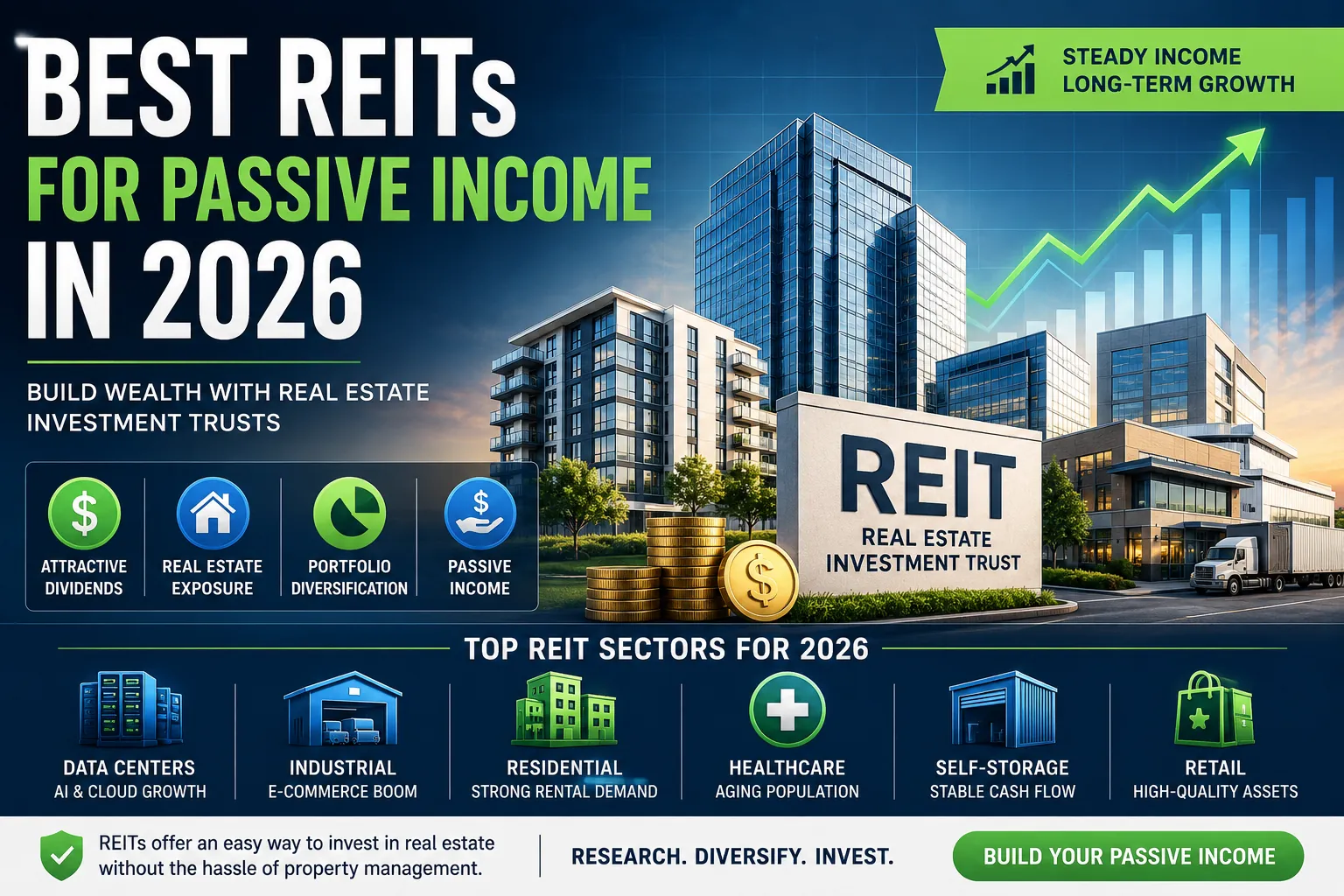
Best REITs for Passive Income in 2026
Introduction
Best REITs for Passive Income opportunities continue to attract investors seeking reliable dividend income and long-term wealth creation. Real Estate Investment Trusts (REITs) allow investors to gain exposure to real estate without directly buying, managing, or maintaining physical properties.
In 2026, REITs remain popular because they offer attractive dividend yields, portfolio diversification, and access to various real estate sectors such as residential housing, industrial warehouses, healthcare facilities, and data centers.
This guide explores how REITs work, their advantages, risks, and some of the best REIT categories investors should consider for passive income.
What Is a REIT?
A Real Estate Investment Trust (REIT) is a company that owns, operates, or finances income-producing real estate.
Instead of purchasing properties yourself, you can buy shares of a REIT and receive a portion of the rental income generated by its portfolio.
REITs may own:
- Apartment buildings
- Shopping centers
- Office buildings
- Data centers
- Healthcare facilities
- Warehouses
- Hotels
- Self-storage properties
Most REITs distribute a significant portion of their profits to shareholders through dividends.
Why Investors Like REITs
REITs offer several benefits for income-focused investors.
Regular Dividend Income
Many REITs pay quarterly dividends.
Some even distribute dividends monthly.
Real Estate Exposure
Investors gain access to real estate markets without owning physical property.
Diversification
REITs help diversify portfolios beyond stocks and bonds.
Passive Income
Shareholders can earn income without property management responsibilities.
Liquidity
Publicly traded REITs can be bought and sold easily through stock exchanges.
Best REIT Categories for Passive Income in 2026
Rather than focusing on a single company, investors should understand which REIT sectors offer strong long-term potential.
1. Data Center REITs
Data center REITs are among the fastest-growing real estate sectors.
They benefit from:
- Artificial intelligence growth
- Cloud computing demand
- Digital transformation
- Increasing data storage needs
As AI adoption accelerates, demand for data infrastructure continues growing.
Why investors like them:
- Strong growth potential
- Technology exposure
- Long-term demand trends
2. Industrial REITs
Industrial REITs own warehouses and logistics facilities.
Growth drivers include:
- E-commerce expansion
- Global supply chains
- Distribution networks
- Online retail growth
Major companies increasingly require warehouse space to support operations.
Industrial REITs remain attractive for both growth and income investors.
3. Residential REITs
Residential REITs invest in:
- Apartment complexes
- Rental communities
- Multifamily housing
Benefits include:
- Stable demand
- Recurring rental income
- Population growth support
Housing remains one of the most resilient real estate sectors.
4. Healthcare REITs
Healthcare REITs own:
- Hospitals
- Medical offices
- Senior living facilities
- Healthcare centers
An aging global population could support long-term demand.
Many investors appreciate healthcare REITs for their relatively defensive characteristics.
5. Self-Storage REITs
Self-storage facilities continue benefiting from:
- Urbanization
- Relocation trends
- Small business demand
These properties often generate stable cash flow and require relatively low maintenance costs.
6. Retail REITs
Retail REITs own shopping centers and commercial properties.
While traditional retail faces challenges, high-quality retail locations remain valuable.
The strongest retail REITs often focus on:
- Grocery-anchored centers
- Essential services
- High-traffic locations
How REITs Generate Passive Income
REIT income typically comes from:
Rental Revenue
Tenants pay rent to occupy properties.
Property Appreciation
Property values may increase over time.
Dividend Payments
REITs distribute profits to shareholders.
Many income investors reinvest dividends to accelerate long-term portfolio growth.
Risks of Investing in REITs
Although REITs offer attractive benefits, investors should understand the risks.
Interest Rate Risk
Higher interest rates can pressure REIT valuations.
Economic Slowdowns
Weak economies may impact property occupancy.
Sector-Specific Risks
Different property types face unique challenges.
Market Volatility
REIT share prices can fluctuate like other stocks.
Diversification can help reduce risk.
How Beginners Can Start Investing in REITs
New investors can begin with:
Individual REIT Stocks
Direct exposure to specific companies.
REIT ETFs
Provide instant diversification across multiple REITs.
Dividend Reinvestment
Allows investors to compound returns over time.
For many beginners, REIT ETFs offer a simple starting point.
REITs vs Dividend Stocks
Both investments can generate passive income.
REITs
Advantages:
- Real estate exposure
- High dividend yields
- Diversification benefits
Dividend Stocks
Advantages:
- Corporate growth potential
- Broader sector exposure
- Potential dividend increases
Many investors combine both strategies for balanced income generation.
Long-Term Outlook for REITs
Several trends support the REIT market heading into 2026:
- Growing demand for data centers
- Continued e-commerce growth
- Population growth
- Urbanization
- Expanding digital infrastructure
These trends could support both income generation and long-term capital appreciation.
Conclusion
Best REITs for Passive Income remain an attractive option for investors seeking consistent income, diversification, and exposure to real estate markets. Whether focusing on data centers, industrial properties, residential housing, or healthcare facilities, REITs offer a convenient way to participate in real estate investing without owning physical properties.
For long-term investors building passive income streams, REITs can play an important role in a diversified portfolio in 2026 and beyond.
Frequently Asked Questions
What is the best REIT sector in 2026?
Data center and industrial REITs are among the most promising sectors due to AI growth and e-commerce expansion.
Are REITs good for passive income?
Yes. Many REITs pay regular dividends and provide exposure to income-producing real estate.
Can beginners invest in REITs?
Absolutely. REIT stocks and REIT ETFs are accessible through most brokerage accounts.
Are REITs safer than stocks?
REITs still carry risks but may provide diversification and income benefits compared to some traditional stocks.