
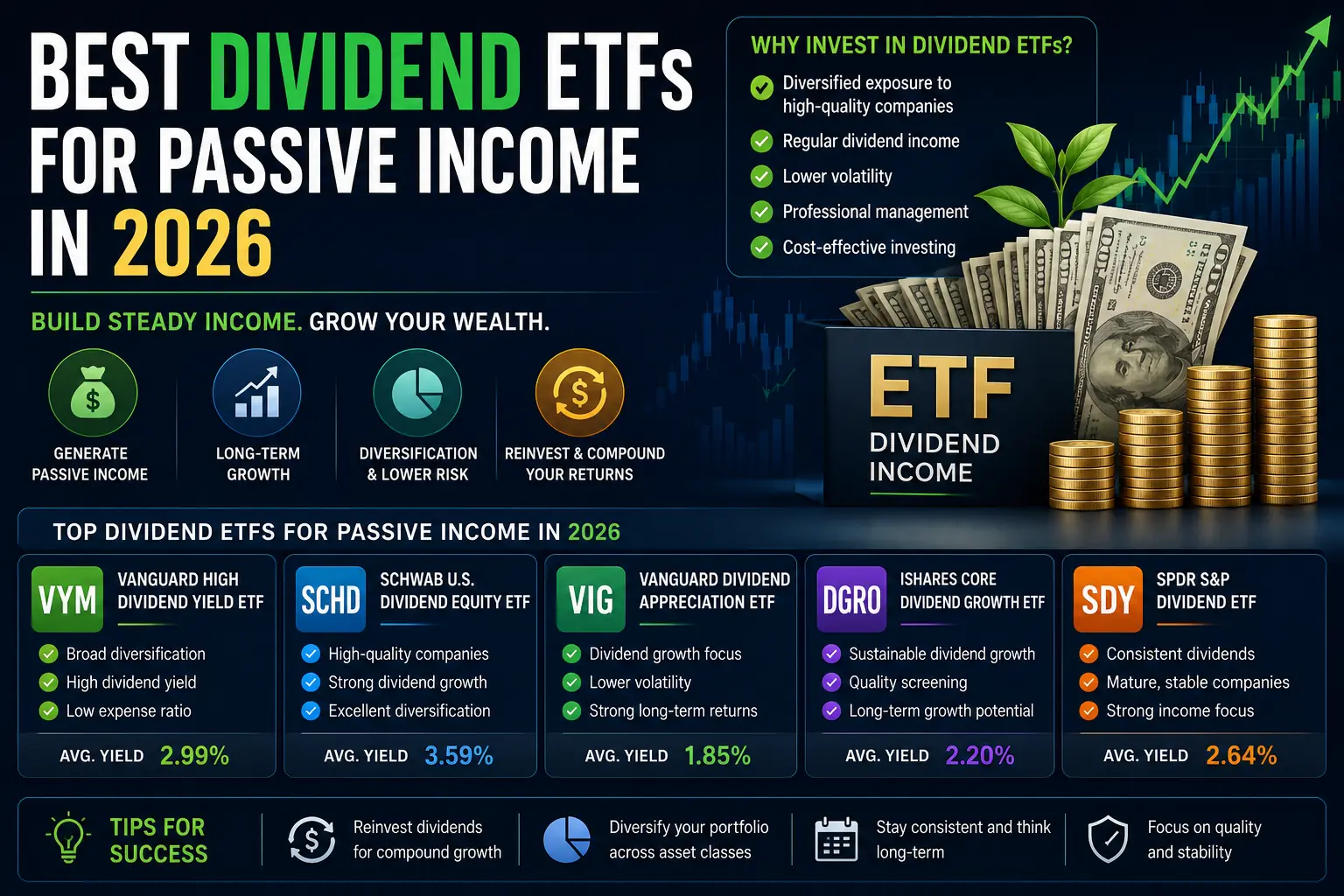
Best Dividend ETFs for Passive Income in 2026
Introduction
Best Dividend ETFs for Passive Income are becoming increasingly popular among investors seeking reliable income and long-term portfolio growth. Dividend-focused exchange-traded funds (ETFs) offer exposure to multiple income-generating companies while reducing the risks associated with investing in individual stocks.
As interest rates, inflation, and market conditions continue evolving in 2026, many investors are looking for ways to generate passive income without actively managing a portfolio. Dividend ETFs provide a simple and diversified solution.
In this guide, we explore some of the best dividend ETFs for passive income in 2026, their advantages, potential risks, and how investors can use them to build long-term wealth.
👉 Related: Best Dividend Stocks for Passive Income in 2026
What Is a Dividend ETF?
A dividend ETF is an exchange-traded fund that invests primarily in companies that pay dividends to shareholders.
Instead of buying individual dividend stocks, investors can purchase a single ETF that provides exposure to dozens or even hundreds of dividend-paying companies.
Benefits include:
- Diversification
- Regular income
- Lower risk than individual stocks
- Professional management
- Easy portfolio building
Why Dividend ETFs Are Popular in 2026
Dividend ETFs remain attractive because they combine income generation with long-term growth potential.
Investors use them to:
- Build passive income streams
- Reduce portfolio volatility
- Reinvest dividends
- Generate retirement income
- Diversify stock market exposure
Many dividend-paying companies are established businesses with strong cash flow and stable earnings.
Key Factors to Consider Before Choosing a Dividend ETF
Before investing in a dividend ETF, consider:
Dividend Yield
The annual income generated relative to the ETF’s price.
Expense Ratio
Lower fees help investors keep more returns.
Portfolio Diversification
Diversified ETFs reduce company-specific risk.
Dividend Growth
Some ETFs focus on companies that regularly increase dividends.
Fund Size and Liquidity
Larger funds often offer better liquidity and lower trading costs.
Best Dividend ETFs for Passive Income in 2026
1. Vanguard High Dividend Yield ETF (VYM)
VYM is one of the most popular dividend ETFs.
Key features:
- Broad diversification
- Large-cap companies
- Competitive dividend yield
- Low expense ratio
Suitable for investors seeking long-term passive income.
2. Schwab U.S. Dividend Equity ETF (SCHD)
SCHD is widely considered one of the strongest dividend ETFs available.
Advantages:
- Focus on high-quality companies
- Strong dividend growth history
- Attractive yield
- Excellent diversification
Many income investors consider SCHD a core portfolio holding.
3. Vanguard Dividend Appreciation ETF (VIG)
VIG focuses on companies with a history of increasing dividends.
Benefits include:
- Dividend growth focus
- High-quality businesses
- Lower volatility
- Strong long-term performance
Ideal for investors seeking both growth and income.
4. iShares Core Dividend Growth ETF (DGRO)
DGRO targets companies with sustainable dividend growth.
Strengths:
- Dividend growth strategy
- Broad diversification
- Quality screening
- Long-term wealth-building potential
5. SPDR S&P Dividend ETF (SDY)
SDY tracks companies with long histories of dividend payments.
Advantages:
- Dividend consistency
- Strong income focus
- Exposure to mature businesses
Popular among conservative investors.
Dividend ETFs vs Individual Dividend Stocks
Dividend ETFs
Pros:
- Diversification
- Lower risk
- Less research required
- Easy management
Cons:
- Less control over holdings
- Slight management fees
Individual Dividend Stocks
Pros:
- Higher potential income
- More control
- Greater customization
Cons:
- Higher risk
- Requires more research
For most beginners, dividend ETFs offer a simpler solution.
Reinvesting Dividends for Long-Term Growth
One of the most powerful strategies is dividend reinvestment.
Instead of spending dividend income, investors can purchase additional ETF shares.
Benefits include:
- Compound growth
- Increased future income
- Faster portfolio expansion
Over long periods, dividend reinvestment can significantly increase total returns.
Risks of Dividend ETFs
Although dividend ETFs are relatively conservative, risks still exist.
Market Risk
ETF values can decline during market downturns.
Dividend Reductions
Companies may reduce dividends during economic stress.
Interest Rate Risk
Higher interest rates can affect dividend-paying stocks.
Sector Concentration
Some dividend ETFs may be heavily exposed to specific sectors.
Diversification remains important.
How Much Passive Income Can Dividend ETFs Generate?
Income depends on:
- Investment amount
- Dividend yield
- Reinvestment strategy
Examples:
| Investment | 3% Yield | 4% Yield |
|---|---|---|
| $10,000 | $300/year | $400/year |
| $50,000 | $1,500/year | $2,000/year |
| $100,000 | $3,000/year | $4,000/year |
Dividend income can grow further through reinvestment and dividend increases.
Building a Dividend ETF Portfolio
A balanced portfolio could include:
Core Dividend ETF
Example:
- SCHD
- VYM
Dividend Growth ETF
Example:
- VIG
- DGRO
Broad Market ETF
Example:
- S&P 500 ETF
This combination provides income, growth, and diversification.
Best Dividend ETFs for Beginners
For beginners, the most attractive options often include:
SCHD
Strong dividend quality and growth.
VYM
Broad diversification and simplicity.
VIG
Excellent dividend growth focus.
These funds provide solid foundations for long-term passive income investing.
Outlook for Dividend ETFs in 2026
Dividend investing remains relevant in 2026 because investors continue seeking:
- Income generation
- Portfolio stability
- Inflation protection
- Long-term wealth creation
Dividend ETFs are expected to remain important components of many investment portfolios.
Conclusion
The Best Dividend ETFs for Passive Income in 2026 offer investors a practical way to generate income while building long-term wealth.
Funds such as SCHD, VYM, VIG, DGRO, and SDY provide diversification, dividend income, and exposure to high-quality companies.
For investors seeking passive income with relatively lower risk, dividend ETFs remain among the most attractive investment options in 2026.
Frequently Asked Questions (FAQ)
What is the best dividend ETF for passive income?
Many investors consider SCHD and VYM among the strongest dividend ETFs available.
Are dividend ETFs good for beginners?
Yes. Dividend ETFs provide diversification and require less research than individual stocks.
Can dividend ETFs generate monthly income?
Most dividend ETFs distribute income quarterly, although some ETFs offer more frequent distributions.
Should I reinvest dividends?
Many long-term investors reinvest dividends to benefit from compound growth.
Are dividend ETFs safer than individual stocks?
Generally, dividend ETFs provide greater diversification and lower company-specific risk.