
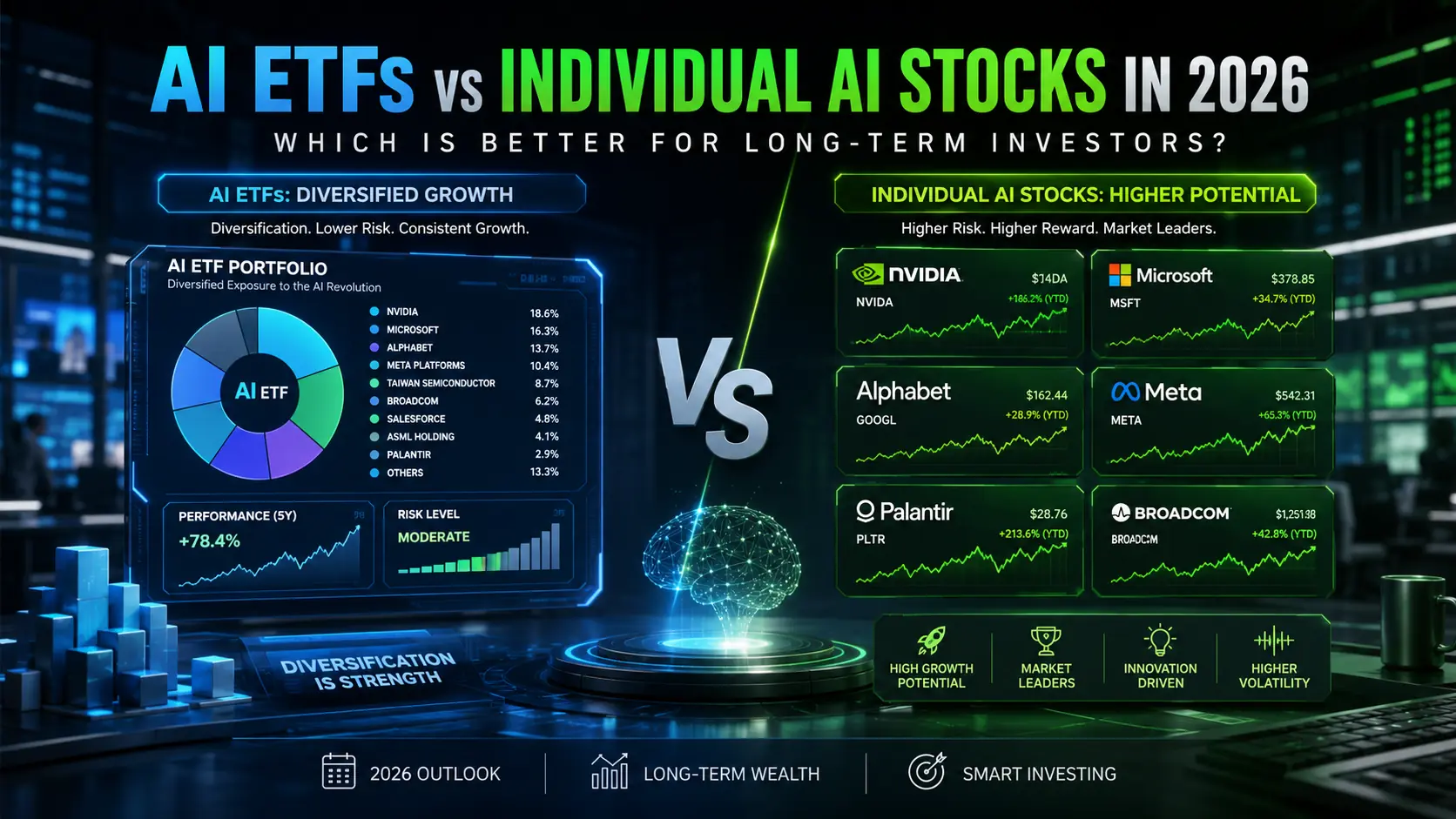
AI ETFs vs AI Stocks in 2026: Which Is Better for Long-Term Investors?
Introduction
AI ETFs vs AI stocks in 2026 is a common question among investors looking to benefit from the rapid growth of artificial intelligence. As AI continues to transform industries such as cloud computing, healthcare, cybersecurity, robotics, and finance, more investors are searching for the best way to gain exposure to this long-term trend.
While some investors prefer buying individual AI stocks such as NVIDIA, Microsoft, or Alphabet, others choose AI-focused exchange-traded funds (ETFs) that provide diversified exposure to multiple companies within the AI ecosystem. Both approaches have advantages and disadvantages, and the right choice depends on your investment goals, risk tolerance, and level of experience.
This guide compares AI ETFs and individual AI stocks in 2026, helping you determine which strategy is best suited for long-term investing.
Understanding AI ETFs
An AI ETF is a fund that holds a basket of companies involved in artificial intelligence technologies. Instead of investing in a single company, investors gain exposure to multiple businesses through one investment.
AI ETFs typically include companies involved in:
- AI software development
- Semiconductors and AI chips
- Cloud computing infrastructure
- Robotics and automation
- Data analytics and machine learning
The main advantage of AI ETFs is diversification. If one company underperforms, the impact on the overall investment is reduced.
Benefits of AI ETFs
- Instant diversification
- Lower company-specific risk
- Suitable for beginners
- Less research required
- Exposure to the broader AI industry
Drawbacks of AI ETFs
- Lower potential returns than top-performing stocks
- Less control over portfolio holdings
- Management fees may apply
Understanding Individual AI Stocks
Individual AI stocks allow investors to buy shares of specific companies that are leading the artificial intelligence revolution.
Examples include:
- NVIDIA
- Microsoft
- Alphabet
- Amazon
- Meta Platforms
Investing in individual stocks gives investors more control and the possibility of generating higher returns if they select winning companies.
Benefits of AI Stocks
- Higher growth potential
- Greater control over investments
- Ability to focus on industry leaders
- No ETF management fees
Drawbacks of AI Stocks
- Higher volatility
- Greater research requirements
- Increased company-specific risk
- Portfolio concentration risk
AI ETFs vs AI Stocks: Key Differences
Diversification
AI ETFs provide exposure to multiple companies, making them more diversified.
Individual stocks concentrate investment in a single company.
Winner: AI ETFs
Potential Returns
Top-performing AI stocks can significantly outperform diversified funds.
For example, a major breakthrough by an AI leader may generate returns far above an ETF’s average performance.
Winner: AI Stocks
Risk Level
AI ETFs reduce risk by spreading investments across many companies.
Individual stocks are more vulnerable to earnings disappointments, regulation changes, or market sentiment.
Winner: AI ETFs
Ease of Investing
Beginners often find ETFs easier because professional managers handle portfolio construction.
Stock investing requires ongoing research and monitoring.
Winner: AI ETFs
Portfolio Control
Investors who select individual stocks can customize their holdings based on personal conviction and market outlook.
Winner: AI Stocks
Which Option Is Better for Beginners?
For most beginner investors, AI ETFs offer a safer starting point.
Benefits include:
- Diversification
- Reduced volatility
- Simpler portfolio management
- Exposure to the entire AI industry
A beginner who is unsure which AI companies will dominate over the next decade may find AI ETFs to be a more comfortable investment choice.
Which Option Is Better for Experienced Investors?
Experienced investors often prefer combining both approaches.
For example:
- 60% AI ETFs
- 40% individual AI stocks
This strategy allows investors to benefit from diversification while still capturing the upside of leading AI companies.
Sample AI Portfolio for 2026
A balanced AI investment portfolio could look like:
- 50% AI ETFs
- 20% NVIDIA
- 10% Microsoft
- 10% Alphabet
- 10% Amazon
This approach combines stability and growth potential.
Important Risks to Consider
Regardless of whether you choose AI ETFs or AI stocks, there are risks:
- High valuations in the AI sector
- Increased competition
- Regulatory uncertainty
- Market volatility
- Technological disruption
Investors should maintain realistic expectations and focus on long-term investing rather than short-term market movements.
AI Investing Outlook for 2026
Artificial intelligence remains one of the most important investment themes of the decade. Demand for AI computing power, cloud infrastructure, automation, and machine learning solutions continues to grow globally.
As businesses increase AI adoption, both AI ETFs and leading AI companies may benefit from long-term industry expansion.
The key is choosing an approach that matches your risk profile and investment objectives.
Conclusion
When comparing AI ETFs vs AI stocks in 2026, there is no single answer that fits every investor.
AI ETFs provide diversification, lower risk, and simplicity, making them ideal for beginners and conservative investors. Individual AI stocks offer higher growth potential and greater portfolio control but require more research and risk management.
For many long-term investors, a combination of both strategies may be the most effective solution. By balancing diversification with targeted exposure to AI leaders, investors can participate in the growth of artificial intelligence while managing portfolio risk effectively.
Frequently Asked Questions (FAQ)
What is the difference between AI ETFs and AI stocks?
AI ETFs invest in multiple AI-related companies, while AI stocks represent ownership in a single company.
Are AI ETFs safer than AI stocks?
Generally, yes. AI ETFs offer diversification, which helps reduce company-specific risk.
Can AI stocks outperform AI ETFs?
Yes. Successful AI companies can generate returns that exceed those of diversified ETFs, but they also carry higher risk.
Which is better for beginners?
Most beginners benefit from AI ETFs because they provide broad exposure to the AI sector with less research required.
Should I invest in both AI ETFs and AI stocks?
Many long-term investors combine both approaches to balance growth opportunities and diversification.