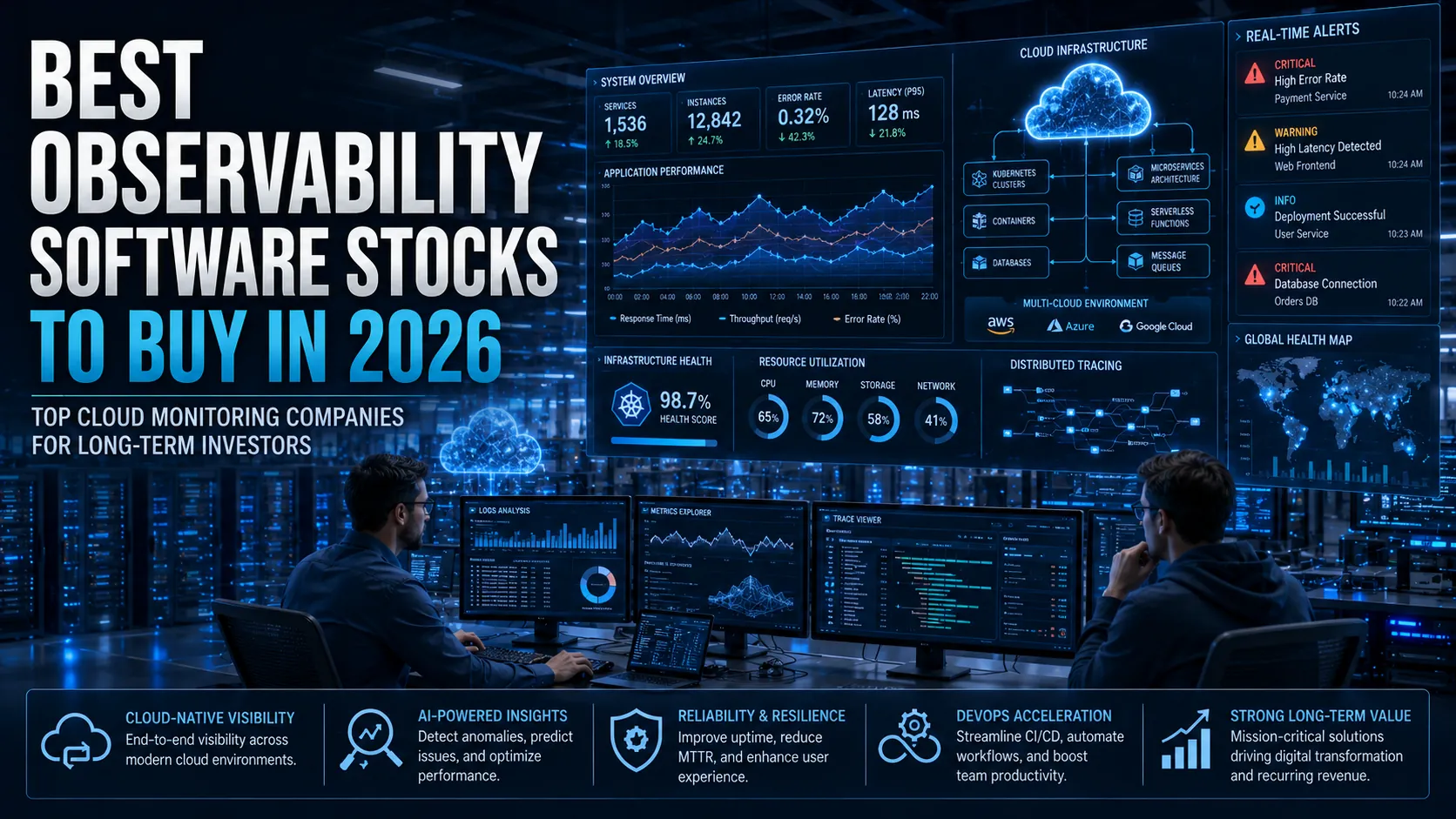
Best Observability Software Stocks to Buy in 2026 (Top Cloud Monitoring Companies)
Introduction
The best observability software stocks to buy in 2026 give investors exposure to the growing complexity of cloud computing, artificial intelligence, cybersecurity, and modern software development.
Businesses increasingly operate applications across public clouds, private data centers, containers, microservices, databases, networks, and artificial intelligence infrastructure. Monitoring these environments with disconnected tools is becoming difficult, expensive, and inefficient.
Observability software helps technology teams understand what is happening across their applications and infrastructure. These platforms collect and analyze information such as logs, metrics, traces, user sessions, security events, and application performance data.
When an application slows down or a cloud service fails, observability software can help engineers identify the source of the problem and restore operations more quickly.
The expansion of generative AI is also creating a new category of monitoring requirements. Companies now need to track large language model performance, AI agent behavior, infrastructure costs, security risks, response quality, and application reliability.
As digital systems become more important to business operations, observability is evolving from a technical monitoring function into a strategic enterprise priority.
In this guide, we will explore the best observability software stocks to buy in 2026, examine the industry’s major growth drivers, and highlight the companies building the platforms used to monitor modern digital infrastructure.
Observability stocks can offer attractive long-term opportunities, but they also involve risks related to competition, software valuations, customer spending, technological disruption, and changing cloud architectures.
This article is educational and does not constitute financial advice. Investors should conduct independent research and evaluate their financial goals and risk tolerance before purchasing any stock.
Why Observability Software Matters in 2026
Observability has become essential because modern applications are far more complex than traditional software systems.
A single digital service may depend on hundreds of microservices, cloud databases, application programming interfaces, containers, third-party platforms, security tools, and distributed computing resources.
When one component fails, the problem can affect customers, employee productivity, revenue, cybersecurity, and the reputation of the business.
Several long-term trends are increasing demand for observability platforms.
Cloud Computing Expansion
Companies continue migrating applications and data to cloud platforms such as Amazon Web Services, Microsoft Azure, and Google Cloud.
Cloud environments can improve flexibility and scalability, but they also create additional operational complexity. Organizations must monitor infrastructure located across multiple regions, cloud providers, and internal systems.
Observability platforms provide centralized visibility across these distributed environments.
Artificial Intelligence Infrastructure
Artificial intelligence applications require specialized infrastructure, including graphics processing units, vector databases, large language models, AI agents, and complex data pipelines.
Traditional monitoring tools may not provide enough information about AI model quality, token usage, latency, hallucinations, security, and infrastructure costs.
Leading observability companies are introducing tools specifically designed to monitor AI applications and autonomous agents.
Growth of Microservices and Containers
Modern software teams increasingly build applications using microservices rather than large monolithic systems.
Each microservice performs a specific function and communicates with other services through APIs. While this architecture can improve scalability, it also creates thousands of potential points of failure.
Observability tools connect logs, metrics, and traces to help engineers understand how individual services interact.
Cybersecurity Convergence
Observability and cybersecurity are becoming more closely connected.
The same telemetry used to identify application failures can also help detect suspicious behavior, unauthorized access, configuration problems, and potential cyberattacks.
Several observability vendors now combine application monitoring, cloud security, security analytics, and incident response in one platform.
Rising Cost of Digital Downtime
Online services have become critical for retailers, banks, healthcare companies, manufacturers, governments, and software providers.
Application failures can interrupt transactions, prevent employees from accessing important systems, and damage customer trust.
Businesses therefore have a strong incentive to invest in platforms that reduce incident response times and improve system reliability.
What Is Observability Software?
Observability software helps organizations understand the internal condition of an application or technology environment by analyzing the data generated by that system.
The three traditional pillars of observability are:
- Logs
- Metrics
- Traces
However, modern observability platforms have expanded far beyond these three categories.
They may also include:
- Application performance monitoring
- Infrastructure monitoring
- Database monitoring
- Network monitoring
- Real-user monitoring
- Synthetic testing
- Digital experience monitoring
- Cloud cost management
- Security information and event management
- AI and large language model observability
- Incident management
- Automated root-cause analysis
The goal is not simply to inform engineers that a problem exists. A strong observability platform should help determine why the problem happened, which systems are affected, and what action should be taken.
What Makes a Good Observability Software Stock?
Not every software company that offers monitoring features represents an attractive long-term observability investment.
Investors should evaluate several important factors.
Platform Breadth
Leading companies usually provide more than one monitoring product.
A broad platform may combine application monitoring, infrastructure monitoring, logs, security, digital experience management, AI monitoring, and incident response.
This creates opportunities to sell additional products to existing customers.
Recurring Revenue
Most observability companies use subscription-based or consumption-based business models.
Recurring revenue can improve financial visibility, while usage-based pricing may allow revenue to increase as customers generate more telemetry and expand their cloud infrastructure.
Large Enterprise Customers
Major enterprises typically operate complicated technology environments and require advanced monitoring capabilities.
A growing number of large customers can indicate that an observability vendor is becoming deeply integrated into critical business operations.
Product Innovation
The observability market changes rapidly.
Companies must continuously improve support for containers, serverless computing, OpenTelemetry, cloud security, generative AI, AI agents, and new software development frameworks.
Competitive Position
The industry includes specialized observability companies, large cloud providers, cybersecurity vendors, and enterprise software platforms.
Successful companies need differentiated technology, strong integrations, recognizable brands, and a large developer ecosystem.
Financial Performance
Investors should consider:
- Revenue growth
- Subscription growth
- Free cash flow
- Profit margins
- Customer retention
- Remaining performance obligations
- Stock-based compensation
- Valuation
Fast revenue growth can be attractive, but investors should avoid ignoring profitability and valuation risks.
Best Observability Software Stocks to Buy in 2026
1. Datadog (NASDAQ: DDOG)
Datadog is one of the most direct publicly traded investments in the observability software industry.
The company operates a unified cloud monitoring and security platform that helps organizations analyze applications, infrastructure, logs, databases, networks, user experiences, cloud costs, and security risks.
Datadog has expanded from its original infrastructure monitoring product into a broad platform serving developers, IT operations teams, security teams, and business users.
The platform surpassed 1,000 integrations in 2025, covering cloud services, infrastructure tools, security platforms, software applications, databases, and emerging AI technologies.
Why Investors Like Datadog
Strong Revenue Growth
Datadog reported first-quarter 2026 revenue of approximately $1.01 billion, representing year-over-year growth of 32%.
The company also generated approximately $289 million in free cash flow during the quarter.
This performance demonstrates continued demand for cloud monitoring, security, and AI-powered observability services.
Expanding Enterprise Adoption
Datadog had approximately 4,550 customers generating at least $100,000 in annual recurring revenue at the end of March 2026.
That number increased from approximately 3,770 one year earlier.
Large customers are important because they often use multiple Datadog products and generate significant amounts of recurring or consumption-based revenue.
AI-Powered Observability
Datadog is investing heavily in artificial intelligence.
Its Bits AI products are designed to investigate alerts, identify likely root causes, assist security teams, and reduce the amount of manual work required during technology incidents.
The company also offers observability tools for large language models and AI agents, helping businesses analyze model performance, quality, security, and cost.
Broad Product Platform
Datadog’s platform includes:
- Infrastructure monitoring
- Application performance monitoring
- Log management
- Database monitoring
- Network monitoring
- Cloud security
- Digital experience monitoring
- Product analytics
- Incident management
- AI and LLM observability
This breadth creates cross-selling opportunities and can make the platform more difficult for customers to replace.
Risks for Datadog Investors
Datadog operates in a highly competitive market and competes with companies such as Dynatrace, Cisco Splunk, Elastic, New Relic, cloud providers, and open-source platforms.
Its usage-based pricing model can also cause revenue growth to slow when customers optimize cloud spending.
The stock may trade at a higher valuation than slower-growing enterprise software companies, creating additional downside risk if growth expectations decline.
2. Dynatrace (NYSE: DT)
Dynatrace develops an AI-powered observability platform for large and complex enterprise technology environments.
Its software helps companies monitor applications, infrastructure, cloud platforms, containers, user experiences, and business transactions.
Dynatrace is particularly focused on enterprise customers that need automated analysis across hybrid and multi-cloud environments.
Why Investors Like Dynatrace
Enterprise-Focused Platform
Dynatrace is designed for organizations operating complicated and highly regulated technology environments.
Its customers include large businesses in financial services, telecommunications, healthcare, manufacturing, retail, and government.
These companies often require advanced monitoring, automation, security, and compliance capabilities.
Automated Root-Cause Analysis
A major part of the Dynatrace platform is its ability to connect large amounts of telemetry and identify the relationships between applications, infrastructure, users, and business services.
Its Davis AI technology is designed to analyze system behavior, detect anomalies, and help teams identify the probable source of incidents.
This can reduce the time engineers spend manually investigating failures.
Hybrid and Multi-Cloud Opportunity
Many large companies are not moving all their systems to one public cloud provider.
Instead, they operate a combination of:
- Public clouds
- Private clouds
- On-premises data centers
- Legacy applications
- Kubernetes environments
- Software-as-a-service platforms
Dynatrace’s ability to monitor these mixed environments supports its enterprise value proposition.
Recurring Subscription Model
Dynatrace generates a large portion of its revenue through subscriptions.
A recurring model provides greater revenue visibility and creates opportunities to expand contracts when customers add more applications, infrastructure, or monitoring capabilities.
Risks for Dynatrace Investors
Dynatrace competes with both specialized monitoring companies and larger technology vendors.
Enterprise sales cycles can be long, and complex implementations may require significant customer support.
The company must also continue innovating as customers adopt OpenTelemetry, generative AI applications, and new cloud-native architectures.
3. Cisco Systems (NASDAQ: CSCO)
Cisco provides investors with diversified exposure to observability through Splunk.
Cisco completed its acquisition of Splunk in 2024, combining Cisco’s networking and security portfolio with Splunk’s data analytics, security, and observability capabilities.
Splunk is widely used to collect, search, analyze, and monitor machine-generated data across applications, infrastructure, networks, and security environments.
Why Investors Like Cisco’s Observability Strategy
Splunk Platform
Splunk provides solutions for:
- Log analytics
- Application performance monitoring
- Infrastructure monitoring
- Digital experience monitoring
- Security analytics
- Incident investigation
- IT operations
Its ability to search and analyze large volumes of machine data makes the platform useful for both observability and cybersecurity.
Networking, Security, and Observability Combination
Cisco has a large global presence in networking, communications, and enterprise security.
Combining network telemetry with Splunk’s analytics platform could provide customers with broader visibility across applications, infrastructure, network performance, and security threats.
This strategy may help Cisco create an integrated platform for enterprise technology operations.
Large Customer Base
Cisco has established relationships with businesses, governments, telecommunications companies, and technology providers worldwide.
These relationships may create opportunities to introduce Splunk products to existing Cisco customers.
Diversified Business Model
Unlike pure-play observability companies, Cisco generates revenue from networking equipment, security, collaboration software, services, and subscriptions.
This diversification may reduce reliance on one software category, although it can also make observability a smaller part of the overall investment thesis.
Risks for Cisco Investors
Cisco is not a pure-play observability company.
Its overall growth depends on several business areas, including networking hardware, enterprise spending, security, and telecommunications infrastructure.
Integrating a large acquisition such as Splunk also involves operational, financial, and product execution risks.
4. Elastic (NYSE: ESTC)
Elastic is the company behind Elasticsearch, a widely used search and analytics technology.
Its platform supports three major solution categories:
- Search
- Observability
- Security
Elastic Observability helps organizations analyze logs, metrics, traces, application performance, infrastructure, and user experiences using a unified data architecture.
Why Investors Like Elastic
Powerful Search Technology
Observability platforms must rapidly search and analyze enormous quantities of machine-generated data.
Elastic’s expertise in indexing, searching, and analyzing unstructured data gives it a strong foundation for observability and security workloads.
Open Ecosystem
Elasticsearch has a large developer community and is widely used across technology environments.
Elastic also supports OpenTelemetry, an open standard for collecting and transferring telemetry data.
Support for open standards can help customers avoid becoming dependent on proprietary data collection systems.
Improving Financial Performance
Elastic reported fiscal 2026 revenue of approximately $1.74 billion, representing growth of 17%.
Subscription revenue reached approximately $1.63 billion, while adjusted free cash flow was approximately $346 million.
The company also reported more than 1,720 customers with annual contract values above $100,000 at the end of fiscal 2026.
Unified Search, Security, and Observability
Elastic can help organizations consolidate multiple workloads onto one platform.
Management has highlighted growing customer interest in replacing fragmented legacy applications with a shared platform for search, security, and observability.
This consolidation strategy may help Elastic expand customer contracts over time.
AI and Kubernetes Monitoring
Elastic continues adding AI-assisted investigations, Prometheus support, Kubernetes monitoring, automated workflows, and observability capabilities for AI applications.
These features position the company to benefit from cloud-native software development and the increasing use of autonomous AI agents.
Risks for Elastic Investors
Elastic competes with specialized observability platforms, security companies, cloud providers, and open-source technologies.
Because the company operates across search, security, and observability, investors must evaluate whether it can compete effectively in all three markets.
Elastic must also balance revenue growth with profitability while continuing to fund product development and sales expansion.
5. Microsoft (NASDAQ: MSFT)
Microsoft is not a pure-play observability company, but it has become one of the industry’s largest players through Azure Monitor, Application Insights, Azure Log Analytics, and its growing AI-powered cloud management ecosystem.
As more organizations migrate workloads to Microsoft Azure, demand for integrated monitoring and observability solutions continues to increase.
Why Investors Like Microsoft
Massive Azure Ecosystem
Azure is one of the world’s largest cloud computing platforms.
Organizations running workloads on Azure often choose Microsoft’s native monitoring tools because they integrate seamlessly with virtual machines, Kubernetes, databases, AI services, networking, and serverless applications.
This creates a natural competitive advantage.
AI-Powered Operations
Microsoft continues integrating generative AI into Azure management through Copilot technologies.
AI assistants help administrators investigate incidents, analyze system performance, identify unusual behavior, and automate repetitive operational tasks.
These capabilities may improve productivity while reducing operational complexity.
Enterprise Relationships
Microsoft already serves millions of enterprise customers through Windows, Microsoft 365, Azure, Dynamics, GitHub, and Power Platform.
Its broad software portfolio creates opportunities to expand observability adoption across existing customers.
Long-Term Cloud Growth
Cloud infrastructure remains one of Microsoft’s fastest-growing businesses.
As enterprise cloud spending continues increasing, Azure monitoring and observability services may experience sustained demand.
Risks for Microsoft Investors
Observability represents only a small portion of Microsoft’s overall business.
Stock performance depends on multiple segments including cloud computing, productivity software, gaming, artificial intelligence, and enterprise applications.
6. Alphabet (NASDAQ: GOOGL)
Alphabet provides observability capabilities through Google Cloud Operations Suite, formerly known as Stackdriver.
Its platform allows organizations to monitor cloud infrastructure, Kubernetes clusters, virtual machines, containers, databases, applications, and AI workloads running on Google Cloud.
Why Investors Like Alphabet
Google Cloud Expansion
Google Cloud continues gaining enterprise customers across artificial intelligence, analytics, cybersecurity, and infrastructure.
As organizations deploy additional workloads on Google Cloud, demand for monitoring services naturally increases.
Leadership in Kubernetes
Google originally created Kubernetes, which has become the dominant container orchestration platform.
Because many cloud-native applications rely on Kubernetes, Google is well positioned within modern observability workflows.
AI Infrastructure
Google is investing heavily in generative AI infrastructure.
Observability solutions become increasingly important as organizations monitor AI models, inference workloads, GPUs, and distributed machine learning environments.
Strong Financial Position
Alphabet generates significant cash flow, allowing continued investment in AI, cloud infrastructure, cybersecurity, and enterprise software.
Risks for Alphabet Investors
Google Cloud remains only one part of Alphabet’s overall business.
Advertising revenue continues representing the company’s primary earnings source, making observability a relatively small contributor to the overall investment thesis.
7. Amazon (NASDAQ: AMZN)
Amazon participates in observability through Amazon CloudWatch, AWS X-Ray, Amazon Managed Grafana, OpenSearch Service, and numerous cloud monitoring services available within Amazon Web Services.
Because AWS remains the world’s largest public cloud provider, Amazon benefits directly from increasing cloud infrastructure adoption.
Why Investors Like Amazon
Largest Public Cloud Platform
Millions of workloads run on AWS.
Customers frequently use AWS monitoring services to observe applications, storage, networking, serverless computing, databases, containers, and AI infrastructure.
Integrated Cloud Platform
AWS provides monitoring capabilities that integrate directly with nearly every cloud service available on the platform.
This simplifies deployment while improving operational visibility.
AI Infrastructure Opportunity
Amazon continues expanding services for generative AI, machine learning, and large language models.
These workloads require sophisticated monitoring, cost optimization, and infrastructure analysis.
Continuous Innovation
AWS consistently launches new cloud services, developer tools, and AI capabilities that strengthen its competitive position.
Risks for Amazon Investors
Amazon’s valuation depends on several business segments including e-commerce, advertising, logistics, Prime subscriptions, and AWS.
Observability represents only one component of its cloud business.
8. ServiceNow (NYSE: NOW)
ServiceNow is increasingly becoming an important participant in digital operations by connecting observability data with IT service management and automated workflows.
Instead of focusing only on monitoring, ServiceNow helps organizations respond to incidents and automate operational processes.
Why Investors Like ServiceNow
Digital Workflow Leadership
ServiceNow helps enterprises automate IT operations, employee workflows, customer support, and business processes.
Observability platforms often integrate directly with ServiceNow to create automated incident response workflows.
AI-Driven Automation
The company continues expanding artificial intelligence capabilities that automate ticket creation, incident investigation, workflow orchestration, and operational decision-making.
Large Enterprise Customer Base
ServiceNow serves many of the world’s largest organizations.
Its software has become deeply integrated into enterprise IT operations, creating long-term recurring revenue opportunities.
Cross-Platform Integrations
ServiceNow integrates with leading observability vendors including Datadog, Dynatrace, Splunk, Elastic, Microsoft, and cloud providers.
This broad ecosystem strengthens its position within enterprise technology operations.
Risks for ServiceNow Investors
ServiceNow is primarily a workflow automation company rather than a dedicated observability provider.
Future growth depends on continued enterprise software spending and successful AI product adoption.
Comparison Table
| Company | Primary Focus | Risk Level | Dividend | Growth Potential |
|---|---|---|---|---|
| Datadog | Cloud Observability | Medium-High | No | Very High |
| Dynatrace | Enterprise Observability | Medium | No | High |
| Cisco | Splunk + Security + Networking | Medium | Yes | Medium |
| Elastic | Search + Security + Observability | Medium | No | High |
| Microsoft | Azure Monitoring | Low | Yes | High |
| Alphabet | Google Cloud Operations | Low | No | High |
| Amazon | AWS Monitoring | Medium | No | High |
| ServiceNow | IT Operations Automation | Medium | No | High |
Risks to Consider
High Valuations
Many observability software companies trade at premium valuation multiples because investors expect rapid long-term growth.
If revenue growth slows, share prices may experience significant volatility.
Intense Competition
The industry includes specialized software vendors, cloud providers, cybersecurity companies, and open-source projects.
Competition remains strong across pricing, innovation, and customer acquisition.
Enterprise Spending Cycles
Large enterprise customers may delay software purchases during periods of economic uncertainty.
Long sales cycles can temporarily affect revenue growth.
Rapid Technological Change
Artificial intelligence, OpenTelemetry, cloud-native architectures, and new developer tools continue changing the observability market.
Companies that fail to innovate may lose market share.
Long-Term Outlook
Observability software is becoming an essential component of modern digital infrastructure.
Cloud computing, artificial intelligence, cybersecurity, Kubernetes, distributed applications, and enterprise digital transformation continue increasing demand for monitoring platforms.
Organizations are no longer satisfied with simply detecting failures.
They increasingly expect AI-powered platforms capable of predicting problems, identifying root causes automatically, reducing operational costs, and improving customer experiences.
As businesses continue modernizing their technology infrastructure, observability software should remain one of the fastest-growing segments within enterprise software.
Final Thoughts
The best observability software stocks to buy in 2026 provide investors with exposure to one of the fastest-growing areas of enterprise technology.
Pure-play companies such as Datadog, Dynatrace, and Elastic focus directly on cloud observability, application monitoring, and AI-powered operations.
Meanwhile, diversified technology leaders including Microsoft, Alphabet, Amazon, Cisco, and ServiceNow continue expanding observability capabilities across their broader cloud and enterprise software ecosystems.
Although competition remains intense and software valuations can fluctuate, the long-term outlook remains attractive as organizations invest in cloud computing, artificial intelligence, cybersecurity, and digital transformation.
Investors seeking long-term exposure to enterprise software and cloud infrastructure may find observability companies worthy of further research as part of a diversified portfolio.
Frequently Asked Questions
What is observability software?
Observability software helps organizations monitor applications, infrastructure, cloud environments, networks, and digital services using logs, metrics, traces, and AI-powered analytics.
Why are observability software stocks growing?
Growth is driven by cloud computing, artificial intelligence, Kubernetes adoption, cybersecurity, digital transformation, and increasingly complex enterprise IT environments.
Which company is the leader in observability software?
Datadog and Dynatrace are widely considered industry leaders, while Microsoft, Amazon, Google, Cisco (Splunk), and Elastic also play important roles.
Are observability stocks good long-term investments?
Many investors view the sector positively because demand for cloud monitoring and AI infrastructure continues expanding. However, software stocks can be volatile and should be evaluated carefully.
What industries use observability software?
Financial services, healthcare, retail, manufacturing, telecommunications, government, technology, media, logistics, and cloud service providers all rely heavily on observability platforms.
Internal Linking :
- Best Enterprise Software Stocks to Buy in 2026
- Best Engineering Software Stocks to Buy in 2026
- Best Industrial IoT Stocks to Buy in 2026
- Best Digital Twin Stocks to Buy in 2026
- Best Cybersecurity Stocks to Watch in 2026
- Best Cloud Computing Stocks to Buy in 2026
- Top AI Stocks to Watch in 2026
- Best Data Center Stocks to Buy in 2026