
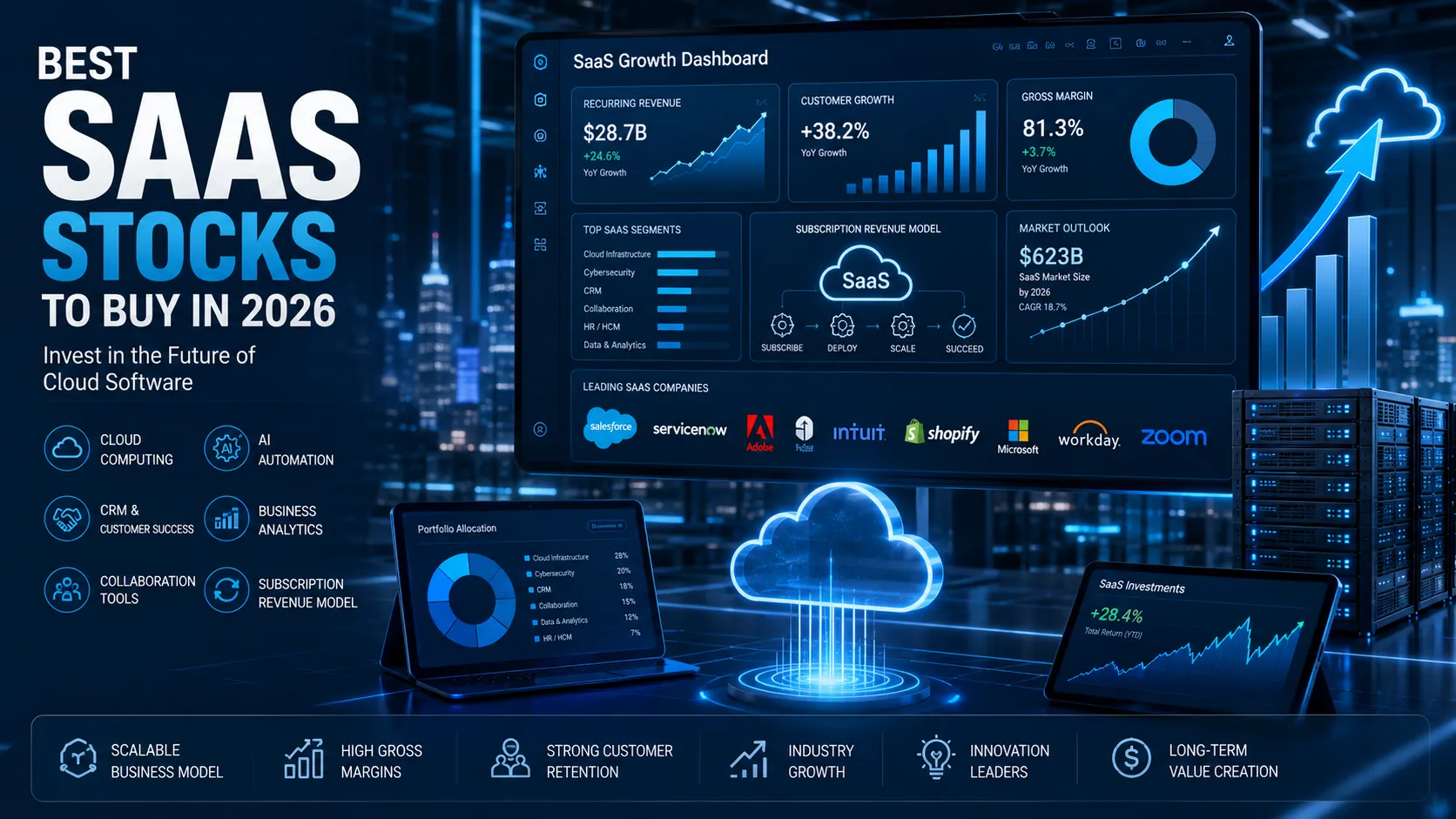
Best SaaS Stocks to Buy in 2026 (Top Software Companies for Long-Term Investors)
Introduction
Best SaaS Stocks to Buy in 2026 are attracting growing interest as businesses continue shifting toward cloud-based software solutions. Software-as-a-Service (SaaS) has transformed how organizations manage customer relationships, financial operations, collaboration, cybersecurity, marketing, and productivity.
Instead of purchasing expensive software licenses and maintaining on-premise servers, companies increasingly rely on subscription-based cloud platforms that are scalable, secure, and continuously updated. This business model has created recurring revenue streams, high customer retention, and attractive long-term growth opportunities for many software companies.
Artificial intelligence is accelerating this trend even further. Many SaaS providers are integrating AI-powered features such as automation, predictive analytics, generative AI assistants, and intelligent workflows into their platforms. As a result, businesses are investing more heavily in cloud software to improve productivity and remain competitive.
In this guide, we’ll explore the Best SaaS Stocks to Buy in 2026, explain why the SaaS industry continues expanding, and highlight some of the leading software companies that investors are watching for long-term growth.
What Are SaaS Stocks?
SaaS stocks are companies that develop and deliver software through the cloud using a subscription model.
Instead of installing software locally, customers access applications through the internet and pay monthly or annual subscription fees.
This business model offers several advantages:
- Predictable recurring revenue
- Lower software deployment costs
- Automatic updates
- High customer retention
- Global scalability
- Faster product innovation
- Lower IT infrastructure costs
Many of today’s largest technology companies generate billions of dollars annually from SaaS products.
Why the SaaS Industry Continues Growing
Several long-term trends continue supporting software companies.
Cloud Adoption
Organizations of every size continue moving workloads from on-premise systems to cloud platforms.
Cloud software offers greater flexibility, lower maintenance costs, and easier collaboration.
Artificial Intelligence Integration
AI has become one of the biggest growth drivers for SaaS companies.
Software providers are embedding AI assistants, automation tools, predictive analytics, and intelligent search into their products.
AI-powered software helps businesses:
- Increase productivity
- Reduce operating costs
- Improve customer service
- Automate repetitive tasks
- Analyze large datasets faster
Digital Transformation
Companies continue investing in digital tools that improve operational efficiency.
Businesses increasingly rely on cloud software for:
- Customer relationship management
- Human resources
- Accounting
- Marketing
- Project management
- Cybersecurity
- Data analytics
Remote and Hybrid Work
Remote work has permanently changed enterprise software demand.
Collaboration platforms, cloud storage, communication tools, and workflow automation remain essential for distributed teams.
Subscription Business Models
Recurring subscription revenue provides software companies with predictable cash flow.
Many investors favor SaaS businesses because recurring revenue often leads to greater financial stability compared to one-time software sales.
Best SaaS Stocks to Buy in 2026
1. Microsoft (NASDAQ: MSFT)
Microsoft remains one of the world’s largest software companies.
Its cloud ecosystem includes Microsoft 365, Azure, Dynamics 365, GitHub, LinkedIn, and Copilot AI.
The company continues integrating artificial intelligence across nearly every product while expanding enterprise cloud services.
Why Investors Like Microsoft
- Global software leader
- Strong recurring subscription revenue
- AI integration through Copilot
- Dominant enterprise customer base
- Excellent financial performance
Growth Drivers
- Microsoft 365
- Azure cloud
- Enterprise AI
- Business productivity software
- Cybersecurity
2. Salesforce (NYSE: CRM)
Salesforce pioneered cloud-based customer relationship management (CRM).
Its platform helps organizations manage sales, customer service, marketing, analytics, and AI-powered customer engagement.
The company’s Einstein AI platform continues adding intelligent automation capabilities.
Why Investors Like Salesforce
- CRM market leader
- Large enterprise customer base
- Strong recurring revenue
- AI-powered software ecosystem
- Continuous product expansion
Growth Drivers
- Customer relationship management
- AI-powered CRM
- Marketing automation
- Enterprise digital transformation
- Cloud applications
3. ServiceNow (NYSE: NOW)
ServiceNow develops enterprise workflow automation software used by large organizations worldwide.
Its platform automates IT services, employee workflows, customer operations, and business processes.
Artificial intelligence continues increasing the value of its automation capabilities.
Why Investors Like ServiceNow
- Enterprise workflow leader
- High customer retention
- AI-driven automation
- Strong recurring revenue
- Rapid enterprise adoption
Growth Drivers
- Workflow automation
- Enterprise AI
- Digital transformation
- Cloud software
- Large enterprise customers
4. Adobe (NASDAQ: ADBE)
Adobe has successfully transformed from a software licensing business into one of the world’s leading SaaS companies.
Creative Cloud, Document Cloud, and Experience Cloud generate recurring subscription revenue while integrating AI features such as Adobe Firefly.
Why Investors Like Adobe
- Strong brand recognition
- Recurring subscription business
- AI-powered creative tools
- Global customer base
- High profitability
Growth Drivers
- Creative Cloud
- AI content generation
- Digital marketing
- Enterprise software
- Content creation
5. Shopify (NASDAQ: SHOP)
Shopify provides cloud-based e-commerce software that enables businesses to build and manage online stores.
The company continues expanding payment solutions, AI-powered merchant tools, logistics services, and international commerce capabilities.
Why Investors Like Shopify
- Global e-commerce platform
- Large merchant ecosystem
- AI-powered commerce tools
- Strong long-term growth potential
- Expanding financial services
Growth Drivers
- Small business digitalization
- E-commerce growth
- Shopify Payments
- AI shopping assistants
- International expansion
- Small business digitalization
6. HubSpot (NYSE: HUBS)
HubSpot has become one of the world’s leading customer relationship management (CRM) and inbound marketing platforms. Its cloud-based software helps businesses manage marketing, sales, customer service, content management, and operations from a single platform.
The company is also integrating artificial intelligence across its products to automate workflows, improve customer engagement, and enhance productivity.
Why Investors Like HubSpot
- Fast-growing SaaS business
- Strong recurring subscription revenue
- AI-powered CRM platform
- Excellent customer retention
- Expanding enterprise adoption
Growth Drivers
- AI-powered marketing
- CRM adoption
- Sales automation
- Customer service software
- Small and medium-sized businesses
7. Intuit (NASDAQ: INTU)
Intuit develops financial software used by millions of individuals and businesses worldwide. Its products include TurboTax, QuickBooks, Credit Karma, and Mailchimp.
The company continues integrating artificial intelligence into bookkeeping, tax preparation, financial planning, and business management.
Why Investors Like Intuit
- Leading financial software provider
- High recurring revenue
- Strong brand recognition
- AI-powered financial tools
- Stable profitability
Growth Drivers
- Small business software
- AI accounting
- Digital tax preparation
- Financial management
- Cloud accounting
8. Atlassian (NASDAQ: TEAM)
Atlassian develops collaboration and productivity software used by software developers, IT teams, and businesses worldwide.
Products such as Jira, Confluence, and Trello have become essential tools for project management and software development.
Artificial intelligence is helping improve automation, documentation, and workflow management across its platform.
Why Investors Like Atlassian
- Leading collaboration software
- Strong developer ecosystem
- Subscription-based revenue
- Global customer base
- Continuous product innovation
Growth Drivers
- Remote work
- Enterprise collaboration
- AI productivity tools
- Software development
- Cloud migration
Sample SaaS Portfolio
A diversified SaaS portfolio may help investors gain exposure to multiple areas of enterprise software.
| Company | Allocation |
|---|---|
| Microsoft | 25% |
| Salesforce | 15% |
| ServiceNow | 15% |
| Adobe | 15% |
| Shopify | 10% |
| HubSpot | 10% |
| Intuit | 5% |
| Atlassian | 5% |
This portfolio is provided for educational purposes only and does not constitute investment advice.
Benefits of Investing in SaaS Stocks
The SaaS industry benefits from several long-term trends that continue supporting revenue growth and innovation.
Recurring Revenue
Subscription-based pricing creates predictable and stable cash flow, making many SaaS businesses financially resilient.
Artificial Intelligence Integration
AI-powered features increase the value of software products by improving automation, analytics, customer support, and decision-making.
High Customer Retention
Many businesses rely on SaaS platforms for daily operations, resulting in long-term customer relationships and recurring subscriptions.
Global Scalability
Cloud software can be deployed worldwide without the need for extensive physical infrastructure, allowing companies to expand rapidly.
Digital Transformation
Organizations continue investing in cloud software to modernize operations, improve productivity, and reduce costs.
Risks of Investing in SaaS Stocks
Although SaaS companies have attractive growth prospects, investors should also consider the potential risks.
Premium Valuations
Many fast-growing software companies trade at relatively high valuation multiples, which can lead to increased stock price volatility.
Competition
The software industry is highly competitive, with both established technology companies and startups continuously launching new products.
Economic Slowdowns
Businesses may delay software spending or reduce IT budgets during periods of economic uncertainty.
Cybersecurity Risks
Cloud software providers must continually invest in security to protect customer data and maintain trust.
Rapid Technological Change
Innovation moves quickly in the software industry. Companies that fail to adapt to AI and other emerging technologies may lose market share.
SaaS Industry Outlook for 2026
The SaaS industry is expected to remain one of the fastest-growing segments of the technology sector.
Artificial Intelligence
AI is transforming enterprise software through intelligent automation, predictive analytics, virtual assistants, and personalized customer experiences.
Cloud Computing
Organizations continue migrating applications and workloads to cloud environments, increasing demand for SaaS solutions.
Enterprise Software Modernization
Businesses are replacing legacy software with cloud-native platforms that are easier to manage, update, and scale.
Remote and Hybrid Work
Cloud collaboration tools remain essential for organizations with distributed workforces.
Small Business Digitalization
Small and medium-sized businesses continue adopting cloud software to improve efficiency and remain competitive.
Overall, the long-term outlook for the SaaS industry remains favorable as digital transformation continues across virtually every sector of the global economy.
Final Thoughts
Best SaaS Stocks to Buy in 2026 offer investors exposure to one of the strongest long-term growth themes in technology. As businesses continue adopting cloud software and integrating artificial intelligence into daily operations, leading SaaS companies are well positioned to benefit from recurring subscription revenue and expanding global demand.
Companies such as Microsoft, Salesforce, ServiceNow, Adobe, Shopify, HubSpot, Intuit, and Atlassian represent different areas of the SaaS ecosystem, including productivity software, customer relationship management, financial software, collaboration tools, and e-commerce platforms.
While software stocks can experience periods of volatility, the continued growth of cloud computing, AI, and enterprise digital transformation makes the SaaS sector an attractive area for long-term investors seeking diversified exposure to technology.
Frequently Asked Questions
What are SaaS stocks?
SaaS stocks are companies that deliver software through the cloud using subscription-based business models. Customers access the software online rather than purchasing traditional software licenses.
Why are SaaS companies popular with investors?
Many SaaS companies generate recurring revenue, maintain high customer retention, and benefit from long-term trends such as cloud computing, artificial intelligence, and digital transformation.
Which SaaS companies are considered industry leaders?
Some of the leading SaaS companies include Microsoft, Salesforce, ServiceNow, Adobe, Shopify, HubSpot, Intuit, and Atlassian.
Are SaaS stocks good long-term investments?
Many investors believe SaaS companies have attractive long-term growth potential due to recurring revenue, AI integration, cloud adoption, and increasing enterprise software demand.
What are the biggest risks of investing in SaaS stocks?
Investors should consider premium valuations, competitive pressures, cybersecurity risks, changing technology trends, and broader economic conditions before investing.