
Best Edge Computing Stocks to Buy in 2026 (Top Edge AI Companies for Long-Term Growth)
Introduction
Best Edge Computing Stocks to Buy in 2026 are gaining attention as artificial intelligence (AI), cloud computing, and connected devices continue reshaping the digital economy. While cloud data centers remain essential, businesses increasingly need to process information closer to where it is generated. This shift has made edge computing one of the fastest-growing segments of the technology industry.
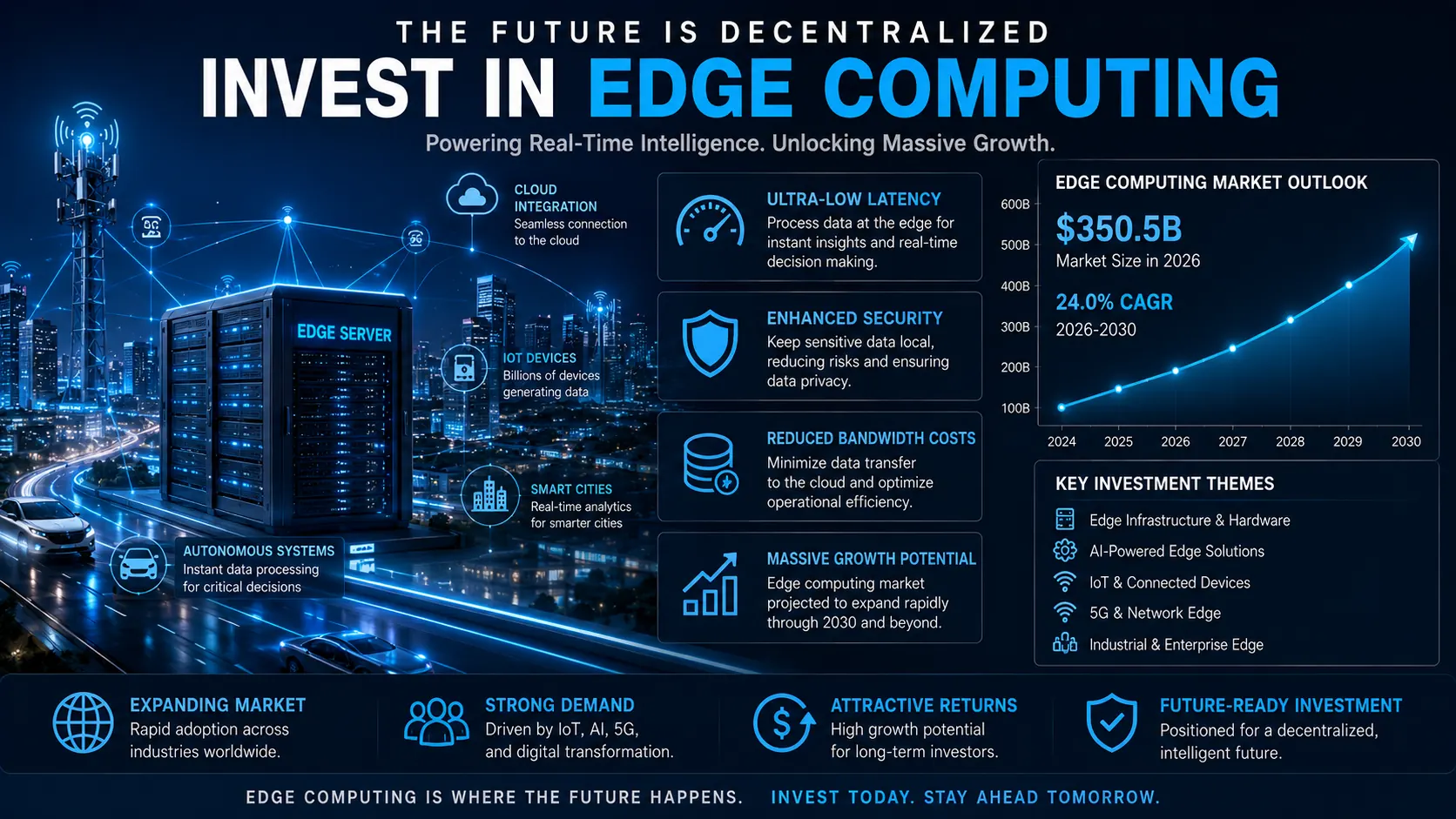
Edge computing reduces latency, improves security, lowers bandwidth costs, and enables real-time decision-making for applications such as autonomous vehicles, smart factories, healthcare, financial services, and industrial automation. As billions of IoT devices generate massive amounts of data every day, companies that provide edge infrastructure are becoming critical players in the AI ecosystem.
Major technology companies are investing billions of dollars to expand edge computing capabilities alongside cloud infrastructure. For investors, this creates exciting opportunities to gain exposure to businesses benefiting from the next phase of digital transformation.
In this guide, you’ll discover the Best Edge Computing Stocks to Buy in 2026, understand the industry’s growth drivers, explore leading companies, and learn the key risks and opportunities before investing.
What Is Edge Computing?
Edge computing is a distributed computing model where data is processed close to the device or location where it is created instead of being sent to a centralized cloud data center.
Rather than relying entirely on distant servers, edge devices perform many computing tasks locally.
Examples include:
- Smart factories
- Self-driving cars
- Smart cities
- Medical devices
- Retail stores
- Industrial robots
- Security cameras
- Telecommunications networks
This approach allows businesses to process information much faster while reducing network congestion.
Why Edge Computing Is Growing Rapidly
Artificial Intelligence Requires Faster Processing
Modern AI applications often require instant responses.
Autonomous vehicles, AI-powered robots, and industrial automation systems cannot afford delays caused by sending every request to distant cloud servers.
Edge computing solves this challenge by bringing processing power closer to users.
Internet of Things (IoT)
Billions of connected devices continuously generate data.
Sensors installed in factories, hospitals, farms, and smart homes require local computing to analyze information efficiently.
5G Networks
The global rollout of 5G is accelerating edge computing adoption.
High-speed, low-latency connections allow businesses to deploy advanced AI applications at the network edge.
Smart Manufacturing
Industry 4.0 depends heavily on local computing for:
- Machine vision
- Predictive maintenance
- Industrial robotics
- Production monitoring
Data Privacy
Processing sensitive information locally helps organizations improve privacy and comply with regulations.
Benefits of Edge Computing
Edge computing provides several important advantages.
Lower Latency
Applications respond almost instantly.
Reduced Bandwidth Costs
Less information needs to travel through cloud networks.
Better Reliability
Many systems continue operating even if internet connectivity is interrupted.
Improved Security
Sensitive data can remain within local environments.
Scalability
Businesses can deploy computing resources where needed without relying entirely on centralized infrastructure.
Best Edge Computing Stocks to Buy in 2026
Cloudflare (NYSE: NET)
Cloudflare has become one of the leading providers of edge computing and edge networking services.
Its global network helps businesses deliver applications with low latency and improved security.
Why Investors Like Cloudflare
- Global edge network
- Strong recurring revenue
- AI infrastructure expansion
- Rapid innovation
Growth Drivers
- Edge AI
- Zero Trust security
- Cloud applications
- Enterprise networking
Akamai Technologies (NASDAQ: AKAM)
Originally known for content delivery networks (CDNs), Akamai has evolved into a major edge computing platform.
Its infrastructure serves businesses across media, gaming, cybersecurity, and cloud services.
Why Investors Like Akamai
- Global infrastructure
- Enterprise customer base
- Stable cash flow
- Growing edge services
Growth Drivers
- Edge cloud
- Cybersecurity
- Streaming services
Fastly (NYSE: FSLY)
Fastly specializes in edge cloud computing and real-time content delivery.
Its platform supports modern web applications requiring high performance.
Why Investors Like Fastly
- Developer-friendly platform
- High-performance edge network
- AI application support
Growth Drivers
- Edge computing
- API acceleration
- Enterprise applications
Cisco Systems (NASDAQ: CSCO)
Cisco remains one of the world’s largest networking companies.
Its routers, switches, and security products play an essential role in edge computing infrastructure.
Why Investors Like Cisco
- Strong profitability
- Large enterprise customer base
- Networking leadership
- Growing software business
Growth Drivers
- Enterprise networking
- AI infrastructure
- Secure edge computing
Nvidia (NASDAQ: NVDA)
Nvidia’s AI GPUs increasingly power edge AI applications.
The company’s platforms support autonomous vehicles, industrial automation, healthcare, and robotics.
Why Investors Like Nvidia
- AI leadership
- Edge AI hardware
- Comprehensive software ecosystem
- Data center dominance
Growth Drivers
- Autonomous machines
- Robotics
- AI inference
- Industrial AI
Vertiv Holdings (NYSE: VRT)
Vertiv supplies critical power and cooling infrastructure supporting edge computing deployments.
Why Investors Like Vertiv
- AI infrastructure exposure
- Data center expertise
- Strong revenue growth
Growth Drivers
- Edge facilities
- AI expansion
- Infrastructure modernization
Edge Computing vs. Cloud Computing
Although closely connected, the two technologies serve different purposes.
Cloud Computing
Cloud platforms centralize computing resources inside massive data centers.
Advantages
- Large-scale computing
- Centralized management
- High storage capacity
Limitations
- Higher latency
- Greater bandwidth usage
Edge Computing
Edge computing processes information closer to users.
Advantages
- Real-time performance
- Lower latency
- Better reliability
- Improved privacy
Many organizations combine both cloud and edge computing to maximize performance.
Sample Edge Computing Portfolio
| Company | Allocation |
|---|---|
| Cloudflare | 25% |
| Akamai Technologies | 20% |
| Cisco Systems | 20% |
| Nvidia | 15% |
| Vertiv Holdings | 10% |
| Fastly | 10% |
Disclaimer: This portfolio is provided for educational purposes only and does not constitute investment advice.
Industries Benefiting from Edge Computing
Healthcare
Real-time patient monitoring and connected medical devices.
Manufacturing
Smart factories and industrial automation.
Transportation
Autonomous vehicles and intelligent traffic systems.
Retail
Personalized shopping experiences and inventory optimization.
Telecommunications
5G infrastructure and network optimization.
Financial Services
Low-latency trading systems and fraud detection.
Energy
Smart grids and predictive maintenance.
Risks of Investing in Edge Computing Stocks
High Competition
Cloud providers continue expanding edge services.
Technology Evolution
Rapid innovation requires continuous investment.
Cybersecurity
Distributed infrastructure introduces new security challenges.
Valuation Risk
Some edge computing companies trade at premium valuations.
Economic Slowdowns
Enterprise technology spending may weaken during recessions.
Diversification helps reduce these risks.
Industry Outlook for 2026
Several trends continue supporting long-term growth.
Artificial Intelligence
AI applications require low-latency infrastructure.
5G Expansion
Global 5G deployment continues accelerating.
Internet of Things
Connected devices continue multiplying.
Autonomous Systems
Vehicles and robots increasingly rely on local computing.
Smart Cities
Governments continue investing in connected infrastructure.
Analysts expect edge computing to remain one of the fastest-growing technology markets over the next decade.
Final Thoughts
Best Edge Computing Stocks to Buy in 2026 offer investors exposure to one of the most important trends shaping the future of technology. As artificial intelligence, 5G, and the Internet of Things continue expanding, demand for low-latency computing infrastructure is expected to increase significantly.
Companies such as Cloudflare, Akamai Technologies, Fastly, Cisco Systems, Nvidia, and Vertiv Holdings are positioned to benefit from growing investment in edge computing infrastructure. While the sector remains competitive and rapidly evolving, its long-term outlook appears promising for investors seeking exposure to AI-driven digital transformation.
Frequently Asked Questions
What are the best edge computing stocks to buy in 2026?
Many investors follow Cloudflare, Akamai Technologies, Cisco Systems, Nvidia, Vertiv Holdings, and Fastly because of their exposure to edge computing infrastructure and AI.
Why is edge computing important?
Edge computing reduces latency, improves security, lowers bandwidth usage, and enables real-time applications such as autonomous vehicles, industrial automation, and smart cities.
Is edge computing replacing cloud computing?
No. Most experts believe edge computing complements cloud computing by processing time-sensitive data closer to users while the cloud handles large-scale storage and analytics.
What industries benefit most from edge computing?
Manufacturing, healthcare, telecommunications, transportation, retail, financial services, and energy are among the largest adopters of edge computing technologies.
Are edge computing stocks good long-term investments?
Many analysts believe edge computing has strong long-term growth potential due to increasing AI adoption, IoT expansion, and the rollout of 5G networks.