
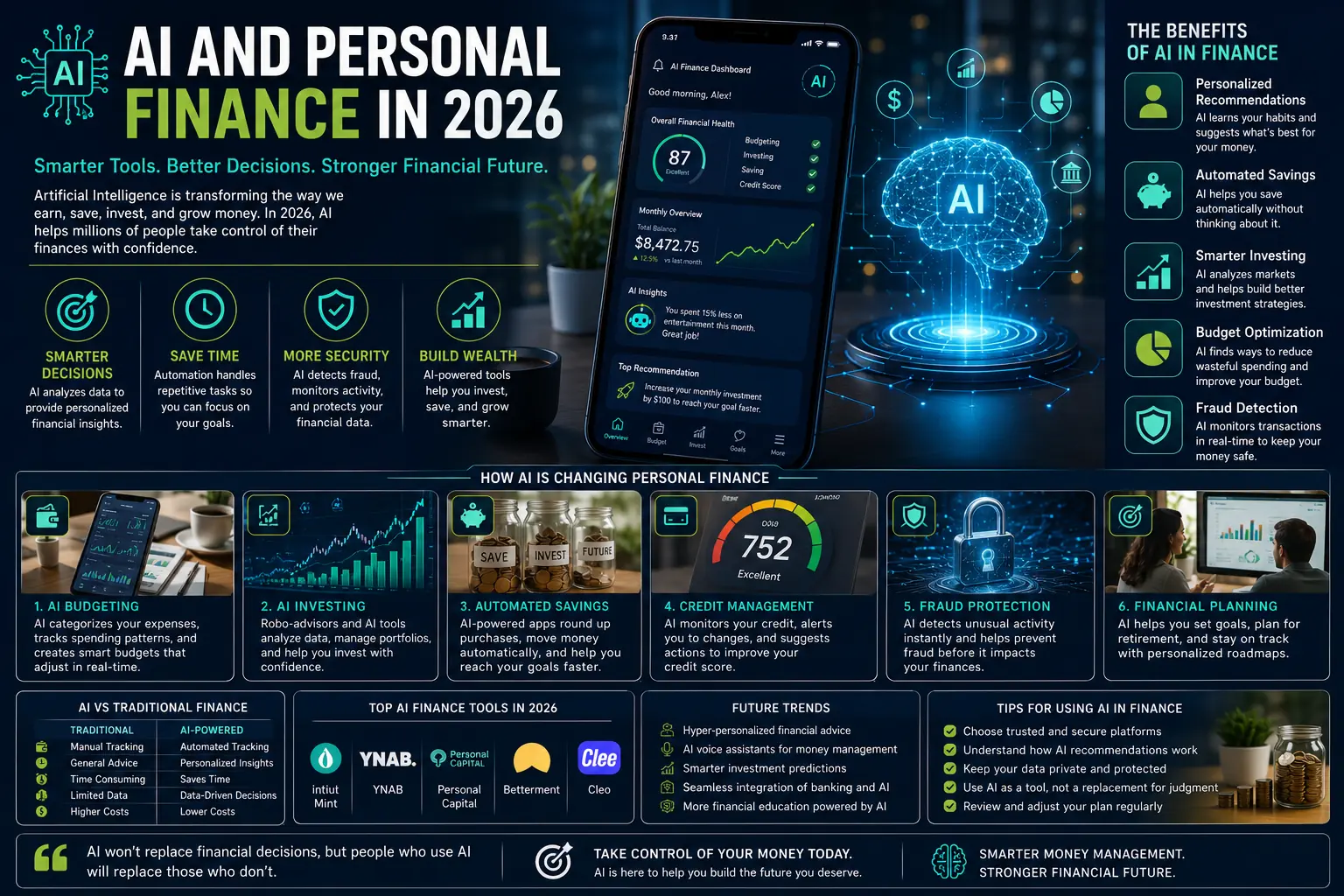
AI and Personal Finance in 2026 (Smarter Budgeting, Investing, and Saving)
Introduction
AI and Personal Finance are becoming increasingly connected as artificial intelligence transforms the way people manage money. From budgeting apps and investment platforms to fraud detection and financial planning, AI is making personal finance more accessible, efficient, and personalized.
In 2026, millions of people use AI-powered tools to track spending, automate savings, improve investment decisions, and achieve financial goals.
In this guide, we explore how AI is changing personal finance and why this technology is becoming an essential part of modern money management.
👉 Related article:
AI vs Human Financial Advisors: Which Is Better in 2026?
What Is AI in Personal Finance?
Artificial intelligence uses data analysis, machine learning, and automation to help individuals make better financial decisions.
AI-powered financial tools can:
- Track spending habits
- Create budgets
- Suggest savings opportunities
- Analyze investments
- Detect fraud
- Automate financial tasks
These capabilities help users manage their finances more efficiently.
Why AI Is Transforming Personal Finance
Several trends are accelerating AI adoption.
More Financial Data
Consumers generate enormous amounts of financial information.
Better Technology
Machine learning models continue improving rapidly.
Increased Accessibility
AI-powered financial tools are available to more people than ever before.
Demand for Personalization
Consumers increasingly expect customized financial advice.
These factors continue driving innovation across the finance industry.
AI-Powered Budgeting Apps
Budgeting is one of the most popular uses of AI in personal finance.
Modern apps can automatically:
- Categorize expenses
- Track spending habits
- Identify unnecessary expenses
- Suggest savings opportunities
Benefits
- Better spending awareness
- Reduced financial stress
- Improved savings habits
Many users find AI budgeting tools easier to maintain than traditional spreadsheets.
AI and Investing
Artificial intelligence is transforming investing.
Portfolio Analysis
AI can analyze thousands of data points quickly.
Risk Assessment
Algorithms evaluate risk tolerance and investment objectives.
Automated Investing
Robo-advisors automatically manage diversified portfolios.
Market Research
AI tools can help investors identify trends and opportunities.
👉 Related article:
Best AI Investing Tools for Beginners in 2026
AI and Automated Savings
Many financial apps now use AI to automate savings.
Examples include:
- Rounding up purchases
- Automatic transfers
- Savings recommendations
- Goal tracking
This helps individuals save consistently without manual effort.
AI and Credit Management
Artificial intelligence also improves credit monitoring.
Credit Score Tracking
AI tools monitor credit activity in real time.
Personalized Recommendations
Users receive suggestions to improve credit health.
Fraud Detection
Suspicious activity can be identified quickly.
These features help consumers protect their financial reputation.
AI and Fraud Prevention
Cybercrime continues growing worldwide.
AI helps financial institutions by:
- Detecting suspicious transactions
- Monitoring account activity
- Preventing fraud
- Improving security
Banks increasingly rely on AI-powered systems to protect customers.
👉 Related article:
Top Cybersecurity Stocks to Watch in 2026
AI and Financial Planning
Financial planning traditionally required professional advisors.
Today, AI tools can help users:
- Set financial goals
- Estimate retirement needs
- Track progress
- Build investment strategies
While AI cannot replace all financial professionals, it can make planning more accessible.
Benefits of AI in Personal Finance
Better Decision-Making
AI analyzes data quickly and objectively.
Time Savings
Automation reduces repetitive financial tasks.
Personalized Insights
Recommendations are tailored to user behavior.
Lower Costs
Many AI tools are affordable or free.
Improved Accessibility
More people can access financial guidance.
Potential Risks of AI in Finance
Despite many benefits, risks remain.
Data Privacy
Financial information must be protected carefully.
Overreliance on Automation
Users should still understand their finances.
Algorithm Errors
AI recommendations are not always perfect.
Security Risks
Cybersecurity remains critical.
Consumers should use reputable financial platforms.
AI vs Traditional Money Management
Traditional Approach
- Manual budgeting
- Manual investing
- Personal advisors
- Time-consuming research
AI-Powered Approach
- Automated budgeting
- Automated investing
- Real-time insights
- Faster analysis
Many people now combine both approaches.
Future Trends for AI and Personal Finance
Several developments are expected in the coming years.
More Personalized Financial Advice
AI systems will become increasingly customized.
Smarter Investment Platforms
Investment recommendations may become more sophisticated.
Enhanced Financial Education
AI assistants can help users learn financial concepts.
Better Fraud Protection
Security systems will continue improving.
These trends may further transform personal finance beyond 2026.
Who Benefits Most from AI Financial Tools?
AI-powered solutions may be particularly useful for:
Beginners
Simple guidance and automation.
Busy Professionals
Less time spent managing finances.
Long-Term Investors
Automated portfolio management.
Budget-Conscious Consumers
Improved expense tracking and savings.
Final Thoughts
AI and Personal Finance are reshaping the financial world in 2026. Artificial intelligence helps individuals budget more effectively, invest more efficiently, automate savings, and improve financial planning.
While AI should not completely replace financial knowledge or professional advice, it can become a powerful tool for building wealth and making smarter financial decisions.
As technology continues evolving, AI will likely play an even greater role in helping people achieve financial success.
FAQ
How is AI used in personal finance?
AI helps with budgeting, investing, savings, fraud detection, and financial planning.
Is AI good for managing money?
AI can improve financial organization and decision-making, but users should remain informed and involved.
Can AI replace financial advisors?
AI can automate many tasks, but complex financial planning often still benefits from human expertise.
Is AI investing safe?
AI investing platforms can be useful, but all investments carry risk.
What are the benefits of AI in personal finance?
Benefits include automation, lower costs, personalized insights, and improved financial management.