
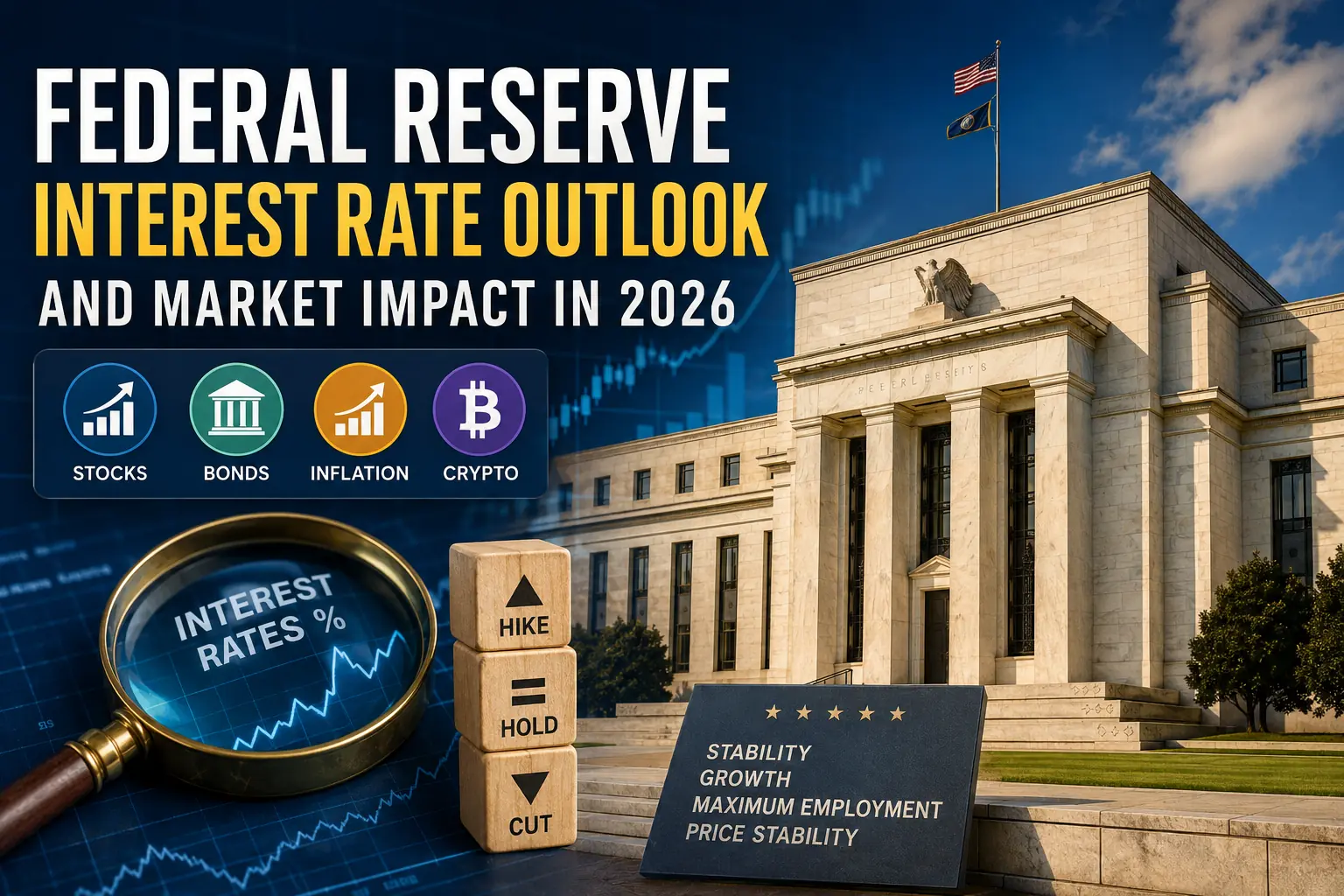
Federal Reserve Interest Rate Outlook and Market Impact in 2026
Introduction
The Federal Reserve Interest Rate Outlook remains one of the most important topics for investors in 2026. Interest rate decisions influence borrowing costs, inflation, consumer spending, business investment, and financial market performance.
Investors across stock markets, bond markets, and cryptocurrency sectors closely monitor Federal Reserve policy because even small rate changes can have significant effects on asset prices.
In this article, we explore the Federal Reserve’s interest rate outlook for 2026 and discuss how future policy decisions could impact various investment sectors.
Why Federal Reserve Interest Rates Matter
The Federal Reserve uses interest rates as a tool to manage economic growth and inflation.
When inflation rises too quickly, the Fed may increase interest rates to slow economic activity. When economic growth weakens, the Fed may lower rates to encourage borrowing and spending.
Interest rates affect:
- Mortgage costs
- Credit card rates
- Business loans
- Savings accounts
- Investment returns
Because of this broad influence, Federal Reserve decisions often create market volatility.
Inflation Remains a Key Focus
Inflation continues to be one of the primary factors influencing Federal Reserve policy in 2026.
The central bank closely monitors:
- Consumer prices
- Wage growth
- Employment data
- Economic activity
If inflation remains above target levels, policymakers may keep rates elevated for a longer period.
If inflation continues to decline, the possibility of rate cuts could increase.
Impact on Stock Markets
Interest rate expectations often influence stock market performance.
Lower interest rates generally support stocks because:
- Borrowing becomes cheaper
- Corporate profits may improve
- Consumer spending can increase
- Growth companies become more attractive
Higher interest rates can create challenges by increasing financing costs and reducing investor risk appetite.
Technology and growth stocks are often the most sensitive to interest rate changes.
Impact on Bond Markets
Bond investors closely monitor Federal Reserve policy because interest rates directly affect bond yields.
Key relationships include:
- Rising rates may pressure existing bond prices.
- Falling rates may increase bond values.
- Treasury yields often react quickly to policy expectations.
Many investors use bonds as a defensive asset during uncertain economic periods.
Impact on Cryptocurrency Markets
Cryptocurrency markets have become increasingly sensitive to Federal Reserve decisions.
Lower interest rates may encourage investors to seek higher-risk assets, including cryptocurrencies.
Higher rates can reduce liquidity and encourage investors to move toward safer investments.
Bitcoin and Ethereum often experience increased volatility around major Federal Reserve announcements.
👉 Investors interested in crypto trends may also enjoy our guide on Ethereum Market Update: Key Trends Investors Should Watch in 2026.
What Investors Should Watch
Several economic indicators may influence future Federal Reserve decisions:
Inflation Reports
Monthly inflation data remains one of the most important indicators.
Employment Data
Strong labor markets can support higher interest rates.
GDP Growth
Economic growth trends help policymakers assess overall economic health.
Consumer Spending
Consumer demand plays a significant role in inflation trends.
Monitoring these reports can help investors better understand future policy direction.
Possible Scenarios for 2026
Scenario 1: Interest Rates Stay High
If inflation remains persistent:
- Borrowing costs may stay elevated.
- Economic growth could slow.
- Markets may experience increased volatility.
Scenario 2: Gradual Rate Cuts
If inflation continues to improve:
- The Federal Reserve could begin lowering rates.
- Stocks may benefit.
- Economic activity could strengthen.
Scenario 3: Economic Slowdown
A significant slowdown could lead to more aggressive policy easing and increased market uncertainty.
How Investors Can Prepare
Investors can consider several strategies:
- Maintain portfolio diversification.
- Focus on long-term goals.
- Avoid emotional decision-making.
- Monitor economic data regularly.
- Understand risk tolerance.
Market conditions can change quickly, making disciplined investing important.
Conclusion
The Federal Reserve Interest Rate Outlook will remain a major market driver throughout 2026. Interest rate decisions influence stocks, bonds, cryptocurrencies, and the broader economy.
While future policy actions depend on inflation and economic conditions, investors who stay informed and maintain a long-term perspective may be better prepared for changing market environments.
Understanding how Federal Reserve policy affects investments can help investors make more informed financial decisions.
FAQ
What is the Federal Reserve interest rate?
The Federal Reserve interest rate is the benchmark rate that influences borrowing costs, savings rates, and overall economic activity in the United States.
Will the Federal Reserve cut interest rates in 2026?
Future rate decisions will depend on inflation, employment data, and economic growth. Investors closely monitor Federal Reserve meetings for guidance.
How do interest rates affect the stock market?
Lower interest rates can support stock prices by reducing borrowing costs and encouraging investment, while higher rates may pressure valuations.
Internal Links
NVIDIA Stock News: Why Investors Are Watching NVIDIA in 2026
How to Start Investing With $100 in 2026
Best AI Investing Tools for Beginners in 2026
Ethereum Market Update: Key Trends Investors Should Watch in 2026